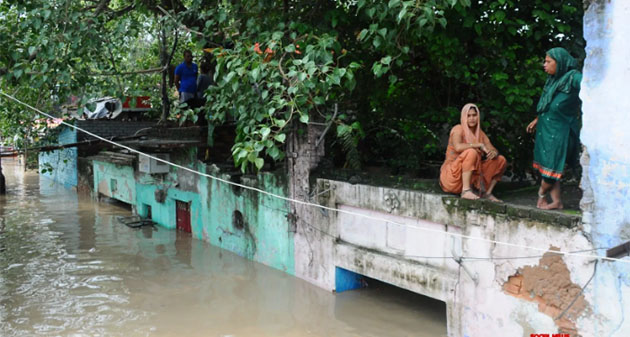
Delhi roads turn into rivers as Yamuna water swells to record level

News Network
July 13, 2023

delhi.jpg

New Delhi, July 13: The torrential Yamuna in Delhi swelled to a staggering 208.48 metres Thursday morning, inundating nearby streets and public and private infrastructure, and causing immense hardships to people living in close proximity to the river.

The water level at the Old Railway Bridge crossed the 208-metre mark Wednesday night and rose to 208.48 metres by 8 am on Thursday. It is expected to rise further, according to the Central Water Commission, which has termed it an "extreme situation".

With the situation deteriorating every passing hour, Chief Minister Arvind Kejriwal urged the Centre to intervene and the city police imposed Section 144 of the CrPC in flood-prone areas to prevent unlawful assembly of four or more people and public movement in groups.

Lt Governor V K Saxena has also called a meeting of the Delhi Disaster Management Authority on Thursday.

In a letter to Union Home Minister Amit Shah, Kejriwal requested that the water from Hathnikund barrage in Haryana be released slowly and pointed out that Delhi is set to host the G20 Summit meeting in a few weeks.

"The news of flooding in the capital of the country will not send a good message to the world. Together we will have to save the people of Delhi from this situation," he said.

There are two major barrages on the Yamuna -- Dakpathar in Dehradun and Hathnikund in Yamunanagar, upstream of Delhi. There are no dams on the river and, therefore, most of the monsoon flow remains unutilised, resulting in floods during the season.

Delhi recorded a rapid increase in the Yamuna's water level over the past three days.

It shot up from 203.14 metres at 11 am on Sunday to 205.4 metres at 5 pm on Monday, breaching the danger mark of 205.33 metres 18 hours earlier than expected.

The river exceeded the evacuation mark of 206 metres Monday night, prompting the relocation of people residing in flood-prone areas to safer locations and the closure of the Old Railway Bridge for road and rail traffic. The water level breached the previous all-time record of 207.49 metres by 1 pm on Wednesday and the 208-metre mark by 10 pm.

Major floods in Delhi occurred in 1924, 1977, 1978, 1988, 1995, 1998, 2010 and 2013. An analysis of flood data from 1963 to 2010 indicate an increasing trend for floods occurring in September, and a decreasing trend in July, according to research.

According to the CWC, the flow rate at the Hathnikund barrage remained above 1.5 cusecs at night.

Normally, the flow rate at the barrage is 352 cusecs, but heavy rainfall in the catchment areas increases the discharge. One cusec is equivalent to 28.32 litres per second.

The India Meteorological Department has predicted heavy rain in Uttarakhand and Uttar Pradesh on Thursday and Friday, raising concern about a further rise in the water level in the rivers.

Jammu and Kashmir, Himachal Pradesh, Punjab and Haryana recorded "heavy to extremely heavy" rainfall over three days from Saturday. This resulted in overflowing rivers, creeks and drains that have massively damaged infrastructure and disrupted essential services.

Delhi witnessed its highest rainfall (153 mm) in a single day in July since 1982 in the 24-hour period ending at 8.30 am on Sunday. The city received an additional 107 mm rainfall in the subsequent 24 hours, exacerbating the situation. The heavy rain transformed roads into gushing streams, parks into watery labyrinths and marketplaces into submerged realms.

The Yamuna river system's catchment covers parts of Uttar Pradesh, Uttarakhand, Himachal Pradesh, Haryana, Rajasthan, Madhya Pradesh and Delhi.

The low-lying areas near the river in Delhi, inhabited by around 41,000 people, are considered prone to flooding. Encroachments on the river's floodplain have occurred over the years, despite the land belonging to the Delhi Development Authority, the revenue department and private individuals.

The city's northeast, east, central, and southeast districts are most affected by floods in the city. A study on 'Urban Flooding and its Management' by the Irrigation and Flood Control Department identifies east Delhi under the floodplain region and highly vulnerable to floods.

The Yamuna breached the danger mark twice in September last year, with the water level reaching 206.38 metres.

In 2019, the river witnessed a peak flow rate of 8.28 lakh cusecs on August 18-19 and the water level rose to 206.6 metres. In 2013, it reached a level of 207.32 metres.


Comments

Add new comment

  • Coastaldigest.com reserves the right to delete or block any comments.
  • Coastaldigset.com is not responsible for its readers’ comments.
  • Comments that are abusive, incendiary or irrelevant are strictly prohibited.
  • Please use a genuine email ID and provide your name to avoid reject.
News Network
February 4,2026

shettigar.jpg

An Indian resident who won the Dh20 million (approximately Rs 50 crore) jackpot in Abu Dhabi's Big Ticket draw has told of his joy at sharing his life-changing fortune with a friend.

Shanthanu Shettigar, a shop manager in Muscat, regularly buys tickets for the monthly grand prize draw with one of his closest friends – and the pair won on February 3.

Mr Shettigar, 33, who is from Udyavar in Udupi district of the southern state of Karnataka and has lived in the Omani capital for eight years, said he was left speechless after learning of his success.

“When I first moved to Muscat, many of my colleagues were purchasing Big Ticket, which encouraged me to give it a try,” he said.

“I started buying tickets on my own, and later began sharing tickets with a close friend. The ticket that brought me this win was one we purchased together.”

“Like most people, I receive a lot of spam calls, and I was fully absorbed in my work as well. I knew the live draw was taking place tonight, but I never imagined my name would be announced,” he said.

“When I realised it was real and that I had won, I was honestly speechless. It still hasn’t fully sunk in, but I’m extremely happy.”

Mr Shettigar is not sure how he will spend his share of the money, but encouraged others to take part.

“This win was completely unexpected, so I want to take some time to think things through before deciding what to do next,” he said.

“I would definitely encourage others to participate with Big Ticket, whether with family or friends – you never know when your moment might come.”

The Big Ticket was established in 1992 with an initial first prize of Dh1 million. It is one of the most popular monthly raffles in the UAE.

It has transformed the lives of many people across the Emirates and beyond.

Entry to the Big Ticket Millionaire is Dh500. Tickets can be bought online or at counters at Zayed International Airport and Al Ain Airport.

Comments

Add new comment

  • Coastaldigest.com reserves the right to delete or block any comments.
  • Coastaldigset.com is not responsible for its readers’ comments.
  • Comments that are abusive, incendiary or irrelevant are strictly prohibited.
  • Please use a genuine email ID and provide your name to avoid reject.
News Network
February 3,2026

Bengaluru: Following reports of fresh Nipah virus (NiV) cases in West Bengal and heightened vigilance across parts of Southeast Asia, the Karnataka Health Department has placed the state on high alert and activated emergency preparedness protocols.

Health officials said enhanced surveillance measures have been initiated after two healthcare workers in Barasat, West Bengal, tested positive for the virus earlier this month. While no cases have been reported in Karnataka so far, authorities said the state’s past exposure to Nipah outbreaks and high inter-state mobility warranted preventive action.

Officials have directed district health teams to intensify monitoring, particularly at hospitals and points of entry, and to ensure early detection and isolation of suspected cases.

High Mortality Virus with Multiple Transmission Routes

Nipah virus is a zoonotic disease that can spread from animals to humans and has a reported fatality rate ranging between 60 and 75 per cent. Fruit bats, also known as flying foxes, are the natural reservoirs of the virus and can transmit it by contaminating food sources with saliva or urine.

Known modes of transmission include:

•    Contaminated food: Consumption of fruits partially eaten by bats or raw date-palm sap
•    Animal contact: Exposure to infected pigs or other animals
•    Human-to-human transmission: Close contact with body fluids of infected persons, particularly in healthcare settings

Symptoms and Disease Progression

The incubation period typically ranges from 4 to 14 days, though delayed onset has also been reported. Early symptoms often resemble common viral infections, making prompt clinical suspicion critical.

•    Initial symptoms: Fever, headache, body aches, fatigue, sore throat
•    Progressive symptoms: Drowsiness, disorientation, altered mental state
•    Severe stage: Seizures, neck stiffness and acute encephalitis, which can rapidly progress to coma

Public Health Advisory

The Health Department has issued precautionary guidelines urging the public to adopt risk-avoidance practices to prevent any local spillover.

Do’s
•    Wash fruits thoroughly before consumption
•    Drink boiled and cooled water
•    Use protective equipment while handling livestock
•    Maintain strict hand hygiene

Don’ts
•    Avoid fruits found on the ground or showing bite marks
•    Do not consume beverages made from raw tree sap, including toddy
•    Avoid areas with dense bat populations
•    Do not handle sick or dead animals

Preparedness Measures

Officials confirmed that isolation wards are being readied in major government hospitals and that medical staff are being sensitised to identify early warning signs.

“There is no cause for panic, but there is a need for heightened vigilance,” a senior health official said, adding that there is currently no approved vaccine or specific antiviral treatment for Nipah, and care remains largely supportive.

Comments

Add new comment

  • Coastaldigest.com reserves the right to delete or block any comments.
  • Coastaldigset.com is not responsible for its readers’ comments.
  • Comments that are abusive, incendiary or irrelevant are strictly prohibited.
  • Please use a genuine email ID and provide your name to avoid reject.
News Network
January 23,2026

modIKERALA.jpg

Prime Minister Narendra Modi, during his visit to Thiruvananthapuram on Friday, January 23, indicated that the Bharatiya Janata Party (BJP) is aiming to expand its political footprint in Kerala ahead of the Assembly elections scheduled in the coming months.

Speaking at a BJP-organised public meeting, Modi drew parallels between the party’s early electoral gains in Gujarat and its recent victory in the Thiruvananthapuram Municipal Corporation. The civic body win, which ended decades of Left control, was cited by the Prime Minister as a possible starting point for the party’s broader ambitions in the state.

Recalling BJP’s political trajectory in Gujarat, Modi said the party was largely insignificant before 1987 and received little media attention. He pointed out that the BJP’s first major breakthrough came with its victory in the Ahmedabad Municipal Corporation that year.

“Just as our journey in Gujarat began with one city, Kerala’s journey has also started with a single city,” Modi said, suggesting that the party’s municipal-level success could translate into wider electoral acceptance.

The Prime Minister alleged that successive governments led by the Left Democratic Front (LDF) and the United Democratic Front (UDF) had failed to adequately develop Thiruvananthapuram. He accused both fronts of corruption and neglect, claiming that basic infrastructure and facilities were denied to the capital city for decades.

According to Modi, the BJP’s control of the civic body represents a shift driven by public dissatisfaction with the existing political alternatives. He asserted that the BJP administration in Thiruvananthapuram had begun working towards development, though no specific details or timelines were outlined.

Addressing the gathering at Putharikandam Maidan, Modi said the BJP intended to project Thiruvananthapuram as a “model city,” reiterating his party’s commitment to governance-led change.

The Prime Minister’s visit to Kerala also included the inauguration of several development projects and the flagging off of new train services, as the BJP intensifies its political outreach in the poll-bound state.

Comments

Add new comment

  • Coastaldigest.com reserves the right to delete or block any comments.
  • Coastaldigset.com is not responsible for its readers’ comments.
  • Comments that are abusive, incendiary or irrelevant are strictly prohibited.
  • Please use a genuine email ID and provide your name to avoid reject.