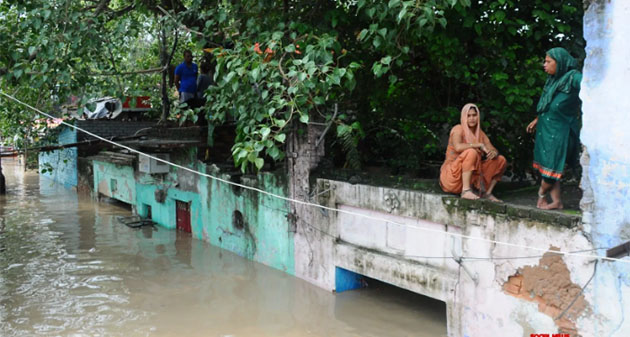
Delhi roads turn into rivers as Yamuna water swells to record level

News Network
July 13, 2023

delhi.jpg

New Delhi, July 13: The torrential Yamuna in Delhi swelled to a staggering 208.48 metres Thursday morning, inundating nearby streets and public and private infrastructure, and causing immense hardships to people living in close proximity to the river.

The water level at the Old Railway Bridge crossed the 208-metre mark Wednesday night and rose to 208.48 metres by 8 am on Thursday. It is expected to rise further, according to the Central Water Commission, which has termed it an "extreme situation".

With the situation deteriorating every passing hour, Chief Minister Arvind Kejriwal urged the Centre to intervene and the city police imposed Section 144 of the CrPC in flood-prone areas to prevent unlawful assembly of four or more people and public movement in groups.

Lt Governor V K Saxena has also called a meeting of the Delhi Disaster Management Authority on Thursday.

In a letter to Union Home Minister Amit Shah, Kejriwal requested that the water from Hathnikund barrage in Haryana be released slowly and pointed out that Delhi is set to host the G20 Summit meeting in a few weeks.

"The news of flooding in the capital of the country will not send a good message to the world. Together we will have to save the people of Delhi from this situation," he said.

There are two major barrages on the Yamuna -- Dakpathar in Dehradun and Hathnikund in Yamunanagar, upstream of Delhi. There are no dams on the river and, therefore, most of the monsoon flow remains unutilised, resulting in floods during the season.

Delhi recorded a rapid increase in the Yamuna's water level over the past three days.

It shot up from 203.14 metres at 11 am on Sunday to 205.4 metres at 5 pm on Monday, breaching the danger mark of 205.33 metres 18 hours earlier than expected.

The river exceeded the evacuation mark of 206 metres Monday night, prompting the relocation of people residing in flood-prone areas to safer locations and the closure of the Old Railway Bridge for road and rail traffic. The water level breached the previous all-time record of 207.49 metres by 1 pm on Wednesday and the 208-metre mark by 10 pm.

Major floods in Delhi occurred in 1924, 1977, 1978, 1988, 1995, 1998, 2010 and 2013. An analysis of flood data from 1963 to 2010 indicate an increasing trend for floods occurring in September, and a decreasing trend in July, according to research.

According to the CWC, the flow rate at the Hathnikund barrage remained above 1.5 cusecs at night.

Normally, the flow rate at the barrage is 352 cusecs, but heavy rainfall in the catchment areas increases the discharge. One cusec is equivalent to 28.32 litres per second.

The India Meteorological Department has predicted heavy rain in Uttarakhand and Uttar Pradesh on Thursday and Friday, raising concern about a further rise in the water level in the rivers.

Jammu and Kashmir, Himachal Pradesh, Punjab and Haryana recorded "heavy to extremely heavy" rainfall over three days from Saturday. This resulted in overflowing rivers, creeks and drains that have massively damaged infrastructure and disrupted essential services.

Delhi witnessed its highest rainfall (153 mm) in a single day in July since 1982 in the 24-hour period ending at 8.30 am on Sunday. The city received an additional 107 mm rainfall in the subsequent 24 hours, exacerbating the situation. The heavy rain transformed roads into gushing streams, parks into watery labyrinths and marketplaces into submerged realms.

The Yamuna river system's catchment covers parts of Uttar Pradesh, Uttarakhand, Himachal Pradesh, Haryana, Rajasthan, Madhya Pradesh and Delhi.

The low-lying areas near the river in Delhi, inhabited by around 41,000 people, are considered prone to flooding. Encroachments on the river's floodplain have occurred over the years, despite the land belonging to the Delhi Development Authority, the revenue department and private individuals.

The city's northeast, east, central, and southeast districts are most affected by floods in the city. A study on 'Urban Flooding and its Management' by the Irrigation and Flood Control Department identifies east Delhi under the floodplain region and highly vulnerable to floods.

The Yamuna breached the danger mark twice in September last year, with the water level reaching 206.38 metres.

In 2019, the river witnessed a peak flow rate of 8.28 lakh cusecs on August 18-19 and the water level rose to 206.6 metres. In 2013, it reached a level of 207.32 metres.


Comments

Add new comment

  • Coastaldigest.com reserves the right to delete or block any comments.
  • Coastaldigset.com is not responsible for its readers’ comments.
  • Comments that are abusive, incendiary or irrelevant are strictly prohibited.
  • Please use a genuine email ID and provide your name to avoid reject.
News Network
November 27,2025

imrankhan.jpg

Authorities at Pakistan’s high-security Adiala Jail in Rawalpindi on Wednesday dismissed speculation about the condition of imprisoned former Pakistan Prime Minister Imran Khan, rejecting rumours that he had been moved out of the facility or was in danger. Officials said Khan was in “good health” and described the viral death claims as “baseless.”

“There is no truth to reports about his transfer from Adiala Jail,” the Rawalpindi prison administration said in a statement, according to Geo News. “He is fully healthy and receiving complete medical attention.”

Amid swirling rumours on social media, Imran Khan’s party, Pakistan Tehreek-e-Insaf (PTI), urged the federal government to issue an official clarification and demanded that authorities allow his family to meet him immediately, Dawn reported.

The frenzy began after Khan’s three sisters called for an impartial probe into what they described as a “brutal” police assault on them and other PTI supporters outside Adiala Jail last week. Soon after, several social media handles circulated unverified claims alleging that Khan had been “killed” inside the prison.

The rumours intensified when a handle named “Afghanistan Times” claimed that “credible sources” had confirmed Khan’s “murder” and that his body had been moved out of the jail — allegations that have not been verified by any credible agency.

Imran Khan, PTI’s patron-in-chief, has been lodged in the Rawalpindi prison since August 2023 in multiple cases. For over a month, an undeclared restriction has prevented family members and senior PTI leaders from meeting him. Khyber-Pakhtunkhwa Chief Minister Sohail Afridi has reportedly been denied access despite making seven attempts.

In a letter to Punjab Police Chief Usman Anwar, Khan’s sisters — Noreen Niazi, Aleema Khan, and Dr. Uzma Khan — said they were “peacefully protesting” outside the jail when police allegedly launched an unprovoked assault after streetlights were switched off.

“At 71, I was seized by my hair, thrown to the ground and dragged across the road,” Noreen Niazi said, alleging that other women present were also slapped and manhandled.

Adiala Jail officials reiterated that speculation over Imran Khan’s health was unfounded and insisted that his well-being was being ensured, Geo News reported.

Comments

Add new comment

  • Coastaldigest.com reserves the right to delete or block any comments.
  • Coastaldigset.com is not responsible for its readers’ comments.
  • Comments that are abusive, incendiary or irrelevant are strictly prohibited.
  • Please use a genuine email ID and provide your name to avoid reject.
News Network
December 4,2025

indigoflight.jpg

Domestic carrier IndiGo has cancelled over 180 flights from three major airports — Mumbai, Delhi and Bengaluru — on Thursday, December 4, as the airline struggles to secure the required crew to operate its flights in the wake of new flight-duty and rest-period norms for pilots.

While the number of cancellations at Mumbai airport stands at 86 (41 arrivals and 45 departures) for the day, at Bengaluru, 73 flights have been cancelled, including 41 arrivals, according to a PTI report that quoted sources.

"IndiGo cancelled over 180 flights on Thursday at three airports-Mumbai, Delhi and Bengaluru," the source told the news agency.

Besides, it had cancelled as many as 33 flights at Delhi airport for Thursday, the source said, adding, "The number of cancellations is expected to be higher by the end of the day."

The Gurugram-based airline's On-Time Performance (OTP) nosedived to 19.7 per cent at six key airports — Delhi, Mumbai, Chennai, Kolkata, Bengaluru and Hyderabad — on December 3, as it struggled to get the required crew to operate its services, down from almost half of December 2, when it was 35 per cent.

"IndiGo has been facing acute crew shortage since the implementation of the second phase of the FDTL (Flight Duty Time Limitations) norms, leading to cancellations and huge delays in its operations across the airports," a source had told PTI on Wednesday.

Chaos continued at several major airports for the third day on Thursday because of the cancellations.

A spokesperson for the Kempegowda International Airport (KIA) in Bengaluru said that 73 IndiGo flights had been cancelled on Thursday.

At least 150 flights were cancelled and dozens of others delayed on Wednesday, airport sources said, leaving thousands of travellers stranded, according to news agency Reuters.

The Directorate General of Civil Aviation (DGCA) has said it is investigating IndiGo flight disruptions and has asked the airline to submit the reasons for the current situation, as well as its plans to reduce flight cancellations and delays.

It may be mentioned here that the pilots' body, Federation of Indian Pilots (FIP), has alleged that IndiGo, despite getting a two-year preparatory window before the full implementation of new flight duty and rest period norms for cockpit crew, "inexplicably" adopted a "hiring freeze".

The FIP said it has urged the safety regulator, the DGCA, not to approve airlines' seasonal flight schedules unless they have adequate staff to operate their services "safely and reliably" in accordance with the New Flight Duty Time Limitations (FDTL) norms.

In a letter to the DGCA late on Wednesday, the FIP urged the DGCA to consider re-evaluating and reallocating slots to other airlines, which have the capacity to operate them without disruption during the peak holiday and fog season if IndiGo continues to "fail in delivering on its commitments to passengers due to its own avoidable staffing shortages."

Comments

Add new comment

  • Coastaldigest.com reserves the right to delete or block any comments.
  • Coastaldigset.com is not responsible for its readers’ comments.
  • Comments that are abusive, incendiary or irrelevant are strictly prohibited.
  • Please use a genuine email ID and provide your name to avoid reject.
News Network
November 22,2025

gaza.jpg

The Israeli regime’s forces have killed two Palestinian children in the Gaza Strip every day since the ceasefire began in early October, UNICEF has warned.

The UN children’s agency said on Friday that Israeli forces continue to attack Palestinians in Gaza even though the agreement was meant to stop the killing.

“Since 11 October, while the ceasefire has been in effect, at least 67 children have been killed in conflict-related incidents in the Gaza Strip. Dozens more have been injured. That is an average of almost two children killed every day since the ceasefire took effect,” UNICEF spokesperson Ricardo Pires said in Geneva, reminding that each number in the statistics represents a child whose life had ended violently.

“These are not statistics,” he said. “Each child had a story, a family, and a future that was stolen from them.”

Data from Palestinian factions, human rights groups, and government bodies recorded since the US-brokered ceasefire deal went into effect on October 10 show that Israeli forces have carried out numerous attacks, each constituting a separate ceasefire violation.

UNICEF teams say they repeatedly continue to witness heart-wrenching scenes of fearful Palestinian children sleeping outdoors with amputated limbs, while others live as orphans in flooded, makeshift shelters.

“I saw this myself in August. There is no safe place for them. The world cannot normalize their suffering,” Pires said, lamenting that the UN could “do a lot more if the aid that is really needed was entering faster.”

The UNICEF spokesperson warned that with the advent of winter, the risks for hundreds of thousands of displaced children will increase.

He warned, “The stakes are incredibly high” for children as winter acts as a threat multiplier, where children have no heating, no insulation, and few blankets. He said respiratory infections rise.

“Too many children have already paid the highest price,” Pires said. “Too many are still paying it, even under a ceasefire. The world promised them it would stop and that we would protect them.”

“Now we must act like it,” the UNICEF spokesperson added.

Since the Israeli regime launched its genocidal war against Palestinians in Gaza in October 2023, it has killed nearly 70,000 people in the territory, most of them women and children, and injured over 170,000 more, while reducing most of the structures in the enclave to rubble.

Comments

Add new comment

  • Coastaldigest.com reserves the right to delete or block any comments.
  • Coastaldigset.com is not responsible for its readers’ comments.
  • Comments that are abusive, incendiary or irrelevant are strictly prohibited.
  • Please use a genuine email ID and provide your name to avoid reject.