



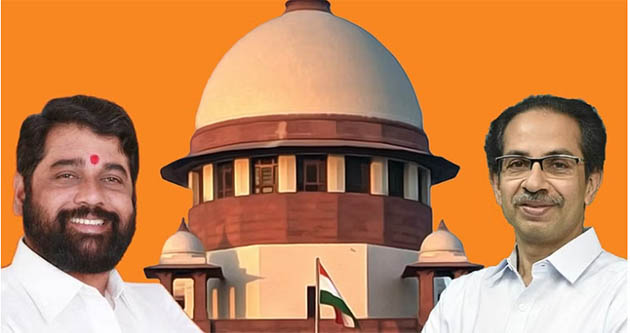
Eknath Shinde continues to be Maha CM; ‘moral victory’ for Uddhav as SC slams governor’s ‘illegal trust vote’

News Network
May 11, 2023

shinde.jpg

New Delhi, May 11: The Supreme Court, in a unanimous judgment, effectively opened the doors for the disqualification of Maharashtra Chief Minister Eknath Shinde for defection from the Shiv Sena party while holding that the then Governor Bhagat Singh Koshiyari’s call for trust vote, which led to the resignation of the Uddhav Thackeray-led Maha Vikas Aghadi government, was illegal.

A Constitution Bench led by Chief Justice of India DY Chandrachud, however, said it cannot quash the resignation of Thackeray, and thus, would not be able to reinstate him as the Chief Minister of Maharashtra, now.

“Thackeray did not face the floor test. Instead, he had resigned. If Thackeray had refrained from resignation, he could have been reinstated. Since the trust vote was not held due to his resignation, this option does not arise. We cannot quash a resignation,” the court held.

On June 29 last year, Thackeray resigned as the Chief Minister and the Maha Vikas Aghadi (MVA) government fell hours after the apex court refused to stay a floor test called for by Maharashtra Governor Bhagat Singh Koshyari on June 30. Following this, the Governor Koshyari had invited Shinde to form the new government.

The judgment, authored by the Chief Justice Chandrachud, held that the Election Commission of India’s decision to recognise the Shinde faction as the “real” Shiv Sena, giving it the party symbol of ‘bow and arrow’, did not have a “retrospective” effect and amounted to an interference with the party’s 2018 Constitution and results of the intra-party polls, following which Thackeray was made a leader.

The court said Maharashtra Assembly Speaker Rahul Narwekar should not have kept the disqualification petitions against Shinde and other MLAs of his camp pending until the Election Commission gave its decision in its favour. The then Deputy Speaker Narhari Zariwal had issued disqualification notices against 39 MLAs, including Shinde, for defection on June 25, 2022.

The court said Shinde did not have the defence of ‘split’ available to him. A “split” from the original political party without a subsequent merger with another party or formation of a new faction is no longer a defence against charges of defection. The Constitution (Ninety-first Amendment) Act, 2003 had deleted the provision of “split” in Paragraph 3 of the Tenth Schedule. The judgment backs the contention raised by the Thackeray faction that the Shinde camp’s refusal to comply with the party whip amounted to a “split” from the original Shiv Sena party. As a result, they had ceased to be party members and were liable to be disqualified as legislators for defection.

Though the Shinde government would continue for the time being, the Supreme Court judgment would gravely impact the Chief Minister’s sole defence that he had only “split” and not defected from the Shiv Sena party. The Constitution Bench also found the appointment of Bharat Gogawale as the new chief whip of Shiv Sena.

The judgment made scathing remarks against Governor Koshiyari, saying he roamed out of the constitutional bounds of his office into the political arena by calling for a trust vote without any “objective material” to support his “inference” that the MVA government had lost the majority and confidence in the House.

Chief Justice Chandrachud said there was nothing in the communications sent by the rebel Shiv Sena MLAs to him that they were withdrawing support to the Thackeray government. In fact, many of them were Ministers in that regime.

“Floor test cannot be used as a means to settle differences within a political party… The Governor erred in concluding that Thackeray had lost support,” Chief Justice Chandrachud lashed out at the Governor.

The court said if the MLAs were unhappy about the “corruption” in the government, either they or then Opposition leader Devendra Fadnavis could have sought a no-confidence motion in the House, which they had not, instead of writing to the Governor. “There is a marked difference between individuals withdrawing from a government and a party withdrawing from the government,” Chief Justice Chandrachud noted.

The court further referred to a larger Bench of seven judges the question whether a Speaker under a cloud can proceed with hearing and deciding disqualification petitions against MLAs. A Constitution Bench judgment in 2016 in the Nabam Rebia case had held that a Speaker who is himself facing notice of disqualification should stop from hearing petitions under the Tenth Schedule. Shinde had countered Zariwal’s disqualification notice by filing a notice of disqualification against the Deputy Speaker. Thackeray had contended that the 2016 judgment opened a constitutional hiatus by which the Speaker cannot use his powers to disqualify MLAs, thus rendering the Tenth Schedule redundant. 

Comments

Add new comment

  • Coastaldigest.com reserves the right to delete or block any comments.
  • Coastaldigset.com is not responsible for its readers’ comments.
  • Comments that are abusive, incendiary or irrelevant are strictly prohibited.
  • Please use a genuine email ID and provide your name to avoid reject.
News Network
February 5,2026

Bengaluru: As air quality continues to worsen across several parts of the city, hospitals in Bengaluru are reporting a steady rise in patients suffering from respiratory illnesses such as asthma, bronchitis and Chronic Obstructive Pulmonary Disease (COPD), health officials and doctors said.

Data from the Suvarna Arogya Suraksha Trust (SAST) shows that 3,891 patients received treatment for respiratory ailments between April and November 2024. The figure rose to 4,187 during the same period in 2025.

Private hospitals, too, are witnessing a 10–15 per cent year-on-year increase in such cases.

While doctors caution that the rise cannot be attributed solely to air pollution, a significant number of patients are non-smokers with no prior history of respiratory disease.

“Nearly 70 per cent of the patients we see are non-smokers with no previous respiratory issues. When other causes are ruled out, air pollution emerges as the most likely factor,” said Dr Manjunath PH, consultant interventional pulmonologist at a hospital in Kengeri.

Doctors noted that patient footfall spikes during the winter months and around Deepavali, when air quality typically worsens.

“There is a clear correlation between poor air quality and the rise in cases. People commonly present with persistent cough, breathlessness and irritation of the respiratory tract, indicating the impact of polluted air on their health,” said Dr Sheetal Chaurasia, consultant in pulmonary medicine at a private hospital in Whitefield.

Dr Chaurasia added that respiratory tract infections are also on the rise.

“Poor air quality leads to chronic airway inflammation, making the airways more vulnerable to infections. We are seeing an increase in both upper and lower respiratory tract infections,” she said.

Patients with pre-existing respiratory conditions remain the worst affected.

“For those already diagnosed with respiratory illnesses, deteriorating air quality significantly worsens the condition. Both the frequency and severity of attacks increase sharply,” said Dr Vandana P, a pulmonologist at a hospital on Bannerghatta Road.

Doctors also flagged a worrying trend of rising respiratory problems among younger adults and children.

To reduce exposure, they advised people to wear masks while travelling on two-wheelers or autos and ensure adequate ventilation at home to minimise indoor air pollution.

Comments

Add new comment

  • Coastaldigest.com reserves the right to delete or block any comments.
  • Coastaldigset.com is not responsible for its readers’ comments.
  • Comments that are abusive, incendiary or irrelevant are strictly prohibited.
  • Please use a genuine email ID and provide your name to avoid reject.
News Network
January 23,2026

Mangaluru: The Karnataka Government Polytechnic (KPT), Mangaluru, has achieved autonomous status from the All India Council for Technical Education (AICTE), becoming the first government polytechnic in the country to receive such recognition in its 78-year history. The status was granted by AICTE, New Delhi, and subsequently approved by the Karnataka Board of Technical Education in October last year.

Officials said the autonomy was conferred a few months ago. Until recently, AICTE extended autonomous status only to engineering colleges, excluding diploma institutions. However, with a renewed national focus on skill development, several government polytechnics across India have now been granted autonomy.

KPT, the second-largest polytechnic in Karnataka, was established in 1946 with four branches and has since expanded to offer eight diploma programmes, including computer science and polymer technology. The institution is spread across a 19-acre campus.

Ravindra M Keni, the first dean of the institution, told The Times of India that AICTE had proposed autonomous status for polytechnic institutions that are over 25 years old. “Many colleges applied. In the first round, 100 institutions were shortlisted, which was further narrowed down to 15 in the second round. We have already completed one semester after becoming an autonomous institution,” he said. He added that nearly 500 students are admitted annually across eight three-year diploma courses.

Explaining the factors that helped KPT secure autonomy, Keni said the institution has consistently recorded 100 per cent admissions and placements for its graduates. He also noted its strong performance in sports, with the college emerging champions for 12 consecutive years, along with active student participation in NCC and NSS activities.

Autonomous status allows KPT to design industry-oriented curricula, conduct examinations, prepare question papers, and manage academic documentation independently. The institution can also directly collaborate with industries and receive priority funding from AICTE or the Ministry of Education. While academic autonomy has been granted, financial control will continue to rest with the state government.

“There will be separate committees for examinations, question paper setting, boards of studies, and boards of examiners. The institution will now have the freedom to conduct admissions without government notifications and issue its own marks cards,” Keni said, adding that new academic initiatives would be planned after a year of functioning under the autonomous framework.

Comments

Add new comment

  • Coastaldigest.com reserves the right to delete or block any comments.
  • Coastaldigset.com is not responsible for its readers’ comments.
  • Comments that are abusive, incendiary or irrelevant are strictly prohibited.
  • Please use a genuine email ID and provide your name to avoid reject.
News Network
February 1,2026

Bengaluru, Feb 1: For travelers landing at Kempegowda International Airport (KIA), the sleek, wood-paneled curves of Terminal 2 promise a world-class welcome. But the famed “Garden City” charm quickly withers at the curb. As India’s aviation sector swells to record numbers—handling over 43 million passengers in Bengaluru alone this past year—the “last mile” has turned into a marathon of frustration.

The Bengaluru Logjam: Rules vs Reality

While the city awaits the 2027 completion of the Namma Metro Blue Line, the interim has been chaotic. Recent “decongestion” rules at Terminal 1 have pushed app-based cab pickups to distant parking zones, forcing weary passengers into a 20-minute walk with luggage.

“I landed after ten months away and felt like a stranger in my own city,” says Ruchitha Jain, a Koramangala resident. “My driver couldn’t find me, staff couldn’t guide me, and the so-called ‘Premium’ lane is just a fancy tax on convenience.”

•    The Cost of Distance: A 40-km cab ride can now easily cross ₹1,500, driven by demand pricing and airport surcharges.

•    The Bus Gap: While Vayu Vajra remains a lifeline, its ₹300–₹400 fare is often cited as the most expensive airport bus service in the country.

A National Pattern of Disconnect

The struggle is not unique to Karnataka. From Chennai’s coast to Hyderabad’s plateau, India’s airports tell a familiar story: brilliant runways, broken exits.

City:    Primary Issue   |    Recent Development

Bengaluru:    Cab pickup restrictions & distance  |    App-based taxis shifted to far parking zones; long walks and fare spikes reported

Chennai:    Multi-Level Parking (MLCP) hike  |    Passengers report 40-minute walks to reach cab pickup points

Hyderabad:    “Taxi mafia” & touting  |    Over 440 touting cases reported; security presence intensified

Mumbai:    Fare scams  |     Tourists charged ₹18,000 for just 400 metres, triggering police action

In Hyderabad, travelers continue to battle entrenched local groups that intimidate Uber and Ola drivers, pushing passengers toward overpriced private taxis. Chennai flyers, meanwhile, complain that reaching the designated pickup zones now takes longer than short-haul flights from cities like Coimbatore.

The ‘Budget Day’ Hope

As Finance Minister Nirmala Sitharaman presents the Union Budget 2026 today, the aviation sector is watching closely. With the government’s renewed emphasis on multimodal integration, there is cautious hope for funding toward seamless airport-metro-bus hubs.

The vision is clear: a future where planes, trains, and metros speak the same language. Until then, passengers at KIA—and airports across India—will continue to discover that the hardest part of flying isn’t the thousands of kilometres in the air, but the last few on the ground.

Comments

Add new comment

  • Coastaldigest.com reserves the right to delete or block any comments.
  • Coastaldigset.com is not responsible for its readers’ comments.
  • Comments that are abusive, incendiary or irrelevant are strictly prohibited.
  • Please use a genuine email ID and provide your name to avoid reject.