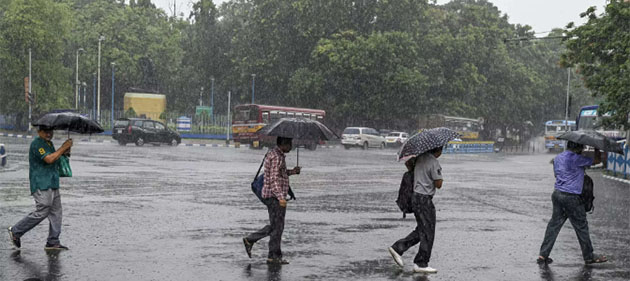
IMD blames El Nino as monsoon season ends with 'below-average' rains in India

News Network
October 1, 2023

rains.jpg

In a year marked by El Niño conditions, the southwest monsoon in India remained subdued to some extent, resulting in “below-average" cumulative rainfall, the India Meteorological Department (IMD) said on September 30, the date which formally marks the end of monsoon season in the country's mainland.

The cumulative rainfall in the four months of monsoon – June to September – amounted to 820 mm, which is lower than the long-period average (LPA) of 868.6 mm.

Rainfall activity ranging between 96 percent and 104 percent of the LPA is defined as normal. In 2022, India had recorded “normal" amount of cumulative rain, whereas, the overall precipitation in monsoon was “above-normal" in 2021.

According to the weather department, some “positive factors" mitigated some of the deficiency caused by El Niño conditions this year, which ended up providing “near normal" precipitation. These factors included the Indian Ocean Dipole (IOD) and Madden-Julian Oscillation (MJO), it said in a statement.

While the IOD is defined by the difference in the sea surface temperatures between the western parts of the Indian Ocean near Africa and the eastern parts of the ocean near Indonesia, MJO is a large-scale atmospheric disturbance originating in tropical Africa and travelling eastward, typically lasting 30 to 60 days. It is known for increasing convection in the Bay of Bengal and the Arabian Sea.

Addressing a press conference, IMD Director General Mrutyunjay Mohapatra said the 2023 monsoon season concluded with 94.4 percent cumulative rainfall, which is “near normal".

Normal rainfall is critical for India's agricultural landscape, with 52 percent of the net cultivated area relying on it. Additionally, it plays a crucial role in replenishing reservoirs essential for drinking water and power generation throughout the country.

Rainfed agriculture contributes to approximately 40 percent of the country's total food production, making it a vital contributor to India's food security and economic stability.

In a pre-monsoon briefing, the IMD had predicted a normal monsoon for India, albeit on the lower side of normal. It had, however, cautioned that El Nino might influence the latter half of the southwest monsoon.

However, normal cumulative rainfall over the country during the monsoon season also doesn't mean even spatial and temporal spread of precipitation.

The Indian monsoon refers to inherent fluctuations and changes that occur over time due to various natural factors. This is called natural variability.

Research, however, shows climate change is making the monsoon more variable. Increased variability means more extreme weather and dry spells.

The IMD chief said monthly rainfall across the country as a whole stood at 91 percent of LPA in June, 113 percent in July, 64 percent in August, and 113 percent in September.

"Out of the 36 meteorological subdivisions, three (constituting 9 percent of the total area) received excess rainfall, 26 received normal rainfall (covering 73 percent of the total area), and seven received deficient rainfall. The seven subdivisions with deficient rainfall are Nagaland, Manipur, Mizoram, and Tripura, Gangetic West Bengal, Jharkhand, Bihar, East UP, South Interior Karnataka, and Kerala," he said.

The IMD reported that east and northeast India recorded 1,115 mm of rainfall against a normal of 1,367.3 mm, which translates to an 18 percent deficit.

Northwest India recorded 593 mm of rainfall compared to a long-period average of 587.6 mm. Central India, where agriculture predominantly relies on monsoon rains, recorded 981.7 mm against a normal of 978 mm. The South Peninsula experienced an eight percent deficit.


Comments

Add new comment

  • Coastaldigest.com reserves the right to delete or block any comments.
  • Coastaldigset.com is not responsible for its readers’ comments.
  • Comments that are abusive, incendiary or irrelevant are strictly prohibited.
  • Please use a genuine email ID and provide your name to avoid reject.
News Network
November 26,2025

students.jpg

Bengaluru, Nov 26: Karnataka is taking its first concrete steps towards lifting a three-decade-old ban on student elections in colleges and universities. Deputy Chief Minister D.K. Shivakumar announced Wednesday that the state government will form a small committee to study the reintroduction of campus polls, a practice halted in 1989 following incidents of violence.

Speaking at a 'Constitution Day' event organised by the Karnataka Congress, Mr. Shivakumar underscored the move's aim: nurturing new political leadership from the grassroots.

"Recently, (Leader of the Opposition in Lok Sabha) Rahul Gandhi wrote a letter to me and Chief Minister (Siddaramaiah) asking us to think about restarting student elections," Shivakumar stated. "I'm announcing today that we'll form a small committee and seek a report on this."

Student elections were banned in Karnataka in 1989, largely due to concerns over violence and the infiltration of political party affiliates into campus life. The ban effectively extinguished vibrant student bodies and the pipeline of young leaders they often produced.

Mr. Shivakumar, who also serves as the Karnataka Congress president, said that former student leaders will be consulted to "study the pros and cons" of the re-introduction.

Acknowledging the history of the ban, he added, "There were many criminal activities taking place back then. We’ll see how we can conduct (student) elections by regulating such criminal activities."

The Deputy CM reminisced about his own journey, which began on campus. He recalled his political activism at Sri Jagadguru Renukacharya College leading to his first Assembly ticket in 1985 at the age of 23. "That's how student leadership was at the time. Such leadership has gone today. College elections have stopped," he lamented, adding that for many, college elections were "like a big movement" where leaders were forged.

The move, driven by the Congress high command's push to cultivate young talent, will face scrutiny from academics and university authorities who have, in the past, expressed concern that the return of polls could disrupt the peaceful academic environment and turn campuses into political battlegrounds.

Comments

Add new comment

  • Coastaldigest.com reserves the right to delete or block any comments.
  • Coastaldigset.com is not responsible for its readers’ comments.
  • Comments that are abusive, incendiary or irrelevant are strictly prohibited.
  • Please use a genuine email ID and provide your name to avoid reject.
News Network
November 26,2025

Mangaluru, Nov 26: Mangaluru East police have registered a case following a sophisticated online fraud where a 57-year-old local resident was allegedly cheated out of ₹13.4 lakh after being targeted on Facebook.

The scam began in February when the complainant, while browsing Facebook reels, was contacted by a woman identifying herself as "Lillian Mary George" from London. After establishing a chat relationship, the woman claimed she would visit India in November and bring a significant sum of money.

The trap was sprung on November 15, when the victim received a call from a woman named "Sonali Gupta," who claimed Lillian had arrived at Mumbai International Airport but was detained by customs. The fraudsters convinced the man that Lillian was carrying £25,000 (about ₹26 lakh) in traveller’s cheques and 1 kg of gold (valued at around ₹30 lakh).

Under the pretense of clearing these items, the victim was asked to make numerous online transfers between November 15 and 18 for various bogus charges, including:

•    "Pounds exchange registration"
•    "Customs declaration issues"
•    "Discount charges"
•    "Money-laundering charges"

Believing the fictitious story, the complainant transferred the cumulative sum of ₹13.4 lakh to various bank accounts provided by the fraudsters. He realised he was cheated when the culprits later promised a refund within two days but stopped answering his calls. The Mangaluru East police are now investigating the case, which highlights the continuing threat of transnational cyber fraud using social engineering and promises of fictitious wealth.

Comments

Add new comment

  • Coastaldigest.com reserves the right to delete or block any comments.
  • Coastaldigset.com is not responsible for its readers’ comments.
  • Comments that are abusive, incendiary or irrelevant are strictly prohibited.
  • Please use a genuine email ID and provide your name to avoid reject.
News Network
November 30,2025

girlnomore.jpg

Mangaluru, Nov 30: A 22-year-old college student succumbed to her injuries at a private hospital in Mangaluru today, days after she was hit by a goods tempo while crossing a road in Padubidri.

The deceased has been identified as Preksha, a resident of Nadsalu Billitota in Padubidri. The fatal incident occurred as Preksha, who was returning home after completing her examination, attempted to cross the service road towards Mangaluru. She was struck by a goods tempo approaching from the Udupi side, causing her to fall and sustain a severe head injury.

Prompt action from local residents ensured she received immediate first aid before being rushed to a hospital in Mangaluru for specialised treatment. Despite medical efforts, she passed away while undergoing care.

Preksha was a student at Karavali College, Vamanjoor on the outskirts of Mangaluru city. The tragedy is compounded by the fact that she belonged to a financially vulnerable family, having previously lost her father. She is survived by her mother and brother.

A case related to the accident has been registered at the Padubidri police station, and an investigation is underway to determine the exact circumstances that led to the collision. The incident highlights the growing concerns over road safety, particularly on busy service roads, and serves as a tragic reminder of the human cost of traffic accidents.

Comments

Add new comment

  • Coastaldigest.com reserves the right to delete or block any comments.
  • Coastaldigset.com is not responsible for its readers’ comments.
  • Comments that are abusive, incendiary or irrelevant are strictly prohibited.
  • Please use a genuine email ID and provide your name to avoid reject.