



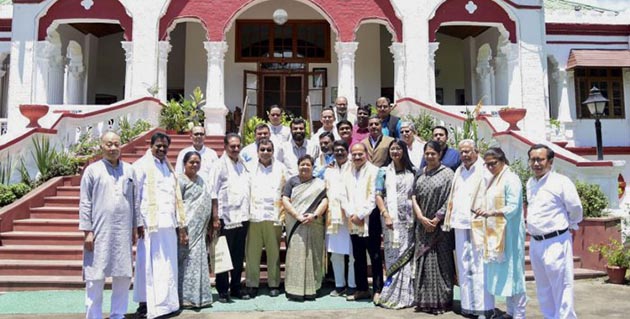
INDIA brings ‘PM Modi’s brazen indifference’ to Manipur Governor’s notice, demands urgent rehabilitation of affected people

News Network
July 30, 2023

opposition.jpg

Guwahati, July 30: Stating that the government machinery has completely failed to control the Manipur ethnic conflict, which is lingering for nearly three months, opposition bloc INDIA on Sunday slammed Prime Minister Narendra Modi over his “silence”, showing “brazen indifference” to the ongoing situation in the northeastern state.

In a memorandum submitted to Manipur Governor Anusuiya Uikey, the 21 opposition MPs who signed the document demanded urgent rehabilitation and resettlement of the affected people to bring peace and harmony to the state.

“From the reports of incessant firing and arson of houses in the last few days, it is established beyond doubt that the state machinery has completely failed to control the situation for the last almost three months,” the memorandum read.

The continued internet ban for the last three months is aiding the unsubstantiated rumours, which is adding to the existing mistrust among the communities, the Parliamentarians said.

“Silence of Hon’ble Prime Minister shows his brazen indifference to the violence in Manipur,” they added in the memorandum.

There is anger and a sense of alienation amongst all communities and it has to be addressed without delay, they said.

“We earnestly request you to restore peace and harmony taking all effective measures, where justice should be the cornerstone. In order to bring peace and harmony, rehabilitation and resettlement of the affected persons is most urgent,” the MPs told the governor.

“You are also requested to apprise the Union government of the complete breakdown of law and order in Manipur for the last 89 days so as to enable them to intervene in the precarious situation in Manipur to restore peace and normalcy,” they added.

The document also stressed that the “failure of both the central and state governments” to protect the lives and properties of the people of the two communities is apparent from the figures of more than 140 deaths (over 160 deaths as per official records), over 500 injuries, burning of more than 5,000 houses and internal displacement of over 60,000 people.

The opposition delegation had arrived in Manipur on Saturday to assess the ground situation and meet victims of the three-month-long ethnic riots in the state.

On the first day of their two-day whirlwind tour, they visited several relief camps in Imphal, Moirang in Bishnupur district and Churachandpur and met scores of victims of ethnic clashes from both the warring communities.

Talking about their visit, the Parliamentarians said in the memorandum that they interacted with the victims taking shelter in the relief camps.

“We are, indeed, very shocked and sad to hear the stories of anxieties, uncertainties, pains and sorrows of the individuals affected by the unprecedented violence unleashed by both sides since the beginning of the clashes,” they added.

The memorandum highlighted that the condition in the relief camps is pathetic, to say the least, and special care needs to be taken for the kids on a priority basis.

“Students from different streams are facing uncertain future, which has to be the priority of the state and the Union governments,” it added.

Later, sharing a copy of the memorandum on Twitter, Congress general secretary Jairam Ramesh slammed Modi and claimed that the anger, anxiety, anguish, pain and sorrow of the people of Manipur make “absolutely no difference” to him.

“While he is busy listening to his own voice and forcing down his ‘Mann ki Baat’ on crores of Indians, the 21 MP delegation of Team INDIA is talking about Manipur ki Baat with the Governor of Manipur,” Ramesh added.

The delegation members left for Delhi on Sunday afternoon after submitting the memorandum to the governor.

Besides Chowdhury and Congress’ Deputy Leader in the Lok Sabha Gaurav Gogoi, the delegation included Sushmita Dev (TMC), Mahua Maji (JMM), Kanimozhi Karunanidhi (DMK), P P Mohammed Faizal (NCP), Chaudhary Jayant Singh (RLD), Manoj Kumar Jha (RJD), N K Premachandran (RSP) and T Thirumavalavan (VCK).

JD(U) chief Rajiv Ranjan (Lalan) Singh and his party colleague Aneel Prasad Hegde, CPI’s Sandosh Kumar, CPI(M)’s A A Rahim, SP’s Javed Ali Khan, IUML’s E T Mohammed Basheer, AAP’s Sushil Gupta, VCK’s D Ravikumar and Arvind Sawant (Shiv Sena-UBT), and Phulo Devi Netam and K Suresh of the Congress were also part of the delegation.

More than 160 people lost their lives and several hundreds were injured since ethnic clashes broke out in Manipur on May 3, after a ‘Tribal Solidarity March’ was organised in the hill districts to protest against the Meitei community’s demand for Scheduled Tribe (ST) status.

Meiteis account for about 53 per cent of Manipur’s population and live mostly in the Imphal Valley. Tribals — Nagas and Kukis — constitute little over 40 per cent and reside in the hill districts. 

Comments

Add new comment

  • Coastaldigest.com reserves the right to delete or block any comments.
  • Coastaldigset.com is not responsible for its readers’ comments.
  • Comments that are abusive, incendiary or irrelevant are strictly prohibited.
  • Please use a genuine email ID and provide your name to avoid reject.
News Network
February 1,2026

Bengaluru, Feb 1: For travelers landing at Kempegowda International Airport (KIA), the sleek, wood-paneled curves of Terminal 2 promise a world-class welcome. But the famed “Garden City” charm quickly withers at the curb. As India’s aviation sector swells to record numbers—handling over 43 million passengers in Bengaluru alone this past year—the “last mile” has turned into a marathon of frustration.

The Bengaluru Logjam: Rules vs Reality

While the city awaits the 2027 completion of the Namma Metro Blue Line, the interim has been chaotic. Recent “decongestion” rules at Terminal 1 have pushed app-based cab pickups to distant parking zones, forcing weary passengers into a 20-minute walk with luggage.

“I landed after ten months away and felt like a stranger in my own city,” says Ruchitha Jain, a Koramangala resident. “My driver couldn’t find me, staff couldn’t guide me, and the so-called ‘Premium’ lane is just a fancy tax on convenience.”

•    The Cost of Distance: A 40-km cab ride can now easily cross ₹1,500, driven by demand pricing and airport surcharges.

•    The Bus Gap: While Vayu Vajra remains a lifeline, its ₹300–₹400 fare is often cited as the most expensive airport bus service in the country.

A National Pattern of Disconnect

The struggle is not unique to Karnataka. From Chennai’s coast to Hyderabad’s plateau, India’s airports tell a familiar story: brilliant runways, broken exits.

City:    Primary Issue   |    Recent Development

Bengaluru:    Cab pickup restrictions & distance  |    App-based taxis shifted to far parking zones; long walks and fare spikes reported

Chennai:    Multi-Level Parking (MLCP) hike  |    Passengers report 40-minute walks to reach cab pickup points

Hyderabad:    “Taxi mafia” & touting  |    Over 440 touting cases reported; security presence intensified

Mumbai:    Fare scams  |     Tourists charged ₹18,000 for just 400 metres, triggering police action

In Hyderabad, travelers continue to battle entrenched local groups that intimidate Uber and Ola drivers, pushing passengers toward overpriced private taxis. Chennai flyers, meanwhile, complain that reaching the designated pickup zones now takes longer than short-haul flights from cities like Coimbatore.

The ‘Budget Day’ Hope

As Finance Minister Nirmala Sitharaman presents the Union Budget 2026 today, the aviation sector is watching closely. With the government’s renewed emphasis on multimodal integration, there is cautious hope for funding toward seamless airport-metro-bus hubs.

The vision is clear: a future where planes, trains, and metros speak the same language. Until then, passengers at KIA—and airports across India—will continue to discover that the hardest part of flying isn’t the thousands of kilometres in the air, but the last few on the ground.

Comments

Add new comment

  • Coastaldigest.com reserves the right to delete or block any comments.
  • Coastaldigset.com is not responsible for its readers’ comments.
  • Comments that are abusive, incendiary or irrelevant are strictly prohibited.
  • Please use a genuine email ID and provide your name to avoid reject.
News Network
February 5,2026

In an era where digital distractions are the primary rival to academic excellence, the Karnataka Education Department is taking the fight directly to the living room. As the SSLC (Class 10) annual examinations loom, officials have launched a localized "digital strike" to ensure students aren't losing their competitive edge to scrolling or soap operas.

The 7-to-9 Lockdown

The department has issued a formal directive urging—and in some cases, enforcing via home visits—a total blackout of mobile phones and television sets between 7:00 PM and 9:00 PM. This two-hour window is being designated as "sacred study time" across the state until the examinations conclude on April 2.

Key Pillars of the Initiative:

•    Doorstep Advocacy: Teachers are transitioning from classrooms to living rooms, meeting parents to explain the psychological benefits of a distraction-free environment.

•    Parental Accountability: The campaign shifts the burden of discipline from the student to the household, asking parents to lead by example and switch off their own devices.

•    The Timeline: The focus remains sharp on the upcoming exam block, scheduled from March 18 to April 2.

"The objective is simple: uninterrupted focus. We are reclaiming the evening hours for the students, ensuring their environment is as prepared as their minds," stated a senior department official.

Student vs. Reality

While the student community has largely welcomed the "forced focus"—with many admitting they lack the willpower to ignore notifications—the move has sparked a debate on enforceability. Without a "TV Police," the success of this initiative rests entirely on the shoulders of parents and the persuasive power of visiting educators.

Comments

Add new comment

  • Coastaldigest.com reserves the right to delete or block any comments.
  • Coastaldigset.com is not responsible for its readers’ comments.
  • Comments that are abusive, incendiary or irrelevant are strictly prohibited.
  • Please use a genuine email ID and provide your name to avoid reject.
News Network
February 1,2026

Bengaluru: The Karnataka High Court has refused to quash an investigation against a WhatsApp group administrator accused of allowing the circulation of obscene and offensive images depicting Hindutva politicians and idols in 2021.

Justice M Nagaprasanna observed that, prima facie, the ingredients of the offence under Section 295A of the Indian Penal Code were made out. “The offence under Section 295A of the IPC is met to every word of its ingredient, albeit prima facie,” the judge said.

The petitioner, Sirajuddin, a resident of Belthangady taluk in Dakshina Kannada district, had challenged the FIR registered against him at the CEN (Cyber, Economics and Narcotics) police station, Mangaluru, for offences under Section 295A of the IPC and Section 67 of the Information Technology Act. Section 295A relates to punishment for deliberate and malicious acts intended to outrage the religious feelings of any class of citizens.

According to the complaint filed by K Jayaraj Salian, also a resident of Belthangady taluk, he received a WhatsApp group link from an unknown source and was added to the group after accessing it. The group reportedly had six administrators and around 250 participants, where obscene and offensive images depicting Hindu deities and certain political figures were allegedly circulated repeatedly.

Sirajuddin was arrested in connection with the case and later released on bail on February 16, 2021. He argued before the court that he was being selectively targeted, while other administrators—including the creator of the group—were neither arrested nor investigated. He also contended that the Magistrate could not have taken cognisance of the offence under Section 295A without prior sanction under Section 196(1) of the CrPC.

Rejecting the argument, Justice Nagaprasanna held that prior sanction is required only at the stage of taking cognisance, and not at the stage of registration of the crime or during investigation.

The judge noted that the State had produced the entire investigation material before the court. “A perusal of the material reveals depictions of Hindu deities in an extraordinarily obscene, demeaning and profane manner. The content is such that its reproduction in a judicial order would itself be inappropriate,” the court said, adding that the material, on its face, had the tendency to outrage religious feelings and disturb communal harmony.

Observing that the case was still at the investigation stage, the court said it could not interdict the probe at this juncture. However, it expressed concern that the investigating officer appeared to have not proceeded uniformly against all administrators. The court clarified that if the investigation revealed the active involvement of any member in permitting the circulation of such content, they must also be proceeded against.

“At this investigative stage, any further observation by this Court would be unnecessary,” the order concluded.

Comments

Add new comment

  • Coastaldigest.com reserves the right to delete or block any comments.
  • Coastaldigset.com is not responsible for its readers’ comments.
  • Comments that are abusive, incendiary or irrelevant are strictly prohibited.
  • Please use a genuine email ID and provide your name to avoid reject.