



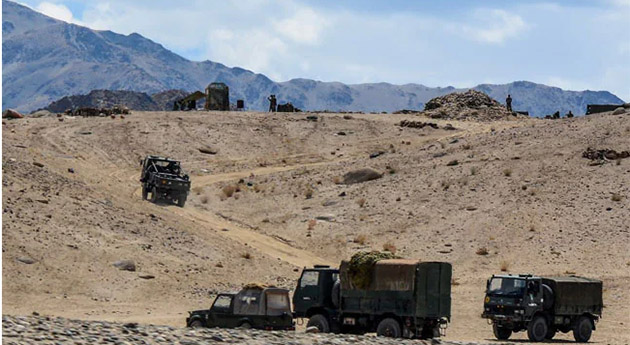
India loses control of 26 patrol points in Ladakh as China takes advantage of buffer areas

News Network
January 25, 2023

IndiaChina.jpg

India, as of the moment, does not have access to 26 out of 65 patrolling points in Eastern Ladakh. The situation is worthy of mention considering India-China stand-off along the 3500 km border.

“Presently there are 65 PPs (Patrolling Points) starting from Karakoram pass to Chumur which are to be patrolled regularly by the ISFs (Indian Security Forces). Out of 65 PPs, our presence is lost in 26 PPs (i.e. PP no. 5-17, 24-32, 37, due to restrictive or no patrolling by the ISFs,” wrote PD Nitya, the Superintendent of Police of Leh, Ladakh’s main city, in a research paper accessed by media. 

The report was filed at last week's annual conference of the country's top police officers in Delhi, attended by Prime Minister Narendra Modi, Union Home Minister Amit Shah and National Security Advisor Ajit Doval.

"Later on, China forces us to accept the fact that as such areas have not seen the presence of ISFs or civilians since long, the Chinese were present in these areas. This leads to a shift in the border under control of ISFs towards Indian side and a "buffer zone" is created in all such pockets which ultimately leads to loss of control over these areas by India. This tactic of PLA (China's People's Liberation Army) to grab land inch-by-inch is known as 'Salami slicing'," it said.

"PLA has taken advantage of the buffer areas in the de-escalation talks by placing their best of cameras on the highest peaks and monitoring the movement of our forces... they object our movement even in the buffer zone, claiming it to be 'their' area of operation and then further ask us to move back to create more 'buffer' areas," the officer wrote.

She said this Chinese strategy was seen in Galwan Valley, the site of a deadly clash in 2020 when 20 Indian troops and at least four Chinese soldiers died in hand-to-hand fighting.

Ms Nitya also said that marking areas as out of bounds and keeping them barren affects troop morale as well. "During an interaction with one senior officer whose unit is based right on forward area, he shared that, if by retreating 400 metres back, we can buy peace with PLA for 4 years, then it's worth it," the report said.

The report was released after a mere few weeks of India accusing China of “unilaterally changing the status-quo” on the Line of Actual Control (LOC).

The encounter in the Galwan Valley in 2020, which sparked a major uptick in tensions between the two nations, was considered to be the most serious confrontation since the December 9 incident in Arunachal Pradesh. Since then, there have been a number of military negotiations that have resulted in a cautious withdrawal of forces on both sides.

AIMIM leader Asaduddin Owaisi accused PM Modi of being the weakest PM India has had for “ceding land to China”.

Delhi chief minister (CM) and Aam Aadmi Party chief Arvind Kejriwal also accused the Centre of continuing and increasing trade with Beijing despite Chinese aggression.

Comments

Add new comment

  • Coastaldigest.com reserves the right to delete or block any comments.
  • Coastaldigset.com is not responsible for its readers’ comments.
  • Comments that are abusive, incendiary or irrelevant are strictly prohibited.
  • Please use a genuine email ID and provide your name to avoid reject.
News Network
January 23,2026

Karnataka Governor Thaawarchand Gehlot read only three lines from the 122-paragraph address prepared by the Congress-led state government while addressing the joint session of the Legislature on Thursday, effectively bypassing large sections critical of the BJP-led Union government.

The omitted portions of the customary Governor’s address outlined what the state government described as a “suppressive situation in economic and policy matters” under India’s federal framework. The speech also sharply criticised the Centre’s move to replace the Mahatma Gandhi National Rural Employment Guarantee Act (MGNREGA) with the Viksit Bharat–Guarantee for Rozgar and Ajeevika Mission (Gramin) Act, commonly referred to as the VB-GRAM (G) Act.

Governor Gehlot had earlier conveyed his objection to several paragraphs that were explicitly critical of the Union government. On Thursday, he confined himself to the opening lines — “I extend a warm welcome to all of you to the joint session of the State legislature. I am extremely pleased to address this august House” — before jumping directly to the concluding sentence of the final paragraph.

He ended the address by reading the last line of paragraph 122: “Overall, my government is firmly committed to doubling the pace of the State’s economic, social and physical development. Jai Hind — Jai Karnataka.”

According to the prepared speech, the Karnataka government demanded the scrapping of the VB-GRAM (G) Act, describing it as “contractor-centric” and detrimental to rural livelihoods, and called for the full restoration of MGNREGA. The state government argued that the new law undermines decentralisation, weakens labour protections, and centralises decision-making in violation of constitutional norms.

Key points from the unread sections of the speech:

•    Karnataka facing a “suppressive” economic and policy environment within the federal system

•    Repeal of MGNREGA described as a blow to rural livelihoods

•    VB-GRAM (G) Act accused of protecting corporate and contractor interests

•    New law alleged to weaken decentralised governance

•    Decision-making said to be imposed by the Centre without consulting states

•    Rights of Adivasis, women, backward classes and agrarian communities curtailed

•    Labourers allegedly placed under contractor control

•    States facing mounting fiscal stress due to central policies

•    VB-GRAM (G) Act accused of enabling large-scale corruption

Comments

Add new comment

  • Coastaldigest.com reserves the right to delete or block any comments.
  • Coastaldigset.com is not responsible for its readers’ comments.
  • Comments that are abusive, incendiary or irrelevant are strictly prohibited.
  • Please use a genuine email ID and provide your name to avoid reject.
News Network
February 1,2026

Bengaluru, Feb 1: For travelers landing at Kempegowda International Airport (KIA), the sleek, wood-paneled curves of Terminal 2 promise a world-class welcome. But the famed “Garden City” charm quickly withers at the curb. As India’s aviation sector swells to record numbers—handling over 43 million passengers in Bengaluru alone this past year—the “last mile” has turned into a marathon of frustration.

The Bengaluru Logjam: Rules vs Reality

While the city awaits the 2027 completion of the Namma Metro Blue Line, the interim has been chaotic. Recent “decongestion” rules at Terminal 1 have pushed app-based cab pickups to distant parking zones, forcing weary passengers into a 20-minute walk with luggage.

“I landed after ten months away and felt like a stranger in my own city,” says Ruchitha Jain, a Koramangala resident. “My driver couldn’t find me, staff couldn’t guide me, and the so-called ‘Premium’ lane is just a fancy tax on convenience.”

•    The Cost of Distance: A 40-km cab ride can now easily cross ₹1,500, driven by demand pricing and airport surcharges.

•    The Bus Gap: While Vayu Vajra remains a lifeline, its ₹300–₹400 fare is often cited as the most expensive airport bus service in the country.

A National Pattern of Disconnect

The struggle is not unique to Karnataka. From Chennai’s coast to Hyderabad’s plateau, India’s airports tell a familiar story: brilliant runways, broken exits.

City:    Primary Issue   |    Recent Development

Bengaluru:    Cab pickup restrictions & distance  |    App-based taxis shifted to far parking zones; long walks and fare spikes reported

Chennai:    Multi-Level Parking (MLCP) hike  |    Passengers report 40-minute walks to reach cab pickup points

Hyderabad:    “Taxi mafia” & touting  |    Over 440 touting cases reported; security presence intensified

Mumbai:    Fare scams  |     Tourists charged ₹18,000 for just 400 metres, triggering police action

In Hyderabad, travelers continue to battle entrenched local groups that intimidate Uber and Ola drivers, pushing passengers toward overpriced private taxis. Chennai flyers, meanwhile, complain that reaching the designated pickup zones now takes longer than short-haul flights from cities like Coimbatore.

The ‘Budget Day’ Hope

As Finance Minister Nirmala Sitharaman presents the Union Budget 2026 today, the aviation sector is watching closely. With the government’s renewed emphasis on multimodal integration, there is cautious hope for funding toward seamless airport-metro-bus hubs.

The vision is clear: a future where planes, trains, and metros speak the same language. Until then, passengers at KIA—and airports across India—will continue to discover that the hardest part of flying isn’t the thousands of kilometres in the air, but the last few on the ground.

Comments

Add new comment

  • Coastaldigest.com reserves the right to delete or block any comments.
  • Coastaldigset.com is not responsible for its readers’ comments.
  • Comments that are abusive, incendiary or irrelevant are strictly prohibited.
  • Please use a genuine email ID and provide your name to avoid reject.