



India ready to contribute to peace process in Ukraine: Modi after talks with Scholz

News Network
February 25, 2023

modiindia.jpg

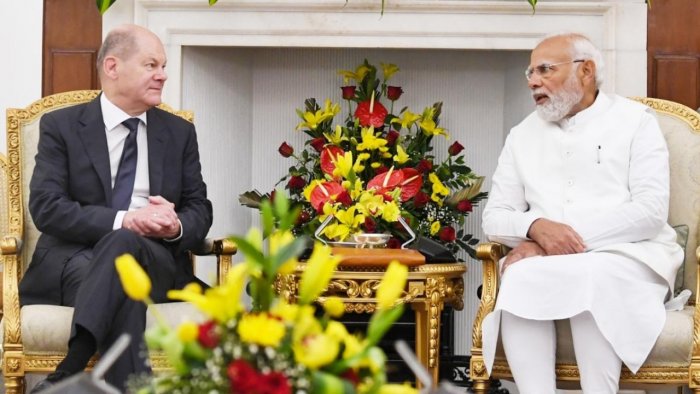
India has been pressing for resolving the Ukraine "dispute" through dialogue and diplomacy and is ready to contribute to any peace process, Prime Minister Narendra Modi said on Saturday after holding talks with visiting German Chancellor Olaf Scholz, who favoured a "clear stand" in the UN on the issue.

The one-year-old conflict and its consequences including on food and energy security figured in the Modi-Scholz dialogue besides ways to ramp up overall bilateral engagement including in areas of trade and investment, new technologies and climate change.

In his statement at a joint press event with Modi, the German Chancellor described the Russian "aggression" against UKraine as a "major catastrophe" that has negatively impacted the globe and said it is important to state "very clearly where we stand on this subject" including at the UN as international law governs international relations.

On Thursday, India abstained in the UN General Assembly on a resolution that underscored the need to reach "comprehensive, just and lasting peace" in Ukraine and called for Russia to end the hostilities.

"Since the beginning of the developments in Ukraine, India has insisted on resolving this dispute through dialogue and diplomacy. India is ready to contribute to any peace process," Modi said in his media statement.

The Prime Minister also said that there has been active cooperation between India and Germany in the fight against terrorism and separatism and countries agreed that concerted action is necessary to end cross-border terrorism, seen as an apparent reference to Pakistan.

The German Chancellor asserted that no one can change borders through use of violence.

"This war violates the fundamental principle to which we had all been agreed for such a long time and that is that you do not change borders through the use of violence," he said.

Scholz arrived here this morning on a two-day India visit, a day after the first anniversary of the Russian invasion of Ukraine that saw the US and its European allies renewing their resolve to strongly back Kyiv and mount pressure on Moscow including through fresh economic sanctions.

"A very important question is securing the supply of food and energy. We have to make sure that countries in Asia, Africa and America are not too strongly and negatively impacted by the terrible war of aggression that Russia started against Ukraine and that the impact is not too negative for them," the German leader said.

Modi said that "increasing cooperation between the two largest democratic economies of the world is not only beneficial for the people of both the countries, it also sends a positive message in today's tension-ridden world."

The Prime Minister said the effects of the Covid-19 pandemic and the Ukraine conflict have been felt across the world and they have had a particularly negative impact on developing countries.

"We expressed our shared concern about this. We agree that these problems can only be solved through joint efforts. We are stressing on this even during India's presidency of the G20," he said.

Scholz said Germany wants to deepen trade relations between India and Europe, asserting that two-way trade and investment would go up following the finalisation of the India-EU free trade pact.

The German Chancellor suggested that he would play a role in the early finalisation of the long-pending FTA and the investment protection pact between India and the EU.

"We need to join forces in that regard and make progress together. It is especially important for one area that in my eyes is of the greatest importance and that is the development of IT and software," Scholz said.

Noting that security and defense cooperation can become an important pillar of strategic partnership between the two countries, Modi said together we will continue to make efforts to fully realise our untapped potential in this area."

There is active cooperation between India and Germany in the fight against terrorism and separatism and both countries also agree that concerted action is necessary to end cross-border terrorism, he added.

The Prime Minister said that apart from being India's largest trading partner in Europe, Germany is also an important source of investment in the country.
"Today, due to the 'Make in India' and 'Self-reliant India' campaigns, new opportunities are opening up in all sectors in India. We are encouraged by the German interest in these opportunities," he said.

The Prime Minister also underlined the importance of reform of the multilateral institutions.

"We also reiterated the consensus that reform of multilateral institutions is necessary to better reflect global realities. This is evident in our active participation within the G4 to reform the UN Security Council," he said.

The G4 comprises India, Brazil, Japan and Germany and all of them are strong contenders for permanent membership of the UN Security Council.

"India and Germany are increasing cooperation for the development of third countries under the triangular development cooperation," Modi said.

He said people-to-people relations between the two countries have also strengthened in the last few years with the inking of the Migration and Mobility Partnership Agreement in December last year and this relationship will be further deepened.

"In accordance with the requirements of the changing times, we are also adding new and modern aspects to our relations. Last year during my visit to Germany, we announced the Green and Sustainable Development Partnership," Modi said.

"Through this, we are expanding cooperation in the areas of climate action and sustainable development goals. We also decided to work together in areas like renewable energy, green hydrogen and biofuels," he added.

Comments

Add new comment

  • Coastaldigest.com reserves the right to delete or block any comments.
  • Coastaldigset.com is not responsible for its readers’ comments.
  • Comments that are abusive, incendiary or irrelevant are strictly prohibited.
  • Please use a genuine email ID and provide your name to avoid reject.
News Network
January 23,2026

Karnataka Governor Thaawarchand Gehlot read only three lines from the 122-paragraph address prepared by the Congress-led state government while addressing the joint session of the Legislature on Thursday, effectively bypassing large sections critical of the BJP-led Union government.

The omitted portions of the customary Governor’s address outlined what the state government described as a “suppressive situation in economic and policy matters” under India’s federal framework. The speech also sharply criticised the Centre’s move to replace the Mahatma Gandhi National Rural Employment Guarantee Act (MGNREGA) with the Viksit Bharat–Guarantee for Rozgar and Ajeevika Mission (Gramin) Act, commonly referred to as the VB-GRAM (G) Act.

Governor Gehlot had earlier conveyed his objection to several paragraphs that were explicitly critical of the Union government. On Thursday, he confined himself to the opening lines — “I extend a warm welcome to all of you to the joint session of the State legislature. I am extremely pleased to address this august House” — before jumping directly to the concluding sentence of the final paragraph.

He ended the address by reading the last line of paragraph 122: “Overall, my government is firmly committed to doubling the pace of the State’s economic, social and physical development. Jai Hind — Jai Karnataka.”

According to the prepared speech, the Karnataka government demanded the scrapping of the VB-GRAM (G) Act, describing it as “contractor-centric” and detrimental to rural livelihoods, and called for the full restoration of MGNREGA. The state government argued that the new law undermines decentralisation, weakens labour protections, and centralises decision-making in violation of constitutional norms.

Key points from the unread sections of the speech:

•    Karnataka facing a “suppressive” economic and policy environment within the federal system

•    Repeal of MGNREGA described as a blow to rural livelihoods

•    VB-GRAM (G) Act accused of protecting corporate and contractor interests

•    New law alleged to weaken decentralised governance

•    Decision-making said to be imposed by the Centre without consulting states

•    Rights of Adivasis, women, backward classes and agrarian communities curtailed

•    Labourers allegedly placed under contractor control

•    States facing mounting fiscal stress due to central policies

•    VB-GRAM (G) Act accused of enabling large-scale corruption

Comments

Add new comment

  • Coastaldigest.com reserves the right to delete or block any comments.
  • Coastaldigset.com is not responsible for its readers’ comments.
  • Comments that are abusive, incendiary or irrelevant are strictly prohibited.
  • Please use a genuine email ID and provide your name to avoid reject.
News Network
February 1,2026

Bengaluru, Feb 1: For travelers landing at Kempegowda International Airport (KIA), the sleek, wood-paneled curves of Terminal 2 promise a world-class welcome. But the famed “Garden City” charm quickly withers at the curb. As India’s aviation sector swells to record numbers—handling over 43 million passengers in Bengaluru alone this past year—the “last mile” has turned into a marathon of frustration.

The Bengaluru Logjam: Rules vs Reality

While the city awaits the 2027 completion of the Namma Metro Blue Line, the interim has been chaotic. Recent “decongestion” rules at Terminal 1 have pushed app-based cab pickups to distant parking zones, forcing weary passengers into a 20-minute walk with luggage.

“I landed after ten months away and felt like a stranger in my own city,” says Ruchitha Jain, a Koramangala resident. “My driver couldn’t find me, staff couldn’t guide me, and the so-called ‘Premium’ lane is just a fancy tax on convenience.”

•    The Cost of Distance: A 40-km cab ride can now easily cross ₹1,500, driven by demand pricing and airport surcharges.

•    The Bus Gap: While Vayu Vajra remains a lifeline, its ₹300–₹400 fare is often cited as the most expensive airport bus service in the country.

A National Pattern of Disconnect

The struggle is not unique to Karnataka. From Chennai’s coast to Hyderabad’s plateau, India’s airports tell a familiar story: brilliant runways, broken exits.

City:    Primary Issue   |    Recent Development

Bengaluru:    Cab pickup restrictions & distance  |    App-based taxis shifted to far parking zones; long walks and fare spikes reported

Chennai:    Multi-Level Parking (MLCP) hike  |    Passengers report 40-minute walks to reach cab pickup points

Hyderabad:    “Taxi mafia” & touting  |    Over 440 touting cases reported; security presence intensified

Mumbai:    Fare scams  |     Tourists charged ₹18,000 for just 400 metres, triggering police action

In Hyderabad, travelers continue to battle entrenched local groups that intimidate Uber and Ola drivers, pushing passengers toward overpriced private taxis. Chennai flyers, meanwhile, complain that reaching the designated pickup zones now takes longer than short-haul flights from cities like Coimbatore.

The ‘Budget Day’ Hope

As Finance Minister Nirmala Sitharaman presents the Union Budget 2026 today, the aviation sector is watching closely. With the government’s renewed emphasis on multimodal integration, there is cautious hope for funding toward seamless airport-metro-bus hubs.

The vision is clear: a future where planes, trains, and metros speak the same language. Until then, passengers at KIA—and airports across India—will continue to discover that the hardest part of flying isn’t the thousands of kilometres in the air, but the last few on the ground.

Comments

Add new comment

  • Coastaldigest.com reserves the right to delete or block any comments.
  • Coastaldigset.com is not responsible for its readers’ comments.
  • Comments that are abusive, incendiary or irrelevant are strictly prohibited.
  • Please use a genuine email ID and provide your name to avoid reject.