India showcases military might, diverse cultural heritage at Kartavya Path on 74th R-Day

Agencies
January 26, 2023

India.jpg

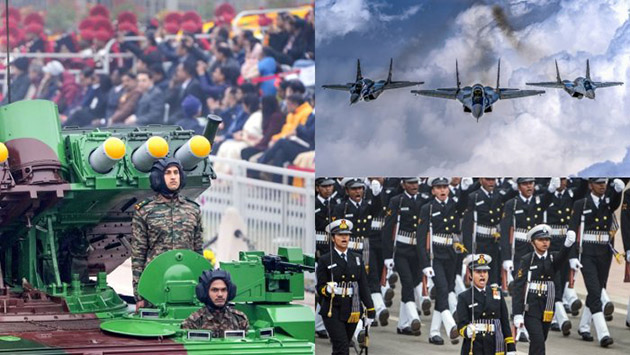
New Delhi, Jan 26: India's military prowess infused with a spirit of "aatmanirbharta" and diverse and vibrant cultural heritage were showcased on the Kartavya Path as the nation celebrated its 74th Republic Day on Thursday.

"Nari Shakti" was predominantly the theme of the celebrations with President Droupadi Murmu, Prime Minister Narendra Modi and a host of other dignitaries joining people and members of the armed forces in marking the august occasion.

Egypt's President Abdel Fattah al-Sisi was the chief guest at the ceremonial event.

A combined band and marching contingent of the Egyptian Armed Forces also took part in the parade that started around 10:30 am and ended close to noon after a fly-past.

The Egyptian contingent included 144 soldiers representing the main branches of the Egyptian Armed Forces and it was led by Col Mahmoud Mohamed Abdelfattah Elkharasawy.

The ceremony commenced with Prime Minister Modi visiting the National War Memorial and paying tributes to the fallen heroes by laying a wreath.

According to tradition, the national flag was unfurled followed by the national anthem with a booming 21-gun salute. However, the ceremonial salute this year was given with 105-mm Indian field guns, which replaced the vintage 25-pounder guns, reflecting upon the growing "aatmanirbharta" in defence.

Shallow fog lowered visibility at the Kartavya Path on Thursday as spectators strained their eyes to watch aerial manoeuvres by a battery of 50 aircraft that flew in different formations.

The military assets which were displayed during the parade included made-in-India equipment, showing the spirit of "aatmanirbhar bharat", officials said.

The main battle tank Arjun, the Nag Missile System (NAMIS) and the K-9 Vajra were also showcased.

All equipment from the Army which were part of the Republic Day celebrations are made-in-India, Chief of Staff Delhi Area Maj Gen Bhavnish Kumar had earlier said.

With 'Nari Shakti' being the theme, the Akash weapon system display had Lt Chetana Sharma at the forefront.

The marching contingents from the Army included one each from the mechanised infantry, the Dogra Regiment, the Punjab Regiment, the Maratha Light Infantry, the Bihar Regiment and the Gorkha Brigade. A camel band from the Border Security Force also took part in the parade.

The Republic Day celebrations were held on the revamped Central Vista avenue and was the first at the ceremonial boulevard after Rajpath was renamed to Kartavya Path last year.

Lt Commander Disha Amrith, a woman naval air operations official posted at a strategic base, led the Indian Navy's contingent of 144 young sailors.

The naval tableau, designed on the theme 'Indian Navy - Combat Ready, Credible, Cohesive and Future Proof', showcased the multi-dimensional capabilities of the force, "Nari Shakti" and key indigenously designed and built assets under "aatmanirbhar bharat", officials said.

The Defence Research and Development Organisation (DRDO) showcased one tableau and equipment. The theme of the tableau was "Securing Nation with Effective Surveillance, Communication and Neutralising Threats".

Indigenously-developed Wheeled Armoured Platform (WhAP), a modular 8X8 wheeled combat platform, carried on a 70-ton trailer was displayed by the DRDO.

Three Param Vir Chakra awardees and three Ashok Chkara awardees also took part in the parade, and a "veterans' tableau" with the theme -- "Towards India's Amrit Kaal with a Resolve of Veterans' Commitment" was also part of it.

The Indian Air Force contingent comprising 144 air warriors and four officers, was led by Sqn Ldr Sindhu Reddy. The air force tableau, designed on the theme "Indian Air Force Power Beyond Boundaries", displayed a rotating globe highlighting IAF's expanded reach, whereby it has been able to provide humanitarian assistance across borders, as also exercises conducted with friendly countries.

A group of "Shramyogis" involved in the construction of the Central Vista, the Kartavya Path, the new Parliament Building along with milk, vegetable and street vendors were specially invited for the parade.

A total of 23 tableaux - 17 from states and union territories and six from various ministries and departments -- depicting India's vibrant cultural heritage, economic and social progress took part in the ceremonial parade with 'Nari Shakti' as the theme for majority of the floats. 

Comments

Add new comment

  • Coastaldigest.com reserves the right to delete or block any comments.
  • Coastaldigset.com is not responsible for its readers’ comments.
  • Comments that are abusive, incendiary or irrelevant are strictly prohibited.
  • Please use a genuine email ID and provide your name to avoid reject.
News Network
December 16,2025

bengal.jpg

The deletion of over 58 lakh names from West Bengal’s draft electoral rolls following a Special Intensive Revision (SIR) has sparked widespread concern and is likely to deepen political tensions in the poll-bound state.

According to the Election Commission, the revision exercise has identified 24 lakh voters as deceased, 19 lakh as relocated, 12 lakh as missing, and 1.3 lakh as duplicate entries. The draft list, published after the completion of the first phase of SIR, aims to remove errors and duplication from the electoral rolls.

However, the scale of deletions has raised fears that a large number of eligible voters may have been wrongly excluded. The Election Commission has said that individuals whose names are missing can file objections and seek corrections. The final voter list is scheduled to be published in February next year, after which the Assembly election announcement is expected. Notably, the last Special Intensive Revision in Bengal was conducted in 2002.

The development has intensified the political row over the SIR process. Chief Minister Mamata Banerjee and her Trinamool Congress have strongly opposed the exercise, accusing the Centre and the Election Commission of attempting to disenfranchise lakhs of voters ahead of the elections.

Addressing a rally in Krishnanagar earlier this month, Banerjee urged people to protest if their names were removed from the voter list, alleging intimidation during elections and warning of serious consequences if voting rights were taken away.

The BJP, meanwhile, has defended the revision and accused the Trinamool Congress of politicising the issue to protect what it claims is an illegal voter base. Leader of the Opposition Suvendu Adhikari alleged that the ruling party fears losing power due to the removal of deceased, fake, and illegal voters.

The controversy comes amid earlier allegations by the Trinamool Congress that excessive work pressure during the SIR led to the deaths by suicide of some Booth Level Officers (BLOs), for which the party blamed the Election Commission. With the draft list now out, another round of political confrontation appears imminent.

As objections begin to be filed, the focus will be on whether the correction mechanism is accessible, transparent, and timely—critical factors in ensuring that no eligible voter is denied their democratic right ahead of a crucial election.

Comments

Add new comment

  • Coastaldigest.com reserves the right to delete or block any comments.
  • Coastaldigset.com is not responsible for its readers’ comments.
  • Comments that are abusive, incendiary or irrelevant are strictly prohibited.
  • Please use a genuine email ID and provide your name to avoid reject.
News Network
December 4,2025

Udupi: A 40-year-old NRI from Udupi has reportedly lost more than Rs 12.25 lakh in an online investment scam operated through Telegram.

According to a complaint filed at the CEN police station, Leo Jerome Mendonsa, who has been working in Dubai for the past 15 years in computer accessories sales, maintains NRI accounts in Karkala and Nitte.

On November 12, 2025, Mendonsa was added to a Telegram group called Instaflow Earnings by unknown individuals. Users identified as Priya and Dipannita persuaded him to invest in “Revenue Tasks.” Initially, Mendonsa transferred Rs 1,100 multiple times and received the promised returns, encouraging him to continue.

On November 14, another user, Nishmitha Shetty, directed him to register on a website, digitvisionuoce.cc, and invest Rs 4 lakh in various shares. Over the next few days, he made multiple transfers totaling Rs 12,25,000, including Rs 50,000 via Google Pay, believing the scheme was legitimate.

After receiving the money, the alleged handlers stopped responding, and neither the invested amount nor the promised profits were returned.

The CEN police have registered a case under Sections 66(C) and 66(D) of the IT Act and Section 318(4) of the Bharatiya Nyaya Sanhita (BNS), and investigations are ongoing.

Comments

Add new comment

  • Coastaldigest.com reserves the right to delete or block any comments.
  • Coastaldigset.com is not responsible for its readers’ comments.
  • Comments that are abusive, incendiary or irrelevant are strictly prohibited.
  • Please use a genuine email ID and provide your name to avoid reject.
News Network
December 13,2025

New Delhi: School-going children are picking up drug and smoking habits and engaging in consumption of alcohol, with the average age of introduction to such harmful substances found to be around 13 years, suggesting a need for earlier interventions as early as primary school, a multi-city survey by AIIMS-Delhi said.

The findings also showed substance use increased in higher grades, with grade XI/XII students two times more likely to report use of substances when compared with grade VIII students. This emphasised the importance of continued prevention and intervention through middle and high school.

The study led by Dr Anju Dhawan of AIIMS's National Drug Dependence Treatment Centre, published in the National Medical Journal of India this month, looks at adolescent substance use across diverse regions.

The survey included 5,920 students from classes 8, 9, 11 and 12 in urban government, private and rural schools across 10 cities -- Bengaluru, Chandigarh, Delhi, Dibrugarh, Hyderabad, Imphal, Jammu, Lucknow, Mumbai, and Ranchi. The data were collected between May 2018 and June 2019.

The average age of initiation for any substance was 12.9 (2.8) years. It was lowest for inhalants (11.3 years) followed by heroin (12.3 years) and opioid pharmaceuticals (without prescription; 12.5 years).

Overall, 15.1 per cent of participants reported lifetime use, 10.3 per cent reported past year use, and 7.2 per cent reported use in the past month of any substance, the study found.

The most common substances used in the past year, after tobacco (4 per cent) and alcohol (3.8 per cent), were opioids (2.8 per cent), followed by cannabis (2 per cent) and inhalants (1.9 per cent). Use of non-prescribed pharmaceutical opioids was most common among opioid users (90.2 per cent).

On being asked, 'Do you think this substance is easily available for a person of your age' separately for each substance category, nearly half the students (46.3 per cent) endorsed that tobacco products and more than one-third of the students (36.5 per cent) agreed that a person of their age can easily procure alcohol products.

Similarly, for Bhang (21.9 per cent), ganja/charas (16.1 per cent), inhalants (15.2 per cent), sedatives (13.7 per cent), opium and heroin (10 per cent each), the students endorsed that these can be easily procured.

About 95 per cent of the children, irrespective of their grade, agreed with the statement that 'drug use is harmful'.

The rates of substance use (any) among boys were significantly higher than those of girls for substance use (ever), use in the past year and use in the past 30 days. Compared to grade VIII students, grade IX students were more likely, and grade XI/XII students were twice as likely to have used any substance (ever).

The likelihood of past-year use of any substance was also higher for grade IX students and for grade XI/XII students as compared to grade VIII students.

About 40 per cent of students mentioned that they had a family member who used tobacco or alcohol each. The use of cannabis (any product) and opioid (any product) by a family member was reported by 8.2 per cent and 3.9 per cent of students, respectively, while the use of other substances, such as inhalants/sedatives by family was 2-3 per cent, the study found.

A relatively smaller percentage of students reported use of tobacco or alcohol among peers as compared to among family members, while a higher percentage reported inhalants, sedatives, cannabis or opioid use among peers.

Children using substances (past year) compared to non-users reported significantly higher any substance use by their family members and peers.

There were 25.7 per cent students who replied 'yes' to the question 'conflicts/fights often occur in your family'. Most students also replied affirmatively to 'family members are aware of how their time is being spent' and 'damily members are aware of with whom they spend their time'.

Comments

Add new comment

  • Coastaldigest.com reserves the right to delete or block any comments.
  • Coastaldigset.com is not responsible for its readers’ comments.
  • Comments that are abusive, incendiary or irrelevant are strictly prohibited.
  • Please use a genuine email ID and provide your name to avoid reject.