India showcases military might, diverse cultural heritage at Kartavya Path on 74th R-Day

Agencies
January 26, 2023

India.jpg

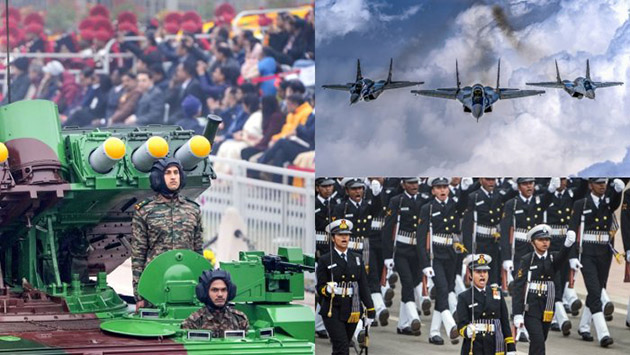
New Delhi, Jan 26: India's military prowess infused with a spirit of "aatmanirbharta" and diverse and vibrant cultural heritage were showcased on the Kartavya Path as the nation celebrated its 74th Republic Day on Thursday.

"Nari Shakti" was predominantly the theme of the celebrations with President Droupadi Murmu, Prime Minister Narendra Modi and a host of other dignitaries joining people and members of the armed forces in marking the august occasion.

Egypt's President Abdel Fattah al-Sisi was the chief guest at the ceremonial event.

A combined band and marching contingent of the Egyptian Armed Forces also took part in the parade that started around 10:30 am and ended close to noon after a fly-past.

The Egyptian contingent included 144 soldiers representing the main branches of the Egyptian Armed Forces and it was led by Col Mahmoud Mohamed Abdelfattah Elkharasawy.

The ceremony commenced with Prime Minister Modi visiting the National War Memorial and paying tributes to the fallen heroes by laying a wreath.

According to tradition, the national flag was unfurled followed by the national anthem with a booming 21-gun salute. However, the ceremonial salute this year was given with 105-mm Indian field guns, which replaced the vintage 25-pounder guns, reflecting upon the growing "aatmanirbharta" in defence.

Shallow fog lowered visibility at the Kartavya Path on Thursday as spectators strained their eyes to watch aerial manoeuvres by a battery of 50 aircraft that flew in different formations.

The military assets which were displayed during the parade included made-in-India equipment, showing the spirit of "aatmanirbhar bharat", officials said.

The main battle tank Arjun, the Nag Missile System (NAMIS) and the K-9 Vajra were also showcased.

All equipment from the Army which were part of the Republic Day celebrations are made-in-India, Chief of Staff Delhi Area Maj Gen Bhavnish Kumar had earlier said.

With 'Nari Shakti' being the theme, the Akash weapon system display had Lt Chetana Sharma at the forefront.

The marching contingents from the Army included one each from the mechanised infantry, the Dogra Regiment, the Punjab Regiment, the Maratha Light Infantry, the Bihar Regiment and the Gorkha Brigade. A camel band from the Border Security Force also took part in the parade.

The Republic Day celebrations were held on the revamped Central Vista avenue and was the first at the ceremonial boulevard after Rajpath was renamed to Kartavya Path last year.

Lt Commander Disha Amrith, a woman naval air operations official posted at a strategic base, led the Indian Navy's contingent of 144 young sailors.

The naval tableau, designed on the theme 'Indian Navy - Combat Ready, Credible, Cohesive and Future Proof', showcased the multi-dimensional capabilities of the force, "Nari Shakti" and key indigenously designed and built assets under "aatmanirbhar bharat", officials said.

The Defence Research and Development Organisation (DRDO) showcased one tableau and equipment. The theme of the tableau was "Securing Nation with Effective Surveillance, Communication and Neutralising Threats".

Indigenously-developed Wheeled Armoured Platform (WhAP), a modular 8X8 wheeled combat platform, carried on a 70-ton trailer was displayed by the DRDO.

Three Param Vir Chakra awardees and three Ashok Chkara awardees also took part in the parade, and a "veterans' tableau" with the theme -- "Towards India's Amrit Kaal with a Resolve of Veterans' Commitment" was also part of it.

The Indian Air Force contingent comprising 144 air warriors and four officers, was led by Sqn Ldr Sindhu Reddy. The air force tableau, designed on the theme "Indian Air Force Power Beyond Boundaries", displayed a rotating globe highlighting IAF's expanded reach, whereby it has been able to provide humanitarian assistance across borders, as also exercises conducted with friendly countries.

A group of "Shramyogis" involved in the construction of the Central Vista, the Kartavya Path, the new Parliament Building along with milk, vegetable and street vendors were specially invited for the parade.

A total of 23 tableaux - 17 from states and union territories and six from various ministries and departments -- depicting India's vibrant cultural heritage, economic and social progress took part in the ceremonial parade with 'Nari Shakti' as the theme for majority of the floats. 

Comments

Add new comment

  • Coastaldigest.com reserves the right to delete or block any comments.
  • Coastaldigset.com is not responsible for its readers’ comments.
  • Comments that are abusive, incendiary or irrelevant are strictly prohibited.
  • Please use a genuine email ID and provide your name to avoid reject.
News Network
February 1,2026

Bengaluru: Karnataka Deputy Chief Minister D K Shivakumar on Sunday criticised the Union Budget presented by Finance Minister Nirmala Sitharaman, claiming it offered no tangible benefit to the state.

Though he said he was yet to study the budget in detail, Shivakumar asserted that Karnataka had gained little from it. “There is no benefit for our state from the central budget. I was observing it. They have now named a programme after Mahatma Gandhi, after repealing the MGNREGA Act that was named after him,” he said.

Speaking to reporters here, the Deputy Chief Minister demanded the restoration of MGNREGA, and made it clear that the newly enacted rural employment scheme — VB-G RAM G — which proposes a 60:40 fund-sharing formula between the Centre and the states, would not be implemented in Karnataka.

“I don’t see any major share for our state in this budget,” he added.

Shivakumar, who also holds charge of Bengaluru development, said there were high expectations for the city from the Union Budget. “The Prime Minister calls Bengaluru a ‘global city’, but what has the Centre done for it?” he asked.

He also drew attention to the problems faced by sugar factories, particularly those in the cooperative sector, alleging a lack of timely decisions and support from the central government.

Noting that the Centre has the authority to fix the minimum support price (MSP) for agricultural produce, Shivakumar said the Union government must take concrete steps to protect farmers’ interests.

Comments

Add new comment

  • Coastaldigest.com reserves the right to delete or block any comments.
  • Coastaldigset.com is not responsible for its readers’ comments.
  • Comments that are abusive, incendiary or irrelevant are strictly prohibited.
  • Please use a genuine email ID and provide your name to avoid reject.
News Network
January 23,2026

Mangaluru: The Karnataka Government Polytechnic (KPT), Mangaluru, has achieved autonomous status from the All India Council for Technical Education (AICTE), becoming the first government polytechnic in the country to receive such recognition in its 78-year history. The status was granted by AICTE, New Delhi, and subsequently approved by the Karnataka Board of Technical Education in October last year.

Officials said the autonomy was conferred a few months ago. Until recently, AICTE extended autonomous status only to engineering colleges, excluding diploma institutions. However, with a renewed national focus on skill development, several government polytechnics across India have now been granted autonomy.

KPT, the second-largest polytechnic in Karnataka, was established in 1946 with four branches and has since expanded to offer eight diploma programmes, including computer science and polymer technology. The institution is spread across a 19-acre campus.

Ravindra M Keni, the first dean of the institution, told The Times of India that AICTE had proposed autonomous status for polytechnic institutions that are over 25 years old. “Many colleges applied. In the first round, 100 institutions were shortlisted, which was further narrowed down to 15 in the second round. We have already completed one semester after becoming an autonomous institution,” he said. He added that nearly 500 students are admitted annually across eight three-year diploma courses.

Explaining the factors that helped KPT secure autonomy, Keni said the institution has consistently recorded 100 per cent admissions and placements for its graduates. He also noted its strong performance in sports, with the college emerging champions for 12 consecutive years, along with active student participation in NCC and NSS activities.

Autonomous status allows KPT to design industry-oriented curricula, conduct examinations, prepare question papers, and manage academic documentation independently. The institution can also directly collaborate with industries and receive priority funding from AICTE or the Ministry of Education. While academic autonomy has been granted, financial control will continue to rest with the state government.

“There will be separate committees for examinations, question paper setting, boards of studies, and boards of examiners. The institution will now have the freedom to conduct admissions without government notifications and issue its own marks cards,” Keni said, adding that new academic initiatives would be planned after a year of functioning under the autonomous framework.

Comments

Add new comment

  • Coastaldigest.com reserves the right to delete or block any comments.
  • Coastaldigset.com is not responsible for its readers’ comments.
  • Comments that are abusive, incendiary or irrelevant are strictly prohibited.
  • Please use a genuine email ID and provide your name to avoid reject.
News Network
February 4,2026

shettigar.jpg

An Indian resident who won the Dh20 million (approximately Rs 50 crore) jackpot in Abu Dhabi's Big Ticket draw has told of his joy at sharing his life-changing fortune with a friend.

Shanthanu Shettigar, a shop manager in Muscat, regularly buys tickets for the monthly grand prize draw with one of his closest friends – and the pair won on February 3.

Mr Shettigar, 33, who is from Udyavar in Udupi district of the southern state of Karnataka and has lived in the Omani capital for eight years, said he was left speechless after learning of his success.

“When I first moved to Muscat, many of my colleagues were purchasing Big Ticket, which encouraged me to give it a try,” he said.

“I started buying tickets on my own, and later began sharing tickets with a close friend. The ticket that brought me this win was one we purchased together.”

“Like most people, I receive a lot of spam calls, and I was fully absorbed in my work as well. I knew the live draw was taking place tonight, but I never imagined my name would be announced,” he said.

“When I realised it was real and that I had won, I was honestly speechless. It still hasn’t fully sunk in, but I’m extremely happy.”

Mr Shettigar is not sure how he will spend his share of the money, but encouraged others to take part.

“This win was completely unexpected, so I want to take some time to think things through before deciding what to do next,” he said.

“I would definitely encourage others to participate with Big Ticket, whether with family or friends – you never know when your moment might come.”

The Big Ticket was established in 1992 with an initial first prize of Dh1 million. It is one of the most popular monthly raffles in the UAE.

It has transformed the lives of many people across the Emirates and beyond.

Entry to the Big Ticket Millionaire is Dh500. Tickets can be bought online or at counters at Zayed International Airport and Al Ain Airport.

Comments

Add new comment

  • Coastaldigest.com reserves the right to delete or block any comments.
  • Coastaldigset.com is not responsible for its readers’ comments.
  • Comments that are abusive, incendiary or irrelevant are strictly prohibited.
  • Please use a genuine email ID and provide your name to avoid reject.