



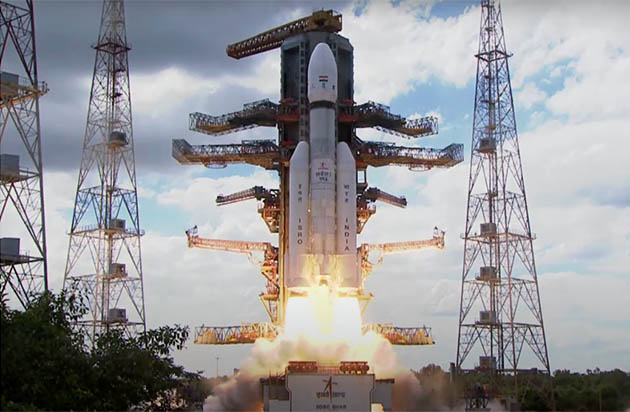
India’s Chandrayaan-3 blasts off to the moon from Sriharikota

News Network
July 14, 2023

chandrayan.jpg

New Delhi, July 14: India’s third unmanned lunar mission, Chandrayaan-3, aimed at exploring the south polar region of the moon, soared into the sky successfully at 2.35 pm on Friday as planned from the second launch pad of the Satish Dhawan Space Centre (SDSC) here. 
 
The precise goal is to make a soft and safe landing on the lunar surface, and if the mission is successful, India will only be the fourth country to have achieved the feat, joining the elite club of the US, Russia, and China. The south-polar region of the moon is of intense interest due to the presence of many permanently shadowed craters which could contain water ice and precious minerals. 
 
At the end of the 25-hour and 30-minute countdown, LVM3-M4, India’s largest and heaviest launch vehicle, LVM3-M4, lifted off at 2:35 pm with the 3,900-kg Chandrayaan-3 spacecraft, including the lander. Minutes later, it transferred the satellites into the Geo Transfer orbit as scientists, including ISRO Chairman S Somnath and his predecessors, were watching the launch from the Control Command Centre. 

Billed as a follow-up mission to Chandrayaan-2 which failed after the lander crash-landed on the moon 48 days later, Chandrayaan-3 will seek to demonstrate end-to-end landing and roving capabilities. The spacecraft will take about 40 days to make a soft landing on the lunar surface which is expected to be between August 23 and 24, eight days lesser than what the Chandrayaan-2 mission took. 
 
The success of Chandrayaan-3 will also help the ISRO fast-tracking its planned manned mission to the space, named Gaganyaan. 
 
The Chandrayaan-3 lander carrying a rover within it will be carried into an orbit around the moon by the propulsion module. A little later, the lander will separate from that module and will attempt to make a soft landing in the south polar region of the moon, which is of intense interest as it has many permanently shadowed craters which could contain water ice and precious minerals. 
 
India’s first unmanned mission, Chandrayaan-1, which took off on October 22, 2008, demonstrated the country’s ability to reach the surface of the moon and discover water on the lunar surface, while the Chandrayaan-2 mission’s aim was to make a soft landing on the moon. 
 
Learning lessons from the failure, the ISRO has made several significant modifications to Friday's mission with officials attributing the 2019 failure to malfunctioning of the onboard computer and propulsion system. 
 
This time around, the lander’s legs have been strengthened, a fifth engine has been removed to reduce the weight, and the landing area has been expanded from 500mx500m (in Chandrayaan-2) to 4kmx2.4 km area in Chandrayaan-3. Several special tests like Integrated Cold and Integrated Hot tests and Lander Leg mechanism performance tests have also been conducted to ensure the success of the mission, the officials added.
 
The Chandrayaan-3 mission is yet another attempt to achieve the goal with the help of a rover. The spacecraft, according to officials, will have four payloads which will study moon quakes, how the surface of the moon allows heat to flow through it, the plasma environment near the moon's surface, and enable scientists to measure the distance between Earth and moon “very accurately.”
 
The two rover payloads study composition of the moon’s surface using X-rays and LASER, while the propulsion module payload will explore the Spectro-polarimetric signatures of the habitable planet, Earth. The mission is divided into three phases -- Earth Centric, Lunar Transfer, and Moon Centric. 
 
The work on Chandrayaan-3 began just a few months after the failure of Chandrayaan-2, but the Covid-19 pandemic and the subsequent lockdown delayed ISRO’s plans. By demonstrating its capabilities to soft-land on the moon, the ISRO is also hoping to expand its business as it is already launching private satellites from Sriharikota.

Comments

Add new comment

  • Coastaldigest.com reserves the right to delete or block any comments.
  • Coastaldigset.com is not responsible for its readers’ comments.
  • Comments that are abusive, incendiary or irrelevant are strictly prohibited.
  • Please use a genuine email ID and provide your name to avoid reject.
News Network
February 4,2026

Mangaluru: Urban local bodies and gram panchayats should make the use of Kannada on signboards mandatory while issuing trade licences to commercial establishments, Dakshina Kannada Deputy Commissioner Darshan HV said. He also called for regular inspections to ensure compliance.

Presiding over the District Kannada Awareness Committee meeting at the deputy commissioner’s office, Darshan said the city corporation would be directed to ensure that shops operating in malls prominently display their names in Kannada. “All commercial establishments, including shops, companies, offices and hotels, must mandatorily display their names in Kannada on signboards,” he said.

The deputy commissioner added that the National Highways Authority of India (NHAI) would be instructed to include Kannada on signboards along national highways. Banks, he said, would be directed through committee meetings to provide application forms in Kannada.

“Even if English-medium schools and colleges impart education in English, their signboards must display the institution’s name in Kannada. Steps will also be taken to ensure that private buses display place names in Kannada,” Darshan said.

During the meeting, committee members raised concerns over the closure of Kannada-medium schools in rural areas due to a shortage of teachers and stressed the need for immediate corrective measures. They also pointed out that several industries employ workers from other states while overlooking local candidates.

Members further demanded that nationalised banks provide deposit and withdrawal slips in Kannada. It was brought to the deputy commissioner’s notice that the presence of staff without knowledge of Kannada in rural branches of nationalised banks is causing hardship to local customers.

Meanwhile, MP Srinath, president of the District Kannada Sahitya Parishat, urged the district administration to allot land for the construction of a district Kannada Bhavana in Mangaluru.

Comments

Add new comment

  • Coastaldigest.com reserves the right to delete or block any comments.
  • Coastaldigset.com is not responsible for its readers’ comments.
  • Comments that are abusive, incendiary or irrelevant are strictly prohibited.
  • Please use a genuine email ID and provide your name to avoid reject.
News Network
January 23,2026

Karnataka Governor Thaawarchand Gehlot read only three lines from the 122-paragraph address prepared by the Congress-led state government while addressing the joint session of the Legislature on Thursday, effectively bypassing large sections critical of the BJP-led Union government.

The omitted portions of the customary Governor’s address outlined what the state government described as a “suppressive situation in economic and policy matters” under India’s federal framework. The speech also sharply criticised the Centre’s move to replace the Mahatma Gandhi National Rural Employment Guarantee Act (MGNREGA) with the Viksit Bharat–Guarantee for Rozgar and Ajeevika Mission (Gramin) Act, commonly referred to as the VB-GRAM (G) Act.

Governor Gehlot had earlier conveyed his objection to several paragraphs that were explicitly critical of the Union government. On Thursday, he confined himself to the opening lines — “I extend a warm welcome to all of you to the joint session of the State legislature. I am extremely pleased to address this august House” — before jumping directly to the concluding sentence of the final paragraph.

He ended the address by reading the last line of paragraph 122: “Overall, my government is firmly committed to doubling the pace of the State’s economic, social and physical development. Jai Hind — Jai Karnataka.”

According to the prepared speech, the Karnataka government demanded the scrapping of the VB-GRAM (G) Act, describing it as “contractor-centric” and detrimental to rural livelihoods, and called for the full restoration of MGNREGA. The state government argued that the new law undermines decentralisation, weakens labour protections, and centralises decision-making in violation of constitutional norms.

Key points from the unread sections of the speech:

•    Karnataka facing a “suppressive” economic and policy environment within the federal system

•    Repeal of MGNREGA described as a blow to rural livelihoods

•    VB-GRAM (G) Act accused of protecting corporate and contractor interests

•    New law alleged to weaken decentralised governance

•    Decision-making said to be imposed by the Centre without consulting states

•    Rights of Adivasis, women, backward classes and agrarian communities curtailed

•    Labourers allegedly placed under contractor control

•    States facing mounting fiscal stress due to central policies

•    VB-GRAM (G) Act accused of enabling large-scale corruption

Comments

Add new comment

  • Coastaldigest.com reserves the right to delete or block any comments.
  • Coastaldigset.com is not responsible for its readers’ comments.
  • Comments that are abusive, incendiary or irrelevant are strictly prohibited.
  • Please use a genuine email ID and provide your name to avoid reject.
News Network
January 23,2026

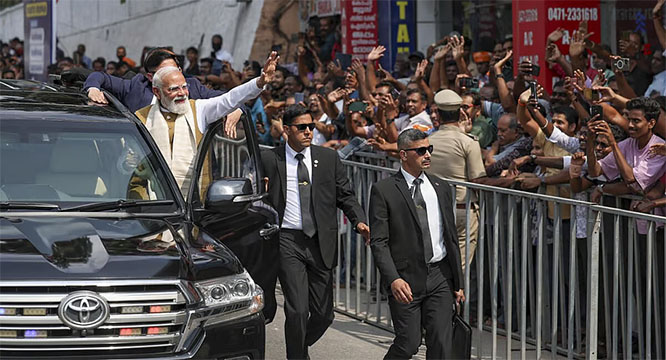
modIKERALA.jpg

Prime Minister Narendra Modi, during his visit to Thiruvananthapuram on Friday, January 23, indicated that the Bharatiya Janata Party (BJP) is aiming to expand its political footprint in Kerala ahead of the Assembly elections scheduled in the coming months.

Speaking at a BJP-organised public meeting, Modi drew parallels between the party’s early electoral gains in Gujarat and its recent victory in the Thiruvananthapuram Municipal Corporation. The civic body win, which ended decades of Left control, was cited by the Prime Minister as a possible starting point for the party’s broader ambitions in the state.

Recalling BJP’s political trajectory in Gujarat, Modi said the party was largely insignificant before 1987 and received little media attention. He pointed out that the BJP’s first major breakthrough came with its victory in the Ahmedabad Municipal Corporation that year.

“Just as our journey in Gujarat began with one city, Kerala’s journey has also started with a single city,” Modi said, suggesting that the party’s municipal-level success could translate into wider electoral acceptance.

The Prime Minister alleged that successive governments led by the Left Democratic Front (LDF) and the United Democratic Front (UDF) had failed to adequately develop Thiruvananthapuram. He accused both fronts of corruption and neglect, claiming that basic infrastructure and facilities were denied to the capital city for decades.

According to Modi, the BJP’s control of the civic body represents a shift driven by public dissatisfaction with the existing political alternatives. He asserted that the BJP administration in Thiruvananthapuram had begun working towards development, though no specific details or timelines were outlined.

Addressing the gathering at Putharikandam Maidan, Modi said the BJP intended to project Thiruvananthapuram as a “model city,” reiterating his party’s commitment to governance-led change.

The Prime Minister’s visit to Kerala also included the inauguration of several development projects and the flagging off of new train services, as the BJP intensifies its political outreach in the poll-bound state.

Comments

Add new comment

  • Coastaldigest.com reserves the right to delete or block any comments.
  • Coastaldigset.com is not responsible for its readers’ comments.
  • Comments that are abusive, incendiary or irrelevant are strictly prohibited.
  • Please use a genuine email ID and provide your name to avoid reject.