Military might, women power on full display at India’s 75th Republic Day Parade

News Network
January 26, 2024

narishakti.jpg

New Delhi: India ushered in its 75th Republic Day on Friday with a grand display of its women power and military might that included elite marching contingents, missiles, warplanes, surveillance gadgets and lethal weapon systems, with French President Emmanuel Macron gracing the occasion as the chief guest.

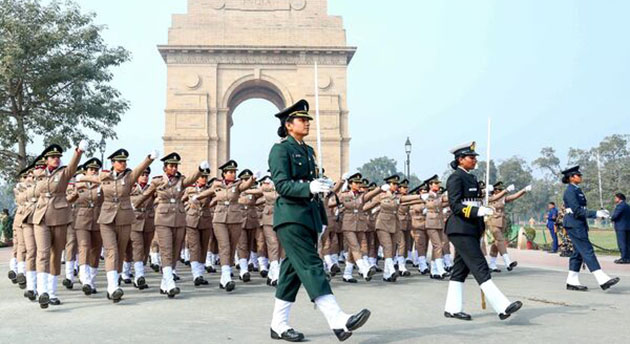
For the first time, an all-women tri-services contingent marched down the Kartavya Path, reflecting the country's growing 'Nari Shakti' (women power).

In another first, the parade was heralded by over 100 women artistes playing Indian musical instruments such as sankh, naadswaram and nagada instead of traditional military bands kickstarting the celebrations.

The parade commenced with President Droupadi Murmu taking the salute shortly after she and Macron, flanked by the Indian president's bodyguards, arrived at the Kartavya Path in a 'traditional buggy'.

Prime Minister Narendra Modi, Defence Minister Rajnath Singh, several other Union ministers, the country's top military brass, foreign diplomats and senior officials were among the spectators at the biggest event on Kartavya Path, the centrepiece boulevard of the national capital.

The first Army contingent leading the mechanised column was the 61 Cavalry which was raised in 1953. It was followed by 11 mechanised columns, 12 marching contingents and a fly-past by advanced light helicopters of the Army Aviation Corps.

Tank T-90 Bhishma, NAG missile systems, infantry combat vehicles, all-terrain vehicles, weapon locating radar system 'Swathi', drone jammer system, and medium-range surface-to-air missile were among the key displays by the mechanised columns.

The all-women tri-service contingent, led by Captain Sandhya of Army Military Police, with three supernumerary officers Captain Sharanya Rao, Sub Lieutenant Anshu Yadav and Flight Lieutenant Shrishti Rao drew huge applause.

Another all-women Armed Forces Medical Services contingent, headed by Major Srishti Khullar with Captain Amba Samant of the Army Dental Corps, Surgeon Lieutenant Kanchana of the Indian Navy and Flight Lieutenant Dhivya Priya of the Indian Air Force also marched down the ceremonial boulevard.

The Army's marching contingents included the Madras Regiment, the Grenadiers, the Rajputana Rifles, the Sikh Regiment and the Kumaon Regiment.

The Indian Navy's contingent consisted of 144 men and women Agniveers, led by Lt Prajwal M as contingent commander and Lt Mudita Goyal, Lt Sharvani Supreiya and Lt Devika H as platoon commanders.

It was followed by a naval tableau, depicting the themes 'Nari Shakti' and 'Sea Power Across the Oceans Through Indigenisation'.

The first part of the tableau showcased the women in the Indian Navy in all roles and ranks, while the second part depicted the very first indigenous Carrier Battle Group, comprising aircraft carrier INS Vikrant, her highly capable escort ships Delhi, Kolkata and Shivalik and the Kalvari class submarine and Rukmani satellite among others.

The Indian Air Force contingent comprised 144 airmen and four officers, and it was led by Squadron Leader Rashmi Thakur. Squadron Leaders Sumita Yadav and Pratiti Ahluwalia and Flight Lieutenant Kirti Rohil were the supernumerary officers.

The IAF tableau was themed 'Bharatiya Vayu Sena: Saksham, Sashakt, Aatmanirbhar'.

The tableau depicted LCA Tejas and Su-30 flying over the Indian Ocean Region and a C-295 transport aircraft being flown by women aircrew in the cockpit.

The GSAT-7A positioned on the tableau represented the IAF's incorporation of space technology in its operations.

The tableau showed that IAF has been at the forefront of rendering humanitarian aid, both within and across borders.

Another highlight of the parade was the veterans' tableau on the theme 'Rashtra Nirmaan: Pehle Bhi, Ab Bhi, Aage Bhi aur Hamesha'. It showcased the bravery and sacrifices of the ex-servicemen towards the nation.

In its tableau, the Defence Research and Development Organisation (DRDO) displayed many home-grown critical systems and technologies developed by it.

The tableau was based on the theme of women power in protecting the nation by providing the defence shield in all the five domains of land, air, sea, cyber and space.

Outstanding scientist Sunita Devi Jena was the contingent commander, with P Laxmi Madhavi, J Sujana Choudhary and A Bhuvaneswari also present on the tableau.

The tableau displayed a man-portable anti-tank guided missile, anti-satellite missile, Agni-5, surface-to-surface ballistic missile, very short range air defence system, naval anti-ship missile'“short range (NASM-SR) and anti-tank guided missile 'HELINA'.

Quick reaction surface-to-air missile (QRSAM), Astra, Light Combat Aircraft 'Tejas', Uttam active electronically scanned array radar (AESAR), advanced electronic warfare system and Shakti Cyber Security systems were also on display.

The themes of the celebrations were -- 'Viksit Bharat' and 'Bharat -- Loktantra Ki Matruka' (India--Mother of Democracy). A 95-member marching contingent and a 30-member band contingent from France also took part in the parade.

Two Rafale fighters and an Airbus A330 multi-role tanker transport aircraft of the French air force also featured in the celebrations.

The celebrations ended with a jaw-dropping flypast by 46 aircraft of the Indian Air Force.

The IAF fleet included 29 fighter jets, seven transport aircraft, nine helicopters and one heritage plane. All these aircraft operated from six different bases.

Fifteen women pilots, including six from the fighter streams, operated the IAF platforms during the fly-past.

For the first time, indigenously-built Tejas aircraft flew in a formation of four aircraft.

There was a previous occasion of one Tejas jet being part of the Republic Day parade but this was the first time that the aircraft flew in a formation.


Comments

Add new comment

  • Coastaldigest.com reserves the right to delete or block any comments.
  • Coastaldigset.com is not responsible for its readers’ comments.
  • Comments that are abusive, incendiary or irrelevant are strictly prohibited.
  • Please use a genuine email ID and provide your name to avoid reject.
News Network
December 4,2025

Mangaluru: Chaos erupted at Mangaluru International Airport (MIA) after IndiGo flight 6E 5150, bound for Mumbai, was repeatedly delayed and ultimately cancelled, leaving around 100 passengers stranded overnight. The incident highlights the ongoing country-wide operational disruptions affecting the airline, largely due to the implementation of new Flight Duty Time Limitations (FDTL) norms for crew.

The flight was initially scheduled for 9:25 PM on Tuesday but was first postponed to 11:40 PM, then midnight, before being cancelled around 3:00 AM. Passengers expressed frustration over last-minute communication and the lack of clarity, with elderly and ailing travellers particularly affected. “Though the airline arranged food, there was no proper communication, leaving us confused,” said one family member.

An IndiGo executive at MIA cited the FDTL rules, designed to prevent pilot fatigue by limiting crew working hours, as the cause of the cancellation. While alternative arrangements, including hotel stays, were offered, about 100 passengers chose to remain at the airport, creating tension. A replacement flight was arranged but also faced delays due to the same constraints, finally departing for Mumbai around 1:45 PM on Wednesday. Passengers either flew, requested refunds, or postponed their travel.

The Mangaluru delay is part of a broader crisis for IndiGo. The airline has been forced to make “calibrated schedule adjustments”—a euphemism for widespread cancellations and delays—after stricter FDTL norms came into effect on November 1.

While an IndiGo spokesperson acknowledged unavoidable flight disruptions due to technology issues, operational requirements, and the updated crew rostering rules, the DGCA has intervened, summoning senior airline officials to explain the chaos and outline corrective measures.

The ripple effect has been felt across the country, with major hubs like Bengaluru and Mumbai reporting numerous cancellations. The Mangaluru incident underscores the systemic operational strain currently confronting India’s largest carrier, leaving passengers nationwide grappling with uncertainty and delays.

Comments

Add new comment

  • Coastaldigest.com reserves the right to delete or block any comments.
  • Coastaldigset.com is not responsible for its readers’ comments.
  • Comments that are abusive, incendiary or irrelevant are strictly prohibited.
  • Please use a genuine email ID and provide your name to avoid reject.
News Network
November 22,2025

The Karnataka government has announced a 50% rebate on pending traffic and transport fines. The discount is available from November 21 to December 12.

The rebate applies to all traffic e-challans and violation cases booked by the RTO between 1991–92 and 2019–20. Officials clarified that the offer is not applicable to pending tax dues and is restricted only to traffic-violation fines.

Across Karnataka, more than 4 lakh RTO cases remain pending, including those involving transport vehicles. While thousands of vehicle owners have already cleared their dues, the department expects to generate substantial revenue through this limited-period rebate.

How to Pay and Avail the Discount

There are three ways to check and pay your pending fines:

1. Through Mobile Apps
Available on both Play Store and App Store:
•    Karnataka State Police (KSP) app
•    KarnatakaOne app
•    ASTraM app

Steps:
•    Enter your vehicle number in any of the above apps
•    Verify the photo/details of your vehicle
•    Pay the fine with the 50% discount applied

2. Visit a Traffic Police Station

You can pay your pending fine at any nearby traffic police station.

3. Visit the Traffic Management Centre (TMC)

•    Location: First Floor, Infantry Road, near Indian Express, Bengaluru

Transport Commissioner Yogeesh A M said, “We don't issue e-challans, so there's no online payment system.”

The department estimates ₹52 crore in pending RTO fines up to March 2020. “With the 50% rebate, we expect to collect around ₹25 crore if all dues are cleared,” he added.

Comments

Add new comment

  • Coastaldigest.com reserves the right to delete or block any comments.
  • Coastaldigset.com is not responsible for its readers’ comments.
  • Comments that are abusive, incendiary or irrelevant are strictly prohibited.
  • Please use a genuine email ID and provide your name to avoid reject.
News Network
December 2,2025

A major upgrade in safety and monitoring is planned for Haj 2026, with every Indian pilgrim set to receive a Haj Suvidha smart wristband linked to the official Haj Suvidha mobile app. The initiative aims to support pilgrims—especially senior citizens—who may struggle with smartphones during the 45-day journey.

What the Smart Wristband Will Do

Officials said the device will come with:
•    Location tracking
•    Pedometer
•    SOS emergency button
•    Qibla compass
•    Prayer timings
•    Basic health monitoring

SP Tiwari, secretary of the UP State Haj Committee, said the goal is to make the pilgrimage safer and more comfortable.

“Most Hajis are elderly and not comfortable with mobile apps,” he said. “The smartwatch will help locate pilgrims who forget their way or cannot communicate their location.”

The wristbands will be monitored by the Consulate General of India in Saudi Arabia, similar to mobile tracking via the Haj Suvidha App.

Free Distribution and Training

•    Smart wristbands will be given free of cost.
•    Training for pilgrims will be conducted between January and February 2026.
•    Sample units will reach state Haj committees soon.
•    Final devices will be distributed as pilgrims begin their journey.

New Rules for Accommodation

Two major decisions have also been finalised for Haj 2026:
1.    Separate rooms for men and women – including married couples. They may stay on the same floor but must occupy different rooms, following stricter Saudi guidelines.
2.    Cooking banned – gas cylinders will not be allowed; all meals will be provided through official catering services arranged by the Haj Committee of India.

These decisions were finalised during a meeting of the Haj Committee of India and state representatives in Mumbai.

Haj Suvidha App Launched Earlier

The government launched the Haj Suvidha App in 2024, offering:

•    Training modules
•    Accommodation and flight details
•    Baggage information
•    SOS and translation tools
•    Grievance redressal

Haj 2026 Quota and Key States

•    India’s total Haj quota for 2026: 1,75,025 pilgrims
•    70% (1,25,000) allotted to the Haj Committee of India
•    30% (around 50,000) reserved for Haj Group Organisers

Uttar Pradesh has the largest allocation (around 30,000 seats), though approximately 18,000 pilgrims are expected to go this year. States with high pilgrim numbers include Kerala, Maharashtra and Gujarat.

Dates of Haj 2026

The pilgrimage is scheduled to take place from 24 May to 29 May, 2026 (tentative).
Haj is one of the five pillars of Islam and is mandatory for Muslims who meet the required conditions.

Comments

Add new comment

  • Coastaldigest.com reserves the right to delete or block any comments.
  • Coastaldigset.com is not responsible for its readers’ comments.
  • Comments that are abusive, incendiary or irrelevant are strictly prohibited.
  • Please use a genuine email ID and provide your name to avoid reject.