No written exams till class 2, assessment should not cause burden for children: Draft NCF

News Network
April 7, 2023

students.jpg

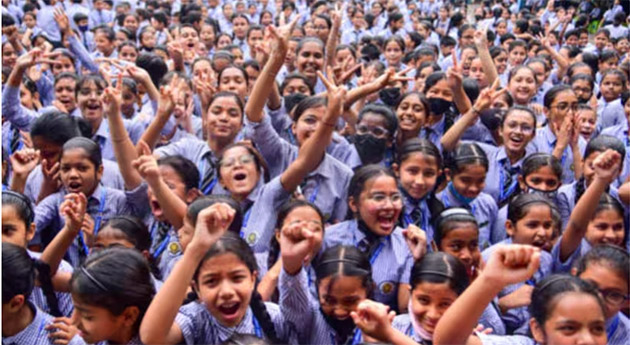
New Delhi, Apr 7: Explicit tests and exams are completely inappropriate assessment tools for children up to class 2 and written tests should be introduced from class 3 onwards, the draft National Curriculum Framework (NCF) has recommended stressing that assessment methods should be such that they do not contribute to any additional burden for the child.

The framework which is being developed along the lines of the new National Education Policy (NEP) suggests that two important methods of assessment that are appropriate for the foundational stage are observations of the child and analysing of artefacts that the child has produced as part of their learning experience.

The draft notes that explicit tests and examinations are completely inappropriate assessment tools for the Foundational stage (preschool to class 2).

"Assessment should allow for diversity among children and in their learning. Children learn differently and express their learning differently too. There might be many ways to assess the achievement of a learning outcome or competency. The teacher should have the ability to design different kinds of assessments for the same learning outcome and use each assessment appropriately.

"Assessment should enable recording and documentation. Children's progress should be described and analysed through the systematic collection of evidence. Assessment should not contribute to any additional burden for the child. Assessment tools and processes should be designed such that they are a natural extension of the learning experience for the child," it adds.

Describing the assessment for the preparatory stage (class 3 to 5), the draft recommends that "written tests should be introduced at this stage".

"A variety of assessment methods should be used to promote learning. Portfolios can be used to capture student progress holistically through their work. This could also provide a reliable picture of their learning to parents. Peer and self-assessments could also be introduced to help students monitor the trajectory of their own learning.

"At the end of the preparatory stage, there should be a comprehensive summative assessment of the student's readiness to enter the middle stage where several new curricular areas are introduced," it adds.

The education ministry released a "pre-draft" of the NCF for school education on Thursday and invited suggestions from stakeholders such as students, parents, teachers and scholars.

The draft prepared by a panel headed by K Kasturirangan, former ISRO chief, suggests that at the middle stage (class 6 to 8), the focus of the curriculum should move to conceptual understanding and higher-order capacities.

"Therefore, classroom assessment techniques such as projects, debates, presentations, experiments, investigations, role plays, journals and portfolios should be used to assess learning. Regular summative assessments at this stage will help students synthesize their learning at logical intervals such as year-end, term-end, unit-end. Summative assessments comprising multiple-choice questions and constructed responses like short and long answers may be used periodically," it says.

In the secondary stage (class 9 to 12), the panel has asserted that comprehensive classroom assessments should be effectively practised for facilitating meaningful learning and constructive feedback. Regular summative assessments should be conducted for recording students learning against competencies.

"Self-assessment will play a key role in student learning at this stage. Students should be facilitated to monitor what they are learning and use the feedback from this monitoring to adjust, adapt, and decide their own strategies for learning.

"Summative assessments can be designed using case-based questions, simulations, and essay-type questions to enable assessment of competencies. At this stage, students should also be prepared to undertake the board examinations and other selection tests to gain access to higher education and livelihood opportunities," the draft adds.

According to ministry officials, the textbooks as per the new NCF will be introduced from next year.

The Education Ministry has designed four NCFs based on the 5+3+3+4 ‘curricular and pedagogical’ structure that NEP 2020 has recommended for school education.

The ministry launched the NCF for the foundational stage (NCF-FS) for children between ages 3-8 years in October 2022. In continuation of that policy, the next NCF for school education is being prepared.

Revamping class 10 and 12 board exams, aligning the shift from 10+2 structure to 5+3+3+4 structure and emphasis on developmental perspectives suggesting curricular and pedagogical shifts at different stages - foundational, preparatory, middle and secondary - are among the recommendations made in the pre-draft.

The NCF has been revised four times - in 1975, 1988, 2000 and 2005. The new proposed revision will be the fifth of the framework.

 

Comments

Add new comment

  • Coastaldigest.com reserves the right to delete or block any comments.
  • Coastaldigset.com is not responsible for its readers’ comments.
  • Comments that are abusive, incendiary or irrelevant are strictly prohibited.
  • Please use a genuine email ID and provide your name to avoid reject.
News Network
November 21,2025

Tejas.jpg

An Indian Air Force (IAF) Tejas fighter jet crashed on Friday, November 21, afternoon during its aerial demonstration at the Dubai Air Show, plunging to the ground at around 2:10 pm local time while performing a manoeuvre before thousands of spectators.

The IAF confirmed the incident, stating that a Tejas aircraft participating in the show had crashed and that further details were being gathered. An Air Force spokesperson said more information would be shared after initial assessments.

The crash sent thick black smoke billowing into the sky near the airport, causing panic among visitors, including families and children who had gathered to watch the display. Authorities have not yet confirmed whether the pilot managed to eject before the aircraft went down. Emergency response teams rushed to the scene, and officials have not released information on casualties or damage so far.

The Tejas is a 4.5-generation, multi-role fighter aircraft developed indigenously by Hindustan Aeronautics Limited (HAL). Designed for versatility, it is capable of offensive air support, close combat, ground attack missions and maritime operations. The aircraft family includes single-seat fighters and twin-seat trainers for both the Air Force and Navy.

HAL describes the latest version, the LCA Mk1A, as the most advanced in the series, featuring an AESA radar, an upgraded electronic warfare suite with radar-warning and self-protection jamming, smart multifunction displays, a digital map generator, a combined interrogator–transponder system and a modern radio altimeter. These enhancements significantly improve the aircraft’s combat capability and survivability.

Further updates from IAF and UAE authorities are awaited.

Comments

Add new comment

  • Coastaldigest.com reserves the right to delete or block any comments.
  • Coastaldigset.com is not responsible for its readers’ comments.
  • Comments that are abusive, incendiary or irrelevant are strictly prohibited.
  • Please use a genuine email ID and provide your name to avoid reject.
News Network
November 30,2025

airportmetro.jpg

Udupi: The pontiffs of Sri Paryaya Puttige Mutt, the sacred seat of Jagadguru Shrimad Madhvacharya Moola Samsthanam, have submitted a proposal to the Prime Minister seeking comprehensive development for Udupi district. 

Proposal for International Airport

A key request is the establishment of an international airport. Highlighting that around 1,000 acres of land are available and suitable, the pontiffs noted that the existing Mangalore Airport provides limited international connectivity. They suggested the airport be developed under a Public-Private Partnership (PPP) or as a Greenfield Airport to boost trade, education, healthcare, and spiritual tourism.

Metro and Rapid Transit Connectivity

The proposal also calls for Metro Rail or Rapid Transit between Mangaluru and Udupi. The 55 km coastal stretch experiences heavy daily commuter traffic, causing congestion. The district administration is ready to prepare an initial project report for a Mass Rapid Transit corridor and requested inclusion under national urban mobility programmes to ensure safe, green, and time-efficient regional transport.

Port and Coastal Development

The pontiffs urged the development of an international-standard port with a cruise terminal along Udupi’s coast. They also requested fast-tracking of pending coastal tourism projects and revising Coastal Regulation Zone (CRZ) norms to encourage sustainable infrastructure and hospitality investment.

IT, AI and Technological Infrastructure

Support was sought for an IT and AI Innovation Park with incubation facilities under Digital India and Startup India initiatives. The proposal also emphasized the need for strengthened data security and cloud computing infrastructure to boost India’s technological independence.

Sports and Education Initiatives

The pontiffs requested national sports status for Kambala, along with financial and infrastructure support. They also sought the establishment of an AIIMS in Udupi, a new IIT campus, and approval for an IIM to promote higher education in the district.

Representation to the Prime Minister

Sri Sugunendra Tirtha Pontiff and Sri Sushrendra Tirtha Swamiji represented the pontiffs in submitting the comprehensive development proposal to the Prime Minister during his recent visit.

Comments

Add new comment

  • Coastaldigest.com reserves the right to delete or block any comments.
  • Coastaldigset.com is not responsible for its readers’ comments.
  • Comments that are abusive, incendiary or irrelevant are strictly prohibited.
  • Please use a genuine email ID and provide your name to avoid reject.
Agencies
November 22,2025

indiapak.jpg

New York/Washington: US President Donald Trump has again claimed to have solved the conflict between India and Pakistan, repeating his assertion during a meeting with New York City Mayor-elect Zohran Mamdani in the Oval Office.

Mamdani flew to Washington DC for his first meeting with Trump in the White House on Friday. Trump said he “enjoyed” the meeting, which he described as “great.”

During remarks in the Oval Office, with Mamdani standing next to him, Trump repeated his claim that he solved the May conflict between India and Pakistan.

"I did eight peace deals of countries, including India and Pakistan,” he said.

On Wednesday, Trump had said he threatened to put 350 per cent tariffs on India and Pakistan if they did not end their conflict, repeating his claim that he solved the fighting between the nuclear-armed neighbours and that Prime Minister Narendra Modi had called him to say “we're not going to go to war.”

Since May 10, when Trump announced on social media that India and Pakistan had agreed to a “full and immediate” ceasefire after a “long night” of talks mediated by Washington, he has repeated his claim over 60 times that he “helped settle” the tensions between India and Pakistan.

India has consistently denied any third-party intervention. India launched Operation Sindoor on May 7, targeting terror infrastructure in Pakistan and Pakistan-occupied Kashmir in retaliation for the April 22 Pahalgam attack that killed 26 civilians. India and Pakistan reached an understanding on May 10 to end the conflict after four days of intense cross-border drone and missile strikes.

Mamdani emerged victorious in the closely-watched battle for New York City Mayor, becoming the first South Asian and Muslim to be elected to sit at the helm of the largest city in the US.

He had been the front-runner in the NYC Mayoral election for months and defeated Republican nominee Curtis Sliwa and political heavyweight former New York State Governor Andrew Cuomo, who ran as an independent candidate and was officially endorsed by Trump just hours before the elections.

Indian-descent Mamdani is the son of renowned filmmaker Mira Nair and Columbia University professor Mahmood Mamdani. He was born and raised in Kampala, Uganda and moved to New York City with his family when he was 7. Mamdani became a naturalised US citizen only recently, in 2018.

Comments

Add new comment

  • Coastaldigest.com reserves the right to delete or block any comments.
  • Coastaldigset.com is not responsible for its readers’ comments.
  • Comments that are abusive, incendiary or irrelevant are strictly prohibited.
  • Please use a genuine email ID and provide your name to avoid reject.