Rescue operations completed a day after deadly Odisha train accident as toll rises to 288

News Network
June 3, 2023

train.jpg

Kolkata, June 3: The death toll in the disastrous railway accident in Odisha has risen to 288 and rescue operations at the site have been completed, a South Eastern Railway official said on Saturday.

The railway ministry has declared that total number of casualties now stands at 1091 including deaths, grievous injuries and simple injuries.

An enquiry into the accident will be held by the commissioner of railway safety (CRS), South Eastern circle, the official said.

The train crash, one of the deadliest in the country, took place in Balasore district about 250 km south of Kolkata and 170 km north of Bhubaneswar around 7 pm on Friday, prompting the Railway Ministry to order a probe. 

Three trains - the Bengaluru-Howrah Superfast Express, Shalimar-Chennai Central Coromandel Express and a goods train were involved in the accident. 

The inquiry into the train accident will be led by A M Chowdhary, Commissioner Railway Safety, South East Circle, the Indian Railways said in a statement. The Commissioner Railway Safety comes under the Ministry of Civil Aviation.

While it is not clear what caused the crash, sources indicate a possible signalling failure.

Several coaches of the 12864 Bengaluru-Howrah Superfast Express, on the way to Howrah, derailed and fell on adjacent tracks, an official said.

"These derailed coaches collided with the 12841 Shalimar-Chennai Central Coromandel Express and its coaches capsized too," he said.

A goods train was also involved in the accident as some of the coaches of the Coromandel Express, which was heading to Chennai, hit its wagons after getting derailed, he added.

Railway Spokesperson Amitabh Sharma told PTI Video that the Coromandel Express derailed first, and its 10-12 coaches fell on the line on which the Bengaluru-Howrah Express was travelling, forcing it to jump off the tracks.

The differing versions of the accident could not be immediately reconciled.

The opposition while expressing condolences at the deaths which occurred in one of India's worst train dissters, also lashed out at the government.

"Government concentrates only on luxury trains. Trains and tracks of common people are neglected. Orissa deaths are the result of it. Rail minister should resign," CPI MP Binoy Viswam said in a tweet.

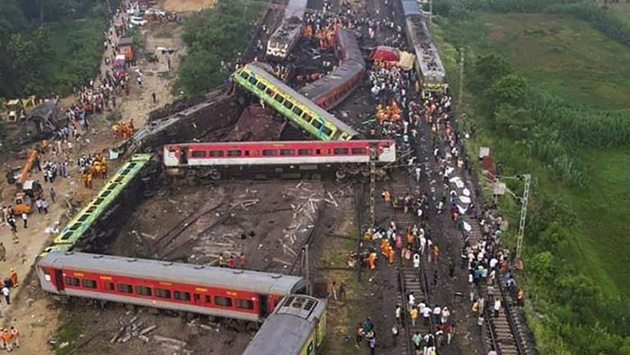
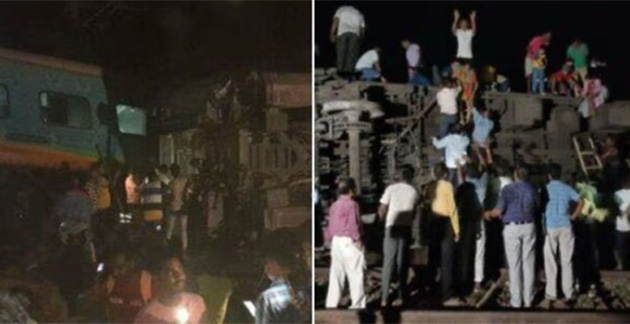
 Gas cutters were used to extricate the bodies from under the derailed coaches. Disaster management personnel and firemen were busy at work trying to extricate bodies as dawn broke on this tiny way station on the east coast railway line.

From a nearby hill the accident site looked like as if a powerful whirlwind had thrown train coaches on top of each other, in a haphazard "wrathful" manner.

Closer to the ground mangled steel and bloodied and disfigured bodies lay enmeshed with each other creating a grotesque sight.

"Some of the scenes at the site were too gory to describe," said a passenger.

Railway tracks were almost destroyed at the spot as mangled coaches lay strewn all over, with some having mounted on another, while a few coaches turned turtle due to the impact.

Pijush Poddar, a resident of Berhampore in West Bengal's Murshidabad district, was travelling to Tamil Nadu in the Coromandel Express to join work there when the accident happened.

"We were jolted and suddenly saw the train bogie turn on one side. Many of us were thrown out of the compartment by the momentum of the derailment. When we managed to crawl out, we found bodies lying all around," he said.

Locals said they heard consecutive loud sounds, following which they rushed to the spot and found the derailed coaches, which were nothing but "a mangled heap of steel".

"The local people really went out on a limb to help us... They not only helped in pulling out people but retrieved our luggage and got us water, " Rupam Banerjee, one of the passengers, told reporters.

One of the coaches “was pushed into the ground " as another from a neighbouring train collapsed on top of it, passengers said.

Work is on to try and extricate that particular bogie and retrieve the dead in it. "This will push up the deth toll significantly," a state disaster relief officer said.

Balasore district hospital looked like a war zone with the injured lying on stretchers in the corridor and rooms bursting at its seams with extra beds propped up.

Harried medical staff were seen trying to bring succour to patients many of whom are from states other than Odisha and had difficulties in communicating. In all some 526 railway accident victims have been admitted to this one single hospital.

Policemen and locals have been volunteering to donate blood at this and many hospitals through the night, said officials. More than 2,000 people gathered at the Balasore Medical College and Hospital in the night to help the injured, and many also donated blood, officials said.

The morgue at the hospital was a pile of white shrouded bodies, many of them yet to be identified as relatives are yet to make their way to the town with many train services cancelled or delayed due to the accident on a major railway trunk route.

Odisha Chief Minister Naveen Patnaik declared one-day state mourning on Saturday in the wake of the deadly triple train crash.

State Special Relief Commissioner Satyabrata Sahoo said those injured in the accident were undergoing treatment in different hospitals.

All government and private hospitals in the nearby districts, including the AIIMS at Bhubaneswar are being used.

Railway Minister Ashwini Vaishnaw reached the site in the morning as did Odisha chief minister Naveen Patnaik.

The railways announced an ex-gratia of Rs 10 lakh for the next of kin of the deceased, Rs 2 lakh for those grievously injured and Rs 50,000 for those who got minor injuries.
Prime Minister Narendra Modi too expressed his distress over the accident, and announced an additional ex-gratia of Rs 2 lakh for the next of kin of the deceased and Rs 50,000 for the injured from the PM's National Relief Fund (PMNRF).

"Distressed by the train accident in Odisha. In this hour of grief, my thoughts are with the bereaved families. May the injured recover soon. Spoke to Railway Minister @AshwiniVaishnaw and took stock of the situation. Rescue ops are underway at the site of the mishap and all possible assistance is being given to those affected," he tweeted.

The Odisha government issued helpline 06782-262286. The railway helplines are 033-26382217 (Howrah), 8972073925 (Kharagpur), 8249591559 (Balasore) and 044- 25330952 (Chennai). Expressing concern over the accident, in which a large number of people from West Bengal were involved, Chief Minister Mamata Banerjee said she was monitoring the situation along with the chief secretary and other officials.

West Bengal Chief Secretary HK Dwivedi said the state was sending a team led by minister Manas Bhunia and MP Dola Sen to the spot.

So far, 18 long-distance trains have been cancelled due to the accident, which happened on the Howrah-Chennai main line in the Kharagpur division of the South Eastern Railway. 
train.jpg

Comments

Add new comment

  • Coastaldigest.com reserves the right to delete or block any comments.
  • Coastaldigset.com is not responsible for its readers’ comments.
  • Comments that are abusive, incendiary or irrelevant are strictly prohibited.
  • Please use a genuine email ID and provide your name to avoid reject.
News Network
February 1,2026

Bengaluru, Feb 1: For travelers landing at Kempegowda International Airport (KIA), the sleek, wood-paneled curves of Terminal 2 promise a world-class welcome. But the famed “Garden City” charm quickly withers at the curb. As India’s aviation sector swells to record numbers—handling over 43 million passengers in Bengaluru alone this past year—the “last mile” has turned into a marathon of frustration.

The Bengaluru Logjam: Rules vs Reality

While the city awaits the 2027 completion of the Namma Metro Blue Line, the interim has been chaotic. Recent “decongestion” rules at Terminal 1 have pushed app-based cab pickups to distant parking zones, forcing weary passengers into a 20-minute walk with luggage.

“I landed after ten months away and felt like a stranger in my own city,” says Ruchitha Jain, a Koramangala resident. “My driver couldn’t find me, staff couldn’t guide me, and the so-called ‘Premium’ lane is just a fancy tax on convenience.”

•    The Cost of Distance: A 40-km cab ride can now easily cross ₹1,500, driven by demand pricing and airport surcharges.

•    The Bus Gap: While Vayu Vajra remains a lifeline, its ₹300–₹400 fare is often cited as the most expensive airport bus service in the country.

A National Pattern of Disconnect

The struggle is not unique to Karnataka. From Chennai’s coast to Hyderabad’s plateau, India’s airports tell a familiar story: brilliant runways, broken exits.

City:    Primary Issue   |    Recent Development

Bengaluru:    Cab pickup restrictions & distance  |    App-based taxis shifted to far parking zones; long walks and fare spikes reported

Chennai:    Multi-Level Parking (MLCP) hike  |    Passengers report 40-minute walks to reach cab pickup points

Hyderabad:    “Taxi mafia” & touting  |    Over 440 touting cases reported; security presence intensified

Mumbai:    Fare scams  |     Tourists charged ₹18,000 for just 400 metres, triggering police action

In Hyderabad, travelers continue to battle entrenched local groups that intimidate Uber and Ola drivers, pushing passengers toward overpriced private taxis. Chennai flyers, meanwhile, complain that reaching the designated pickup zones now takes longer than short-haul flights from cities like Coimbatore.

The ‘Budget Day’ Hope

As Finance Minister Nirmala Sitharaman presents the Union Budget 2026 today, the aviation sector is watching closely. With the government’s renewed emphasis on multimodal integration, there is cautious hope for funding toward seamless airport-metro-bus hubs.

The vision is clear: a future where planes, trains, and metros speak the same language. Until then, passengers at KIA—and airports across India—will continue to discover that the hardest part of flying isn’t the thousands of kilometres in the air, but the last few on the ground.

Comments

Add new comment

  • Coastaldigest.com reserves the right to delete or block any comments.
  • Coastaldigset.com is not responsible for its readers’ comments.
  • Comments that are abusive, incendiary or irrelevant are strictly prohibited.
  • Please use a genuine email ID and provide your name to avoid reject.
News Network
January 23,2026

modIKERALA.jpg

Prime Minister Narendra Modi, during his visit to Thiruvananthapuram on Friday, January 23, indicated that the Bharatiya Janata Party (BJP) is aiming to expand its political footprint in Kerala ahead of the Assembly elections scheduled in the coming months.

Speaking at a BJP-organised public meeting, Modi drew parallels between the party’s early electoral gains in Gujarat and its recent victory in the Thiruvananthapuram Municipal Corporation. The civic body win, which ended decades of Left control, was cited by the Prime Minister as a possible starting point for the party’s broader ambitions in the state.

Recalling BJP’s political trajectory in Gujarat, Modi said the party was largely insignificant before 1987 and received little media attention. He pointed out that the BJP’s first major breakthrough came with its victory in the Ahmedabad Municipal Corporation that year.

“Just as our journey in Gujarat began with one city, Kerala’s journey has also started with a single city,” Modi said, suggesting that the party’s municipal-level success could translate into wider electoral acceptance.

The Prime Minister alleged that successive governments led by the Left Democratic Front (LDF) and the United Democratic Front (UDF) had failed to adequately develop Thiruvananthapuram. He accused both fronts of corruption and neglect, claiming that basic infrastructure and facilities were denied to the capital city for decades.

According to Modi, the BJP’s control of the civic body represents a shift driven by public dissatisfaction with the existing political alternatives. He asserted that the BJP administration in Thiruvananthapuram had begun working towards development, though no specific details or timelines were outlined.

Addressing the gathering at Putharikandam Maidan, Modi said the BJP intended to project Thiruvananthapuram as a “model city,” reiterating his party’s commitment to governance-led change.

The Prime Minister’s visit to Kerala also included the inauguration of several development projects and the flagging off of new train services, as the BJP intensifies its political outreach in the poll-bound state.

Comments

Add new comment

  • Coastaldigest.com reserves the right to delete or block any comments.
  • Coastaldigset.com is not responsible for its readers’ comments.
  • Comments that are abusive, incendiary or irrelevant are strictly prohibited.
  • Please use a genuine email ID and provide your name to avoid reject.
News Network
January 23,2026

modIKERALA.jpg

Prime Minister Narendra Modi, during his visit to Thiruvananthapuram on Friday, January 23, indicated that the Bharatiya Janata Party (BJP) is aiming to expand its political footprint in Kerala ahead of the Assembly elections scheduled in the coming months.

Speaking at a BJP-organised public meeting, Modi drew parallels between the party’s early electoral gains in Gujarat and its recent victory in the Thiruvananthapuram Municipal Corporation. The civic body win, which ended decades of Left control, was cited by the Prime Minister as a possible starting point for the party’s broader ambitions in the state.

Recalling BJP’s political trajectory in Gujarat, Modi said the party was largely insignificant before 1987 and received little media attention. He pointed out that the BJP’s first major breakthrough came with its victory in the Ahmedabad Municipal Corporation that year.

“Just as our journey in Gujarat began with one city, Kerala’s journey has also started with a single city,” Modi said, suggesting that the party’s municipal-level success could translate into wider electoral acceptance.

The Prime Minister alleged that successive governments led by the Left Democratic Front (LDF) and the United Democratic Front (UDF) had failed to adequately develop Thiruvananthapuram. He accused both fronts of corruption and neglect, claiming that basic infrastructure and facilities were denied to the capital city for decades.

According to Modi, the BJP’s control of the civic body represents a shift driven by public dissatisfaction with the existing political alternatives. He asserted that the BJP administration in Thiruvananthapuram had begun working towards development, though no specific details or timelines were outlined.

Addressing the gathering at Putharikandam Maidan, Modi said the BJP intended to project Thiruvananthapuram as a “model city,” reiterating his party’s commitment to governance-led change.

The Prime Minister’s visit to Kerala also included the inauguration of several development projects and the flagging off of new train services, as the BJP intensifies its political outreach in the poll-bound state.

Comments

Add new comment

  • Coastaldigest.com reserves the right to delete or block any comments.
  • Coastaldigset.com is not responsible for its readers’ comments.
  • Comments that are abusive, incendiary or irrelevant are strictly prohibited.
  • Please use a genuine email ID and provide your name to avoid reject.