



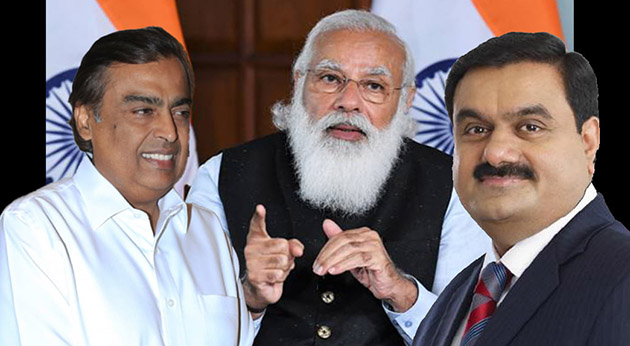
‘Sab Changa Si’: India's richest 1 per cent own more than 40 per cent of country’s total wealth!

News Network
January 16, 2023

adaniambani.jpg

The richest one per cent in India now own more than 40 per cent of the country's total wealth, while the bottom half of the population together share just 3 per cent of wealth, a new study showed on Monday.

Releasing the India supplement of its annual inequality report on the first day of the World Economic Forum Annual Meeting here, rights group Oxfam International said that taxing India's ten-richest at 5 per cent can fetch entire money to bring children back to school.

"A one-off tax on unrealized gains from 2017–2021 on just one billionaire, Gautam Adani, could have raised Rs 1.79 lakh crore, enough to employ more than five million Indian primary school teachers for a year," it added.

The report titled 'Survival of the Richest' further said that if India's billionaires are taxed once at 2 per cent on their entire wealth, it would support the requirement of Rs 40,423 crore for the nutrition of malnourished in the country for the next three years.

"A one-time tax of 5 per cent on the 10 richest billionaires in the country (Rs 1.37 lakh crore) is more than 1.5 times the funds estimated by the Health and Family Welfare Ministry (Rs 86,200 crore) and the Ministry of Ayush (Rs 3,050 crore) for the year 2022-23," it added.

On gender inequality, the report said that female workers earned only 63 paise for every 1 rupee a male worker earned.

For Scheduled Castes and rural workers, the difference is even starker -- the former earned 55 per cent of what the advantaged social groups earned, and the latter earned only half of the urban earnings between 2018 and 2019.

"Taxing the top 100 Indian billionaires at 2.5 per cent, or taxing the top 10 Indian billionaires at 5 per cent would nearly cover the entire amount required to bring the children back into school," it added.

Oxfam said the report is a mix of qualitative and quantitative information to explore the impact of inequality in India.

Secondary sources like Forbes and Credit Suisse have been used to look at the wealth inequality and billionaire wealth in the country, while government sources like NSS, Union budget documents, parliamentary questions, etc have been used to corroborate arguments made through out the report.

Since the pandemic begun to Nov 2022, billionaires in India have seen their wealth surge by 121 per cent or Rs 3,608 crore per day in real terms, Oxfam said.

On the other hand, approximately 64 per cent of the total Rs 14.83 lakh crore in Goods and Services Tax (GST) came from bottom 50 per cent of the population in 2021-22, with only 3 per cent of GST coming from the top 10 per cent.

Oxfam said the total number of billionaires in India increased from 102 in 2020 to 166 in 2022.

The combined wealth of India's 100 richest has touched USD 660 billion (Rs 54.12 lakh crore) -– an amount that could fund the entire Union Budget for more than 18 months, it added.

Oxfam India CEO Amitabh Behar said, "The country's marginalised – Dalits, Adivasis, Muslims, Women and informal sector workers are continuing to suffer in a system which ensures the survival of the richest.

"The poor are paying disproportionately higher taxes, spending more on essentials items and services when compared to the rich. The time has come to tax the rich and ensure they pay their fair share."

Behar urged the Union finance minister to implement progressive tax measures such as wealth tax and inheritance tax, which he said have been historically proven to be effective in tackling inequality.

Citing a nationwide survey by Fight Inequality Alliance India (FIA India) in 2021, Oxfam said it found that more than 80 per cent of people in India support tax on the rich and corporations who earned record profits during the Covid-19 pandemic.

"More than 90 per cent participants demanded budget measures to combat inequality such as universal social security, right to health and expansion of budget to prevent gender-based violence," it added.

"It's time we demolish the convenient myth that tax cuts for the richest result in their wealth somehow 'trickling down' to everyone else. Taxing the super-rich is the strategic precondition to reducing inequality and resuscitating democracy.

"We need to do this for innovation. For stronger public services and for happier and healthier societies," said Gabriela Bucher, Executive Director of Oxfam International.

Oxfam India urged the Union finance minister to introduce one-off solidarity wealth taxes and windfall taxes to end crisis profiteering. It also demanded a permanent increase in taxes on the richest 1 per cent and especially raise taxes on capital gains, which are subject to lower tax rates than other forms of income.

Oxfam also called for inheritance, property, and land taxes, as well as net wealth taxes, while enhancing the budgetary allocation of the health sector to 2.5 per cent of GDP by 2025, as envisaged in the National Health Policy. Oxfam said it also wants public health systems to be strengthened and budgetary allocation for education to be enhanced to the global benchmark of 6 per cent of GDP.

"Ensure workers in formal and informal sector are paid basic minimum wages. The minimum wages should be at par with living wages which is essential for living a life with dignity," it added. 

Comments

Add new comment

  • Coastaldigest.com reserves the right to delete or block any comments.
  • Coastaldigset.com is not responsible for its readers’ comments.
  • Comments that are abusive, incendiary or irrelevant are strictly prohibited.
  • Please use a genuine email ID and provide your name to avoid reject.
News Network
December 2,2025

A major upgrade in safety and monitoring is planned for Haj 2026, with every Indian pilgrim set to receive a Haj Suvidha smart wristband linked to the official Haj Suvidha mobile app. The initiative aims to support pilgrims—especially senior citizens—who may struggle with smartphones during the 45-day journey.

What the Smart Wristband Will Do

Officials said the device will come with:
•    Location tracking
•    Pedometer
•    SOS emergency button
•    Qibla compass
•    Prayer timings
•    Basic health monitoring

SP Tiwari, secretary of the UP State Haj Committee, said the goal is to make the pilgrimage safer and more comfortable.

“Most Hajis are elderly and not comfortable with mobile apps,” he said. “The smartwatch will help locate pilgrims who forget their way or cannot communicate their location.”

The wristbands will be monitored by the Consulate General of India in Saudi Arabia, similar to mobile tracking via the Haj Suvidha App.

Free Distribution and Training

•    Smart wristbands will be given free of cost.
•    Training for pilgrims will be conducted between January and February 2026.
•    Sample units will reach state Haj committees soon.
•    Final devices will be distributed as pilgrims begin their journey.

New Rules for Accommodation

Two major decisions have also been finalised for Haj 2026:
1.    Separate rooms for men and women – including married couples. They may stay on the same floor but must occupy different rooms, following stricter Saudi guidelines.
2.    Cooking banned – gas cylinders will not be allowed; all meals will be provided through official catering services arranged by the Haj Committee of India.

These decisions were finalised during a meeting of the Haj Committee of India and state representatives in Mumbai.

Haj Suvidha App Launched Earlier

The government launched the Haj Suvidha App in 2024, offering:

•    Training modules
•    Accommodation and flight details
•    Baggage information
•    SOS and translation tools
•    Grievance redressal

Haj 2026 Quota and Key States

•    India’s total Haj quota for 2026: 1,75,025 pilgrims
•    70% (1,25,000) allotted to the Haj Committee of India
•    30% (around 50,000) reserved for Haj Group Organisers

Uttar Pradesh has the largest allocation (around 30,000 seats), though approximately 18,000 pilgrims are expected to go this year. States with high pilgrim numbers include Kerala, Maharashtra and Gujarat.

Dates of Haj 2026

The pilgrimage is scheduled to take place from 24 May to 29 May, 2026 (tentative).
Haj is one of the five pillars of Islam and is mandatory for Muslims who meet the required conditions.

Comments

Add new comment

  • Coastaldigest.com reserves the right to delete or block any comments.
  • Coastaldigset.com is not responsible for its readers’ comments.
  • Comments that are abusive, incendiary or irrelevant are strictly prohibited.
  • Please use a genuine email ID and provide your name to avoid reject.
News Network
November 21,2025

Bantwal: A domestic dispute appears to have led to a violent confrontation in BC Road area, where the owner of a textile shop was allegedly attacked with a knife by his wife on Wednesday evening.

Krishna Kumar Somayaji, the owner of Somayaji Textiles, sustained serious injuries in the incident and was immediately taken to a hospital for treatment. He is currently receiving care in the intensive care unit and is reported to have survived the assault, according to police.

The Bantwal Town police have registered a case against Somayaji's wife, Jyothi KT, who has since been taken into custody.

Police stated that the complainant, Namita, an employee at the shop, reported the sequence of events. She stated that around 7 p.m. on Wednesday, the suspect entered the shop, wearing a burqa and disguised as a customer, before attacking Somayaji with a knife. The employee then transported the injured owner to a local hospital via an autorickshaw.

Superintendent of Police Arun K confirmed that an ongoing domestic dispute between Somayaji and his wife reportedly preceded the attack. Police noted that Jyothi KT had previously visited the shop and issued threats.

Based on the complaint, Bantwal Town police have registered a case under relevant sections of the Bharatiya Nyaya Sanhita (BNS) and the Indian Arms Act-1959. An investigation into the incident is currently underway.

Comments

Add new comment

  • Coastaldigest.com reserves the right to delete or block any comments.
  • Coastaldigset.com is not responsible for its readers’ comments.
  • Comments that are abusive, incendiary or irrelevant are strictly prohibited.
  • Please use a genuine email ID and provide your name to avoid reject.
News Network
December 4,2025

indigoflight.jpg

Domestic carrier IndiGo has cancelled over 180 flights from three major airports — Mumbai, Delhi and Bengaluru — on Thursday, December 4, as the airline struggles to secure the required crew to operate its flights in the wake of new flight-duty and rest-period norms for pilots.

While the number of cancellations at Mumbai airport stands at 86 (41 arrivals and 45 departures) for the day, at Bengaluru, 73 flights have been cancelled, including 41 arrivals, according to a PTI report that quoted sources.

"IndiGo cancelled over 180 flights on Thursday at three airports-Mumbai, Delhi and Bengaluru," the source told the news agency.

Besides, it had cancelled as many as 33 flights at Delhi airport for Thursday, the source said, adding, "The number of cancellations is expected to be higher by the end of the day."

The Gurugram-based airline's On-Time Performance (OTP) nosedived to 19.7 per cent at six key airports — Delhi, Mumbai, Chennai, Kolkata, Bengaluru and Hyderabad — on December 3, as it struggled to get the required crew to operate its services, down from almost half of December 2, when it was 35 per cent.

"IndiGo has been facing acute crew shortage since the implementation of the second phase of the FDTL (Flight Duty Time Limitations) norms, leading to cancellations and huge delays in its operations across the airports," a source had told PTI on Wednesday.

Chaos continued at several major airports for the third day on Thursday because of the cancellations.

A spokesperson for the Kempegowda International Airport (KIA) in Bengaluru said that 73 IndiGo flights had been cancelled on Thursday.

At least 150 flights were cancelled and dozens of others delayed on Wednesday, airport sources said, leaving thousands of travellers stranded, according to news agency Reuters.

The Directorate General of Civil Aviation (DGCA) has said it is investigating IndiGo flight disruptions and has asked the airline to submit the reasons for the current situation, as well as its plans to reduce flight cancellations and delays.

It may be mentioned here that the pilots' body, Federation of Indian Pilots (FIP), has alleged that IndiGo, despite getting a two-year preparatory window before the full implementation of new flight duty and rest period norms for cockpit crew, "inexplicably" adopted a "hiring freeze".

The FIP said it has urged the safety regulator, the DGCA, not to approve airlines' seasonal flight schedules unless they have adequate staff to operate their services "safely and reliably" in accordance with the New Flight Duty Time Limitations (FDTL) norms.

In a letter to the DGCA late on Wednesday, the FIP urged the DGCA to consider re-evaluating and reallocating slots to other airlines, which have the capacity to operate them without disruption during the peak holiday and fog season if IndiGo continues to "fail in delivering on its commitments to passengers due to its own avoidable staffing shortages."

Comments

Add new comment

  • Coastaldigest.com reserves the right to delete or block any comments.
  • Coastaldigset.com is not responsible for its readers’ comments.
  • Comments that are abusive, incendiary or irrelevant are strictly prohibited.
  • Please use a genuine email ID and provide your name to avoid reject.