SC upholds 10% quota for EWS, says it does not violate Constitution

News Network
November 7, 2022

New Delhi, Nov 7: The Supreme Court has upheld the 103rd Constitution Amendment providing for 10% quota for the economically weaker sections (EWS) from unreserved categories. The beneficiaries can avail the quota for admission to central institutions and Central government jobs.

A five-judge constitution bench of Chief Justice UU Lalit and Justices Dinesh Maheshwari, S Ravindra Bhat, Bela M Trivedi and JB Pardiwala, in a 4-1 verdict, held that the provisions of the concerned amendment is not in violation of the Constitution.

Reading out the verdict, Justice Maheshwari says that 103rd Constitutional amendment is valid and does not violate the basic structure of the Constitution.

Justice Trivedi says that there is a need to revisit the reservation policy and it should have a time span. Justice Pardiwala, while holding the amendment valid, observed that reservation cannot go on indefinitely and agreed with Justice Trivedi on a need to re-examine the reservation policy.

However Justice Bhatt disagreed with the majority verdict and said leaving out the poor from SCs/STs/ OBCs from availing the reservation benefit under EWS category is discriminatory.

The 103rd Constitution Amendment Bill was passed by Parliament in January 2019.

While delivering the verdict on the validity of EWS quota, the bench had considered three broad questions:

Is quota based on economic criteria valid?

The Constitution does not talk about the concept of preferential treatment on the basis of a person’s economic status. The bench therefore mulled on:
•    >> Is reservation based on economic criteria is permitted by the Constitution?

•    >> Will it go against basic structure of Constitution, if allowed?

Is 103rd Amendment a breach on Constutuion?

•    >> The court examined possible breach of Constitution by the 103rd Amendment from two aspects:

•    >> Permitting the state to make special provisions in relation to admission to private unaided institutions

Excluding SEBCs (Socially and Educationally Backward Classes)/OBCs (Other Backward Classes)/SCs(Scheduled Casts)/STs (Scheduled Tribes) from the scope of EWS reservation.

The 50% quota cap issue

The bench also considered if the 50% cap on reservation as fixed by it in the Indra Sawhney judgment is inviolable and cannot be breached.

The Centre's contention

•    >> Granting of 10% quota to the poor section will not impact other categories

•    >> It has approved creation of more than 2.1 lakh seats in central educational institutions to ensure that EWS quota didn’t impact SC/STs and OBCs

•    >> 103rd Amendment strengthened the basic structure of the Constitution by ensuring economic justice to its citizens

•    >> Upper limit on quota is not a "golden inviolable rule"

What petitioners said
•    >> Economic criteria could not be a basis for granting reservation

•    >> Granting quota to the forward class is a “fraud on the constitution” and amounted to stabbing its heart

What is the 103rd Amendment
•    >> The Bill was introduced in Parliament in January 2019, and subsequntly passed by the Lok Sabha and Rajya Sabha before getting the presidential assent.

•    >> It introduces 10% reservation for Economically Weaker Sections (EWS) for admission to Centre-run as well as private educational institutions (except for minority educational institutions)

•    >> It also provides for similar reservations for employment in Central Government jobs

•    >> Such reservations not mandatory in state govt-run institutions or state government jobs

•    >> Some states have voluntarily chosen to implement similar reservations

Who can avail EWS quota benefits
•    >> Persons with an annual gross household income of up to Rs 8 lakh

•    >> Excluded: Families owning over 5 acres of agricultural land, a house over 1,000 square feet, a plot of over 100-yards in a notified municipal area or over a 200-yards plot in a non-notified municipal area

•    >> Communities that already have reservations such as SCs, STs and the "non creamy layer" of OBCs

Comments

Add new comment

  • Coastaldigest.com reserves the right to delete or block any comments.
  • Coastaldigset.com is not responsible for its readers’ comments.
  • Comments that are abusive, incendiary or irrelevant are strictly prohibited.
  • Please use a genuine email ID and provide your name to avoid reject.
News Network
February 4,2026

Mangaluru: Urban local bodies and gram panchayats should make the use of Kannada on signboards mandatory while issuing trade licences to commercial establishments, Dakshina Kannada Deputy Commissioner Darshan HV said. He also called for regular inspections to ensure compliance.

Presiding over the District Kannada Awareness Committee meeting at the deputy commissioner’s office, Darshan said the city corporation would be directed to ensure that shops operating in malls prominently display their names in Kannada. “All commercial establishments, including shops, companies, offices and hotels, must mandatorily display their names in Kannada on signboards,” he said.

The deputy commissioner added that the National Highways Authority of India (NHAI) would be instructed to include Kannada on signboards along national highways. Banks, he said, would be directed through committee meetings to provide application forms in Kannada.

“Even if English-medium schools and colleges impart education in English, their signboards must display the institution’s name in Kannada. Steps will also be taken to ensure that private buses display place names in Kannada,” Darshan said.

During the meeting, committee members raised concerns over the closure of Kannada-medium schools in rural areas due to a shortage of teachers and stressed the need for immediate corrective measures. They also pointed out that several industries employ workers from other states while overlooking local candidates.

Members further demanded that nationalised banks provide deposit and withdrawal slips in Kannada. It was brought to the deputy commissioner’s notice that the presence of staff without knowledge of Kannada in rural branches of nationalised banks is causing hardship to local customers.

Meanwhile, MP Srinath, president of the District Kannada Sahitya Parishat, urged the district administration to allot land for the construction of a district Kannada Bhavana in Mangaluru.

Comments

Add new comment

  • Coastaldigest.com reserves the right to delete or block any comments.
  • Coastaldigset.com is not responsible for its readers’ comments.
  • Comments that are abusive, incendiary or irrelevant are strictly prohibited.
  • Please use a genuine email ID and provide your name to avoid reject.
News Network
February 1,2026

Bengaluru, Feb 1: For travelers landing at Kempegowda International Airport (KIA), the sleek, wood-paneled curves of Terminal 2 promise a world-class welcome. But the famed “Garden City” charm quickly withers at the curb. As India’s aviation sector swells to record numbers—handling over 43 million passengers in Bengaluru alone this past year—the “last mile” has turned into a marathon of frustration.

The Bengaluru Logjam: Rules vs Reality

While the city awaits the 2027 completion of the Namma Metro Blue Line, the interim has been chaotic. Recent “decongestion” rules at Terminal 1 have pushed app-based cab pickups to distant parking zones, forcing weary passengers into a 20-minute walk with luggage.

“I landed after ten months away and felt like a stranger in my own city,” says Ruchitha Jain, a Koramangala resident. “My driver couldn’t find me, staff couldn’t guide me, and the so-called ‘Premium’ lane is just a fancy tax on convenience.”

•    The Cost of Distance: A 40-km cab ride can now easily cross ₹1,500, driven by demand pricing and airport surcharges.

•    The Bus Gap: While Vayu Vajra remains a lifeline, its ₹300–₹400 fare is often cited as the most expensive airport bus service in the country.

A National Pattern of Disconnect

The struggle is not unique to Karnataka. From Chennai’s coast to Hyderabad’s plateau, India’s airports tell a familiar story: brilliant runways, broken exits.

City:    Primary Issue   |    Recent Development

Bengaluru:    Cab pickup restrictions & distance  |    App-based taxis shifted to far parking zones; long walks and fare spikes reported

Chennai:    Multi-Level Parking (MLCP) hike  |    Passengers report 40-minute walks to reach cab pickup points

Hyderabad:    “Taxi mafia” & touting  |    Over 440 touting cases reported; security presence intensified

Mumbai:    Fare scams  |     Tourists charged ₹18,000 for just 400 metres, triggering police action

In Hyderabad, travelers continue to battle entrenched local groups that intimidate Uber and Ola drivers, pushing passengers toward overpriced private taxis. Chennai flyers, meanwhile, complain that reaching the designated pickup zones now takes longer than short-haul flights from cities like Coimbatore.

The ‘Budget Day’ Hope

As Finance Minister Nirmala Sitharaman presents the Union Budget 2026 today, the aviation sector is watching closely. With the government’s renewed emphasis on multimodal integration, there is cautious hope for funding toward seamless airport-metro-bus hubs.

The vision is clear: a future where planes, trains, and metros speak the same language. Until then, passengers at KIA—and airports across India—will continue to discover that the hardest part of flying isn’t the thousands of kilometres in the air, but the last few on the ground.

Comments

Chandramohan
 - 
Friday, 6 Feb 2026

Sir, I request the airport authorities to introduce a free transport services from terminal 1 to terminal 2 as is very difficult for the passengers to reach terminal 2 along with their luggage. Also a trolley should be provided to reach the counter. Hope the authorities would help the passengers as soon as possible.

Add new comment

  • Coastaldigest.com reserves the right to delete or block any comments.
  • Coastaldigset.com is not responsible for its readers’ comments.
  • Comments that are abusive, incendiary or irrelevant are strictly prohibited.
  • Please use a genuine email ID and provide your name to avoid reject.
News Network
January 23,2026

modIKERALA.jpg

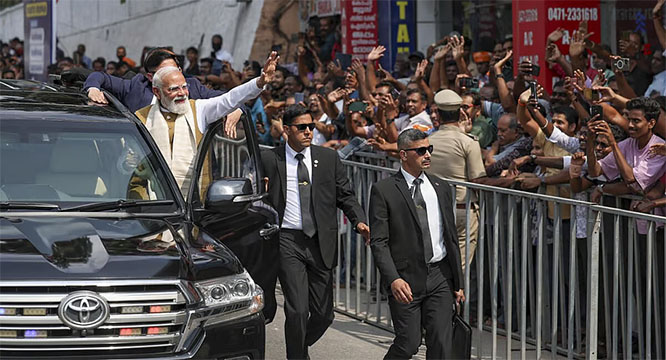
Prime Minister Narendra Modi, during his visit to Thiruvananthapuram on Friday, January 23, indicated that the Bharatiya Janata Party (BJP) is aiming to expand its political footprint in Kerala ahead of the Assembly elections scheduled in the coming months.

Speaking at a BJP-organised public meeting, Modi drew parallels between the party’s early electoral gains in Gujarat and its recent victory in the Thiruvananthapuram Municipal Corporation. The civic body win, which ended decades of Left control, was cited by the Prime Minister as a possible starting point for the party’s broader ambitions in the state.

Recalling BJP’s political trajectory in Gujarat, Modi said the party was largely insignificant before 1987 and received little media attention. He pointed out that the BJP’s first major breakthrough came with its victory in the Ahmedabad Municipal Corporation that year.

“Just as our journey in Gujarat began with one city, Kerala’s journey has also started with a single city,” Modi said, suggesting that the party’s municipal-level success could translate into wider electoral acceptance.

The Prime Minister alleged that successive governments led by the Left Democratic Front (LDF) and the United Democratic Front (UDF) had failed to adequately develop Thiruvananthapuram. He accused both fronts of corruption and neglect, claiming that basic infrastructure and facilities were denied to the capital city for decades.

According to Modi, the BJP’s control of the civic body represents a shift driven by public dissatisfaction with the existing political alternatives. He asserted that the BJP administration in Thiruvananthapuram had begun working towards development, though no specific details or timelines were outlined.

Addressing the gathering at Putharikandam Maidan, Modi said the BJP intended to project Thiruvananthapuram as a “model city,” reiterating his party’s commitment to governance-led change.

The Prime Minister’s visit to Kerala also included the inauguration of several development projects and the flagging off of new train services, as the BJP intensifies its political outreach in the poll-bound state.

Comments

Add new comment

  • Coastaldigest.com reserves the right to delete or block any comments.
  • Coastaldigset.com is not responsible for its readers’ comments.
  • Comments that are abusive, incendiary or irrelevant are strictly prohibited.
  • Please use a genuine email ID and provide your name to avoid reject.