



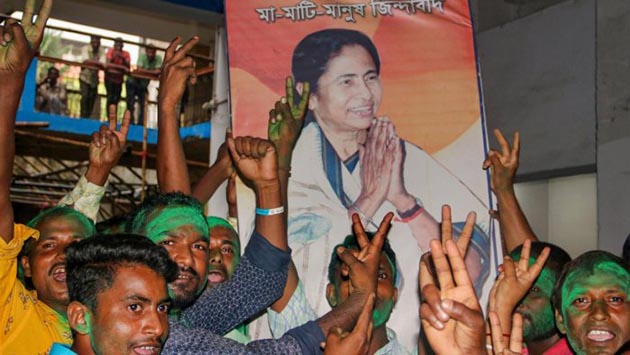
TMC sweeps West Bengal rural polls, bags around 35,000 gram panchayat seats

News Network
July 12, 2023

mamata.jpg

Kolkata, July 12: The ruling Trinamool Congress on Wednesday looked poised to sweep to a massive victory in violence-scarred rural polls in Bengal as the overnight count of ballots gave it an unassailable lead in results declared till now by the State Election Commission.

The TMC has won in 34,359 gram panchayat seats, besides leading in 752 seats, according to the SEC as of 8 am on Wednesday. Its nearest rival BJP has won 9,545 seats and is leading in 180 seats. In all elections are being held for 63,229 gram panchayat seats. The CPI( M) has won 2,885 and is leading in 96 seats. The Congress won 2,498 seats and is leading in 72.

The counting though largely peaceful was marred by stray incidents including bombs being hurled in Bhangar, a spot where there had been deaths in the run-up to election, leading to firing by central forces and state police on Tuesday night on an unruly mob which resulted in injuries including on ISF supporters and policemen including an IPS officer. 

The ruling TMC won 6,134 Panchayat samiti seats while leading 61 seats. BJP has won 939 and is leading in 149 seats, while CPI(M) has won 165 seats and is leading in 14 others and Congress has won in 244 seats and is leading in 7 seats. Elections were held for 9,728 Panchayat Samiti seats.

TMC has also won all 554 Zila Parishad results declared so far and is leading in 201 others. The BJP has in contrast won 19 and is leading in 7 seats.

The CPI(M) has won 2 seats and is leading in 2 more seats, while Congress has won 4 and is leading in 10. In all, there are 928 Zila Parishad seats.

Chief Minister Mamata Banerjee who had suffered an injury during campaigning thanked people for reposing trust in her on Tuesday night.

"It's TMC all the way in rural Bengal. I want to thank the people for their love, affection and support towards the TMC. This election has proved that only TMC resides in the heart of the people of the state," Banerjee said in a social media post.

The elections are being seen by all parties as an indicator of which way the wind will blow in the 2024 parliamentary elections from this part of the country.

The violence which rocked the panchayat polls held on Saturday has claimed at least 15 lives with 11 of them from the ruling TMC. Since elections were announced last month, the number of people who died in poll-related incidents has been 33, with the ruling party suffering 60 per cent of the deaths.

Allegations of vote tampering and violence by various parties forced the SEC to order re-polling in 696 seats on Monday, which passed more or less peacefully. Intervention by the Calcutta High Court had seen the deployment of central police forces on both election and counting days.

Though Bengal has a long history of violent rural polls with 40 people killed in one single day of polling during the 2003 panchayat elections, this year’s violence which was covered extensively by the media focused national attention on it.

Governor CV Ananda Bose who had rushed to Delhi to give a report on the violence told newspersons Tuesday "Political parties should realise elections are not grounds to examine one's physical strength".

Counting of votes for the three-tier panchayat polls to nearly 74,000 seats which besides the gram panchayat seats, also includes 9,730 panchayat samiti seats and 928 zilla parishad seats, began at 8 am on Tuesday largely peacefully amid tight security, officials said.

Vote counting is on at 339 venues spread across 22 districts and is likely to carry over to Wednesday. The maximum number of counting centres is in South 24 Parganas at 28, while the minimum is in Kalimpong at four. Some northern districts are also facing inclement weather.

"Counting which began at 8 am yesterday continued overnight and will be completed today" an SEC official said Wednesday.

In Darjeeling hills, out of the 598 seats in Darjeeling and 281 in Kalimpong, the Bharatiya Gorkha Prajatantrik Morcha (BGPM) was leading in many areas and looks likely to be the new numero uno in the Bengal hill districts.

All the counting venues are manned by armed state police personnel and central forces, with prohibitory orders under Section 144 of CrPC being imposed outside the venue to avoid any untoward incidents. There are a total of 767 strong rooms across 22 districts.

Large crowds of supporters of various candidates gathered at various centres to ensure that counting was conducted correctly.

In various districts, TMC supporters celebrated their victory by dancing and smearing each other with green colour, the party’s chosen colour.

A total of 5.67 crore people living in the state's rural areas were eligible to decide the fate of 2.06 lakh candidates in 73,887 seats of the three-tier-panchayat system. 

Comments

Add new comment

  • Coastaldigest.com reserves the right to delete or block any comments.
  • Coastaldigset.com is not responsible for its readers’ comments.
  • Comments that are abusive, incendiary or irrelevant are strictly prohibited.
  • Please use a genuine email ID and provide your name to avoid reject.
News Network
February 1,2026

Bengaluru, Feb 1: For travelers landing at Kempegowda International Airport (KIA), the sleek, wood-paneled curves of Terminal 2 promise a world-class welcome. But the famed “Garden City” charm quickly withers at the curb. As India’s aviation sector swells to record numbers—handling over 43 million passengers in Bengaluru alone this past year—the “last mile” has turned into a marathon of frustration.

The Bengaluru Logjam: Rules vs Reality

While the city awaits the 2027 completion of the Namma Metro Blue Line, the interim has been chaotic. Recent “decongestion” rules at Terminal 1 have pushed app-based cab pickups to distant parking zones, forcing weary passengers into a 20-minute walk with luggage.

“I landed after ten months away and felt like a stranger in my own city,” says Ruchitha Jain, a Koramangala resident. “My driver couldn’t find me, staff couldn’t guide me, and the so-called ‘Premium’ lane is just a fancy tax on convenience.”

•    The Cost of Distance: A 40-km cab ride can now easily cross ₹1,500, driven by demand pricing and airport surcharges.

•    The Bus Gap: While Vayu Vajra remains a lifeline, its ₹300–₹400 fare is often cited as the most expensive airport bus service in the country.

A National Pattern of Disconnect

The struggle is not unique to Karnataka. From Chennai’s coast to Hyderabad’s plateau, India’s airports tell a familiar story: brilliant runways, broken exits.

City:    Primary Issue   |    Recent Development

Bengaluru:    Cab pickup restrictions & distance  |    App-based taxis shifted to far parking zones; long walks and fare spikes reported

Chennai:    Multi-Level Parking (MLCP) hike  |    Passengers report 40-minute walks to reach cab pickup points

Hyderabad:    “Taxi mafia” & touting  |    Over 440 touting cases reported; security presence intensified

Mumbai:    Fare scams  |     Tourists charged ₹18,000 for just 400 metres, triggering police action

In Hyderabad, travelers continue to battle entrenched local groups that intimidate Uber and Ola drivers, pushing passengers toward overpriced private taxis. Chennai flyers, meanwhile, complain that reaching the designated pickup zones now takes longer than short-haul flights from cities like Coimbatore.

The ‘Budget Day’ Hope

As Finance Minister Nirmala Sitharaman presents the Union Budget 2026 today, the aviation sector is watching closely. With the government’s renewed emphasis on multimodal integration, there is cautious hope for funding toward seamless airport-metro-bus hubs.

The vision is clear: a future where planes, trains, and metros speak the same language. Until then, passengers at KIA—and airports across India—will continue to discover that the hardest part of flying isn’t the thousands of kilometres in the air, but the last few on the ground.

Comments

Add new comment

  • Coastaldigest.com reserves the right to delete or block any comments.
  • Coastaldigset.com is not responsible for its readers’ comments.
  • Comments that are abusive, incendiary or irrelevant are strictly prohibited.
  • Please use a genuine email ID and provide your name to avoid reject.
News Network
February 1,2026

Bengaluru: Karnataka Deputy Chief Minister D K Shivakumar on Sunday criticised the Union Budget presented by Finance Minister Nirmala Sitharaman, claiming it offered no tangible benefit to the state.

Though he said he was yet to study the budget in detail, Shivakumar asserted that Karnataka had gained little from it. “There is no benefit for our state from the central budget. I was observing it. They have now named a programme after Mahatma Gandhi, after repealing the MGNREGA Act that was named after him,” he said.

Speaking to reporters here, the Deputy Chief Minister demanded the restoration of MGNREGA, and made it clear that the newly enacted rural employment scheme — VB-G RAM G — which proposes a 60:40 fund-sharing formula between the Centre and the states, would not be implemented in Karnataka.

“I don’t see any major share for our state in this budget,” he added.

Shivakumar, who also holds charge of Bengaluru development, said there were high expectations for the city from the Union Budget. “The Prime Minister calls Bengaluru a ‘global city’, but what has the Centre done for it?” he asked.

He also drew attention to the problems faced by sugar factories, particularly those in the cooperative sector, alleging a lack of timely decisions and support from the central government.

Noting that the Centre has the authority to fix the minimum support price (MSP) for agricultural produce, Shivakumar said the Union government must take concrete steps to protect farmers’ interests.

Comments

Add new comment

  • Coastaldigest.com reserves the right to delete or block any comments.
  • Coastaldigset.com is not responsible for its readers’ comments.
  • Comments that are abusive, incendiary or irrelevant are strictly prohibited.
  • Please use a genuine email ID and provide your name to avoid reject.
News Network
January 23,2026

Karnataka Governor Thaawarchand Gehlot read only three lines from the 122-paragraph address prepared by the Congress-led state government while addressing the joint session of the Legislature on Thursday, effectively bypassing large sections critical of the BJP-led Union government.

The omitted portions of the customary Governor’s address outlined what the state government described as a “suppressive situation in economic and policy matters” under India’s federal framework. The speech also sharply criticised the Centre’s move to replace the Mahatma Gandhi National Rural Employment Guarantee Act (MGNREGA) with the Viksit Bharat–Guarantee for Rozgar and Ajeevika Mission (Gramin) Act, commonly referred to as the VB-GRAM (G) Act.

Governor Gehlot had earlier conveyed his objection to several paragraphs that were explicitly critical of the Union government. On Thursday, he confined himself to the opening lines — “I extend a warm welcome to all of you to the joint session of the State legislature. I am extremely pleased to address this august House” — before jumping directly to the concluding sentence of the final paragraph.

He ended the address by reading the last line of paragraph 122: “Overall, my government is firmly committed to doubling the pace of the State’s economic, social and physical development. Jai Hind — Jai Karnataka.”

According to the prepared speech, the Karnataka government demanded the scrapping of the VB-GRAM (G) Act, describing it as “contractor-centric” and detrimental to rural livelihoods, and called for the full restoration of MGNREGA. The state government argued that the new law undermines decentralisation, weakens labour protections, and centralises decision-making in violation of constitutional norms.

Key points from the unread sections of the speech:

•    Karnataka facing a “suppressive” economic and policy environment within the federal system

•    Repeal of MGNREGA described as a blow to rural livelihoods

•    VB-GRAM (G) Act accused of protecting corporate and contractor interests

•    New law alleged to weaken decentralised governance

•    Decision-making said to be imposed by the Centre without consulting states

•    Rights of Adivasis, women, backward classes and agrarian communities curtailed

•    Labourers allegedly placed under contractor control

•    States facing mounting fiscal stress due to central policies

•    VB-GRAM (G) Act accused of enabling large-scale corruption

Comments

Add new comment

  • Coastaldigest.com reserves the right to delete or block any comments.
  • Coastaldigset.com is not responsible for its readers’ comments.
  • Comments that are abusive, incendiary or irrelevant are strictly prohibited.
  • Please use a genuine email ID and provide your name to avoid reject.