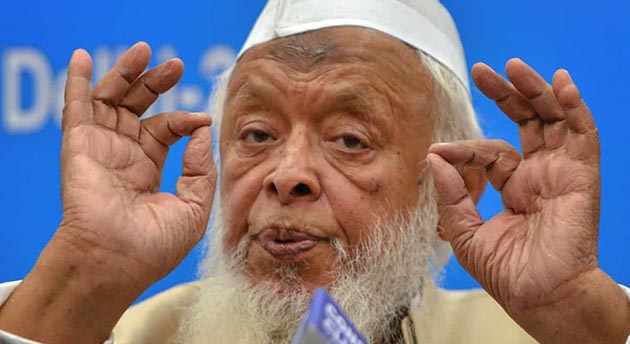
UCC against religious freedom; will fight legally, won’t take to streets: Jamiat Ulema-e-Hind

News Network
June 19, 2023

jamiat.jpg

New Delhi, June 19: Prominent Muslim organisation Jamiat Ulema-e-Hind on Monday claimed that the Uniform Civil Code is against the religious freedom guaranteed under the the Constitution but said it will not take to the streets to protest against it and instead would oppose it by taking all possible steps within the ambit of law.

The statement by the Muslim organisation comes days after the Law Commission initiated a fresh consultation process on the Uniform Civil Code (UCC) by seeking views from stakeholders, including public and recognised religious organisations, on the politically sensitive issue.

In a statement, the Jamiat Ulema-e-Hind said it opposes the UCC as it is "totally against the religious freedom and fundamental rights guaranteed to the citizens in Articles 25 and 26 of the Constitution."

"Our Constitution is a secular Constitution, in which every citizen has been given full religious freedom, and every person has been also given the right to choose the religion of his choice, because there is no official religion for the Indian state, and it gives complete freedom to all its citizens," the Jamiat said.

A resolution opposing the UCC was also passed by the executive committee of the Jamiat (Arshad Madani faction) at its executive meeting Sunday.

The demand for a UCC is nothing but a deliberate attempt to curtail the religious freedom of citizens, the Jamiat alleged.

Hence, Jamiat has been opposing this effort from day one as it feels that the demand for a UCC is part of an attempt to destroy the religious freedom of the citizens and the original spirit of the Constitution, the statement said.

The UCC is against the fundamental rights given in the Constitution, it is unacceptable to Muslims, and detrimental to the unity and integrity of the country.

While expressing his views on the resolution passed, Jamiat president Maulana Arshad Madani said this matter pertains not only to Muslims but to all Indians.

Jamiat Ulema-e-Hind cannot compromise on religious affairs and worship in any way, he said.

"We will not protest on the streets but will take all possible steps within the ambit of law (to oppose the UCC)," he said.

In a pluralistic society like India, where followers of different religions have been living in peace and unity following the teachings of their respective religions for centuries, the idea of imposing a UCC is not only surprising but it also seems that Article 44 of the Constitution is being used keeping a particular sect in mind to mislead the majority, the Jamiat said.

"It is being said that this is written in the Constitution, although the second sarsanghchalak (chief) of the RSS Guru Golwalkar, himself said that 'Uniform Civil Code is unnatural to India and against its diversity'. Moreover, while the UCC has been mentioned in the directive principles, the fundamental rights of citizens have been guaranteed in the Constitution," it said.

The Jamiat alleged that the basic rights of the citizens are often being violated and there is no protest about it.

History says that for centuries, people in this country have been following their own religious principles. The religious beliefs and customs of the people have been different, but there has never been any conflict or tension between them, it said.

Jamiat considers religious freedom as being the spirit of the Constitution, whereas Article 44 is an optional matter under Directive Principles of State Policy, the statement said.

Liquor ban in the country also comes under the Directive Principles, it said citing an example.

Neither Parliament nor the Supreme Court has the authority to change the basic provisions listed under Chapter 3 of the Constitution, the Jamiat argued.

In fact, people of a certain mindset are trying to mislead the majority by saying that UCC is part of the Constitution, the Jamiat said.

The minorities, tribes and some other communities of the country have been given freedom under the religious and social law because the identity of different religious communities and groups are associated with their religious and social rituals and customs, and this is also the basis of unity, integrity and unity of the country, the Muslim body asserted.

For centuries, people of different religious groups and communities have been living according to their own personal laws, and in view of this, the Constitution has given citizens religious freedom, it said.


Comments

Add new comment

  • Coastaldigest.com reserves the right to delete or block any comments.
  • Coastaldigset.com is not responsible for its readers’ comments.
  • Comments that are abusive, incendiary or irrelevant are strictly prohibited.
  • Please use a genuine email ID and provide your name to avoid reject.
News Network
January 23,2026

Mangaluru: The Karnataka Government Polytechnic (KPT), Mangaluru, has achieved autonomous status from the All India Council for Technical Education (AICTE), becoming the first government polytechnic in the country to receive such recognition in its 78-year history. The status was granted by AICTE, New Delhi, and subsequently approved by the Karnataka Board of Technical Education in October last year.

Officials said the autonomy was conferred a few months ago. Until recently, AICTE extended autonomous status only to engineering colleges, excluding diploma institutions. However, with a renewed national focus on skill development, several government polytechnics across India have now been granted autonomy.

KPT, the second-largest polytechnic in Karnataka, was established in 1946 with four branches and has since expanded to offer eight diploma programmes, including computer science and polymer technology. The institution is spread across a 19-acre campus.

Ravindra M Keni, the first dean of the institution, told The Times of India that AICTE had proposed autonomous status for polytechnic institutions that are over 25 years old. “Many colleges applied. In the first round, 100 institutions were shortlisted, which was further narrowed down to 15 in the second round. We have already completed one semester after becoming an autonomous institution,” he said. He added that nearly 500 students are admitted annually across eight three-year diploma courses.

Explaining the factors that helped KPT secure autonomy, Keni said the institution has consistently recorded 100 per cent admissions and placements for its graduates. He also noted its strong performance in sports, with the college emerging champions for 12 consecutive years, along with active student participation in NCC and NSS activities.

Autonomous status allows KPT to design industry-oriented curricula, conduct examinations, prepare question papers, and manage academic documentation independently. The institution can also directly collaborate with industries and receive priority funding from AICTE or the Ministry of Education. While academic autonomy has been granted, financial control will continue to rest with the state government.

“There will be separate committees for examinations, question paper setting, boards of studies, and boards of examiners. The institution will now have the freedom to conduct admissions without government notifications and issue its own marks cards,” Keni said, adding that new academic initiatives would be planned after a year of functioning under the autonomous framework.

Comments

Add new comment

  • Coastaldigest.com reserves the right to delete or block any comments.
  • Coastaldigset.com is not responsible for its readers’ comments.
  • Comments that are abusive, incendiary or irrelevant are strictly prohibited.
  • Please use a genuine email ID and provide your name to avoid reject.
News Network
February 4,2026

shettigar.jpg

An Indian resident who won the Dh20 million (approximately Rs 50 crore) jackpot in Abu Dhabi's Big Ticket draw has told of his joy at sharing his life-changing fortune with a friend.

Shanthanu Shettigar, a shop manager in Muscat, regularly buys tickets for the monthly grand prize draw with one of his closest friends – and the pair won on February 3.

Mr Shettigar, 33, who is from Udyavar in Udupi district of the southern state of Karnataka and has lived in the Omani capital for eight years, said he was left speechless after learning of his success.

“When I first moved to Muscat, many of my colleagues were purchasing Big Ticket, which encouraged me to give it a try,” he said.

“I started buying tickets on my own, and later began sharing tickets with a close friend. The ticket that brought me this win was one we purchased together.”

“Like most people, I receive a lot of spam calls, and I was fully absorbed in my work as well. I knew the live draw was taking place tonight, but I never imagined my name would be announced,” he said.

“When I realised it was real and that I had won, I was honestly speechless. It still hasn’t fully sunk in, but I’m extremely happy.”

Mr Shettigar is not sure how he will spend his share of the money, but encouraged others to take part.

“This win was completely unexpected, so I want to take some time to think things through before deciding what to do next,” he said.

“I would definitely encourage others to participate with Big Ticket, whether with family or friends – you never know when your moment might come.”

The Big Ticket was established in 1992 with an initial first prize of Dh1 million. It is one of the most popular monthly raffles in the UAE.

It has transformed the lives of many people across the Emirates and beyond.

Entry to the Big Ticket Millionaire is Dh500. Tickets can be bought online or at counters at Zayed International Airport and Al Ain Airport.

Comments

Add new comment

  • Coastaldigest.com reserves the right to delete or block any comments.
  • Coastaldigset.com is not responsible for its readers’ comments.
  • Comments that are abusive, incendiary or irrelevant are strictly prohibited.
  • Please use a genuine email ID and provide your name to avoid reject.
News Network
January 23,2026

oscar.jpg

The Voice of Hind Rajab, inspired by the tragic final moments of a young Palestinian girl killed by Israeli fire in Gaza, has been nominated for an Academy Award in the Best International Feature Film category.

Directed by Tunisian filmmaker Kaouther Ben Hania, the film recounts the true story of five-year-old Hind Rajab, who lost her life in January 2024 while fleeing Israeli bombardment with her family.

The film features the real audio of Hind’s desperate call to the Palestinian Red Crescent Society, where she pleaded for help moments before the vehicle she was in was struck by 355 bullets.

The haunting narrative begins with a brief call made from the besieged Tel al-Hawa neighborhood of Gaza, where gunfire and armored vehicles drowned out every sound.

After witnessing the brutal killing of her family, she made a trembling call, her voice reduced to a whisper as she spoke of the massacre and her unbearable loneliness as the sole survivor.

Premiering at the Venice International Film Festival in September 2025, The Voice of Hind Rajab garnered widespread acclaim, receiving a record-setting 23-minute standing ovation and the Silver Lion Grand Jury Prize, the festival’s second-highest honor.

In her acceptance speech, Ben Hania dedicated the film to humanitarian workers and first responders in Gaza, emphasizing that Hind's voice symbolizes countless civilians affected by war.

She aims to give voice to victims often reduced to mere statistics, highlighting the broader suffering of civilians in war zones.

The film’s Oscar nomination underscores its powerful storytelling and ethical approach to depicting real-life tragedy, making it a crucial piece of contemporary cinema.

It serves not only as a narration of individual tragedy but also as an artistic and documentary response to the silence and censorship that often overshadow West Asian struggles and wars.

Using an innovative method she calls docufiction, Ben Hania bridges unvarnished reality and narrative structure, creating a work that is both artistically valuable and socially impactful.

Born in 1977 in Sidi Bouzid—later the epicenter of the Arab revolution—her background profoundly influenced her worldview and artistic approach.

She is a graduate of the Higher School of Audiovisual Arts of Tunis, Pantheon-Sorbonne University, and La Fémis in Paris, where her studies equipped her with the technical and theoretical tools needed to address complex subjects. 

Comments

Add new comment

  • Coastaldigest.com reserves the right to delete or block any comments.
  • Coastaldigset.com is not responsible for its readers’ comments.
  • Comments that are abusive, incendiary or irrelevant are strictly prohibited.
  • Please use a genuine email ID and provide your name to avoid reject.