



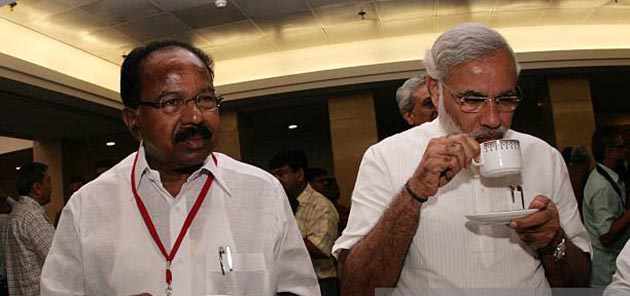
UCC will destabilize India, demolish diversity and create chaos in society: Moily warns Modi

News Network
July 5, 2023

modd.jpg

New Delhi, July 5: Amid the raging debate over the Uniform Civil Code, senior Congress leader and former law minister M Veerappa Moily on Wednesday urged Prime Minister Narendra Modi, the Law Commission and all political leaders not to open the "Pandora's box" on personal laws and "create chaos" in the society.

He also alleged that it was an issue that was intended to divide the society, destabilise the country and demolish the diversity enjoyed in Indian society.

In a statement, Moily underlined that Article 25 provides for the Right to Freedom of Religion.

"Prime Minister Narendra Modi has recently given a public thrust to Uniform Civil Code (UCC). Even though the Constitution of India makes a mention of the UCC, the founding fathers of the Constitution in the Constituent Assembly had chosen not to make it mandatory, as it involves the diversity of Indian society," said Moily, who was the law minister in the UPA-II government from May 2009 to May 2011.

Uniformity or commonality of the civil code for all regions and cultures of India is a different matter, he argued. 

"It would entail breaking the promise made to Nagas and Mizos to not interfere in their customs and could feed secessionist sentiments that are active to varying degrees in the region," Moily said.

He added that this will have repercussions not only for minorities such as Muslims, Christians, it will also have substantial effect on Sikhs, Jains, Buddhist and hundreds of tribes and among various sects in Hindus such as Aliyasantana in Dakshina Kannada in Karnataka and Marumakkathayam in Kerala.

"As expected, UCC is envisaged as a Muslim issue, forgetting other diversities prevailing in the country," he alleged.

Moily noted that the 21st Law Commission of India had declared that the UCC is neither necessary nor desirable.

He said that the Constitution bench of the Supreme Court had already framed seven questions of law linked to religious freedom, rights and practices in the Sabarimala case. 

The first of the seven questions is what is the scope and ambit of Right to Freedom of Religion under Article 25 of the Constitution, he pointed out and noted that the said reference is still pending in the Supreme Court.

The 22nd Law Commission of India has rushed to issue a public notice for a fresh debate on the Uniform Civil Code, he said.

"The statement of the prime minister at the most may be a platitude in the meeting of the BJP party and may be a part of the BJP manifesto for the forthcoming Lok Sabha election of 2024," Moily said.

Neither any state nor the next Parliament can rush to the UCC legislation in the absence of a full-fledged report of the 22nd Law Commission or the judgment of the Supreme Court which had framed seven questions of law, he asserted.

The right to preserve one's religious identities through personal laws cannot be annulled by a premature proclamation of the prime minister, the senior Congress leader said.

He said that it should not be forgotten that the report of the 21st Law Commission of India will have to be debated and the Supreme Court should also come out with its verdict. 

"All the debates which are taking place now are premature, short-sighted and tend to create hatred in the society. Such debates are also intended to sabotage the concept of secularism which has always been upheld by the founding fathers of the Constitution," Moily said.

"I appeal to the prime minister of India, the Law Commission and all the political leaders not to open up the Pandora's box on personal laws and create chaos in the society which is intended to divide the society and destabilise the country and to demolish the diversity enjoyed in the Indian society," he said.

UCC refers to a common set of laws that are applicable to all the citizens of India that is not based on religion and dealing with marriage, divorce, inheritance and adoption among other matters.

The Law Commission had on June 14 initiated a fresh consultation process on UCC by seeking views from stakeholders, including public and recognised religious organisations, on the politically sensitive issue.

Addressing a gathering of party workers in Bhopal last week, Prime Minister Modi had made a strong pitch for the UCC, saying that the Constitution calls for equal rights for all citizens.

Modi had also said the opposition is using the issue of UCC to mislead and provoke the Muslim community.

Comments

Add new comment

  • Coastaldigest.com reserves the right to delete or block any comments.
  • Coastaldigset.com is not responsible for its readers’ comments.
  • Comments that are abusive, incendiary or irrelevant are strictly prohibited.
  • Please use a genuine email ID and provide your name to avoid reject.
News Network
February 1,2026

Bengaluru, Feb 1: For travelers landing at Kempegowda International Airport (KIA), the sleek, wood-paneled curves of Terminal 2 promise a world-class welcome. But the famed “Garden City” charm quickly withers at the curb. As India’s aviation sector swells to record numbers—handling over 43 million passengers in Bengaluru alone this past year—the “last mile” has turned into a marathon of frustration.

The Bengaluru Logjam: Rules vs Reality

While the city awaits the 2027 completion of the Namma Metro Blue Line, the interim has been chaotic. Recent “decongestion” rules at Terminal 1 have pushed app-based cab pickups to distant parking zones, forcing weary passengers into a 20-minute walk with luggage.

“I landed after ten months away and felt like a stranger in my own city,” says Ruchitha Jain, a Koramangala resident. “My driver couldn’t find me, staff couldn’t guide me, and the so-called ‘Premium’ lane is just a fancy tax on convenience.”

•    The Cost of Distance: A 40-km cab ride can now easily cross ₹1,500, driven by demand pricing and airport surcharges.

•    The Bus Gap: While Vayu Vajra remains a lifeline, its ₹300–₹400 fare is often cited as the most expensive airport bus service in the country.

A National Pattern of Disconnect

The struggle is not unique to Karnataka. From Chennai’s coast to Hyderabad’s plateau, India’s airports tell a familiar story: brilliant runways, broken exits.

City:    Primary Issue   |    Recent Development

Bengaluru:    Cab pickup restrictions & distance  |    App-based taxis shifted to far parking zones; long walks and fare spikes reported

Chennai:    Multi-Level Parking (MLCP) hike  |    Passengers report 40-minute walks to reach cab pickup points

Hyderabad:    “Taxi mafia” & touting  |    Over 440 touting cases reported; security presence intensified

Mumbai:    Fare scams  |     Tourists charged ₹18,000 for just 400 metres, triggering police action

In Hyderabad, travelers continue to battle entrenched local groups that intimidate Uber and Ola drivers, pushing passengers toward overpriced private taxis. Chennai flyers, meanwhile, complain that reaching the designated pickup zones now takes longer than short-haul flights from cities like Coimbatore.

The ‘Budget Day’ Hope

As Finance Minister Nirmala Sitharaman presents the Union Budget 2026 today, the aviation sector is watching closely. With the government’s renewed emphasis on multimodal integration, there is cautious hope for funding toward seamless airport-metro-bus hubs.

The vision is clear: a future where planes, trains, and metros speak the same language. Until then, passengers at KIA—and airports across India—will continue to discover that the hardest part of flying isn’t the thousands of kilometres in the air, but the last few on the ground.

Comments

Add new comment

  • Coastaldigest.com reserves the right to delete or block any comments.
  • Coastaldigset.com is not responsible for its readers’ comments.
  • Comments that are abusive, incendiary or irrelevant are strictly prohibited.
  • Please use a genuine email ID and provide your name to avoid reject.
coastaldigest.com news network
February 5,2026

protestkerala.jpg

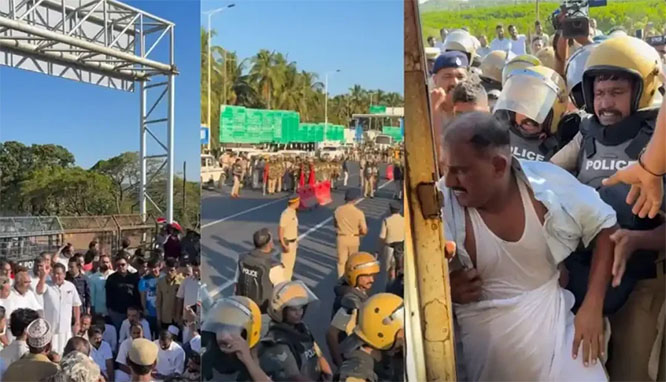
Mangaluru: The KSRTC Mangaluru division has rolled back the fare hike on buses operating on the Mangaluru–Kasaragod route following the suspension of toll collection at the Arikkady toll plaza near Kumbala in Kasaragod district.

The fare revision had been implemented after the National Highways Authority of India (NHAI) began toll collection at the Arikkady plaza on NH-66. As a result, fares for ordinary and Rajahamsa services were increased by ₹7 and ₹10, respectively, raising the bus fare from Mangaluru to Kasaragod from ₹81 to ₹88.

Senior Divisional Controller of KSRTC’s Mangaluru division, Rajesh Shetty, said the fares were reduced after toll collection at the Arikkady plaza was stopped. “The tollgate began operations on January 13, and the toll amount was deducted from the FASTag accounts of KSRTC buses operating on the route. Following an order from the central government to suspend toll collection, KSRTC has also withdrawn the additional fare with immediate effect,” he said.

At present, vehicles travelling on the Mangaluru–Kasaragod route pay toll only at the Talapady toll plaza. The toll for light motor vehicles (LMVs) at Talapady is ₹80 for a same-day return, while heavy vehicles, including buses, are charged ₹250. At Arikkady, the toll rates were ₹130 for LMVs (same-day return) and ₹450 for buses.

Protests against Arikkady toll plaza

The Arikkady toll plaza witnessed widespread protests from January 12, the day toll collection commenced. On the second day, an action committee led by Manjeshwar MLA A K M Ashraf launched an indefinite protest at the site. Except for the BJP, leaders and workers of most major political parties participated in the agitation.

On the night of January 14, a large number of protesters gathered at the plaza and vandalised property, following which authorities temporarily suspended toll operations. The BJP later also expressed opposition to the toll plaza and criticised NHAI’s decision. 

Comments

Add new comment

  • Coastaldigest.com reserves the right to delete or block any comments.
  • Coastaldigset.com is not responsible for its readers’ comments.
  • Comments that are abusive, incendiary or irrelevant are strictly prohibited.
  • Please use a genuine email ID and provide your name to avoid reject.
News Network
January 23,2026

Karnataka Governor Thaawarchand Gehlot read only three lines from the 122-paragraph address prepared by the Congress-led state government while addressing the joint session of the Legislature on Thursday, effectively bypassing large sections critical of the BJP-led Union government.

The omitted portions of the customary Governor’s address outlined what the state government described as a “suppressive situation in economic and policy matters” under India’s federal framework. The speech also sharply criticised the Centre’s move to replace the Mahatma Gandhi National Rural Employment Guarantee Act (MGNREGA) with the Viksit Bharat–Guarantee for Rozgar and Ajeevika Mission (Gramin) Act, commonly referred to as the VB-GRAM (G) Act.

Governor Gehlot had earlier conveyed his objection to several paragraphs that were explicitly critical of the Union government. On Thursday, he confined himself to the opening lines — “I extend a warm welcome to all of you to the joint session of the State legislature. I am extremely pleased to address this august House” — before jumping directly to the concluding sentence of the final paragraph.

He ended the address by reading the last line of paragraph 122: “Overall, my government is firmly committed to doubling the pace of the State’s economic, social and physical development. Jai Hind — Jai Karnataka.”

According to the prepared speech, the Karnataka government demanded the scrapping of the VB-GRAM (G) Act, describing it as “contractor-centric” and detrimental to rural livelihoods, and called for the full restoration of MGNREGA. The state government argued that the new law undermines decentralisation, weakens labour protections, and centralises decision-making in violation of constitutional norms.

Key points from the unread sections of the speech:

•    Karnataka facing a “suppressive” economic and policy environment within the federal system

•    Repeal of MGNREGA described as a blow to rural livelihoods

•    VB-GRAM (G) Act accused of protecting corporate and contractor interests

•    New law alleged to weaken decentralised governance

•    Decision-making said to be imposed by the Centre without consulting states

•    Rights of Adivasis, women, backward classes and agrarian communities curtailed

•    Labourers allegedly placed under contractor control

•    States facing mounting fiscal stress due to central policies

•    VB-GRAM (G) Act accused of enabling large-scale corruption

Comments

Add new comment

  • Coastaldigest.com reserves the right to delete or block any comments.
  • Coastaldigset.com is not responsible for its readers’ comments.
  • Comments that are abusive, incendiary or irrelevant are strictly prohibited.
  • Please use a genuine email ID and provide your name to avoid reject.