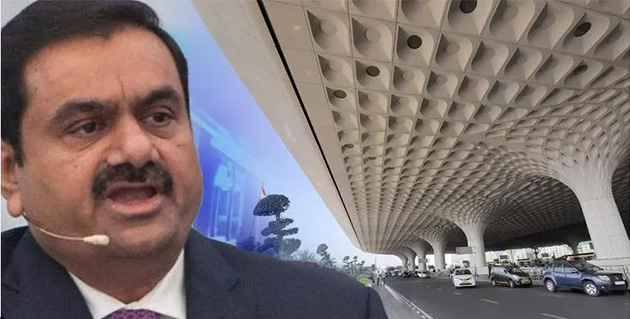
'Why PMO ignored Niti recommendations against handing over 6 airports to Adani?'

News Network
February 8, 2023

adani.jpg

New Delhi, Feb 8: The Congress on Wednesday questioned as to why the Prime Minister’s Office “ignored” Niti Aayog recommendations against handing over six airports to an “inexperienced” Adani Group, a day after Rahul Gandhi linked the meteoric rise in the wealth of the business conglomerate to the BJP coming to power.

In the Congress’ HAHK (Hum Adani Ke Hain Kaun) series, the party’s general secretary Jairam Ramesh posed a set of three questions to the BJP, asking how the group became the largest airport operator in the country in a short span on time.

He also alleged that while the Congress-led UPA government promoted competition in the sector, the BJP dispensation favoured one business group.

In 2006, the United Progressive Alliance government awarded concessions to the GMR and GVK groups to operate Delhi and Mumbai airports respectively for a period of 30 years, he said. On November 7, 2006, the Supreme Court upheld these privatisation along with the condition that each bidder needed to partner with an experienced airport operator, he said.

Even though GMR had emerged as the top bidder in both cases, it was decided not to award both the airports to the firm in the interests of competition, the Congress leader claimed.

However, the BJP government in 2019 gave the right to operate six airports — Ahmedabad, Lucknow, Mangalore, Jaipur, Guwahati and Thiruvananthapuram — to the Adani Group, which had zero prior experience of operating airports, for a period of 50 years, Ramesh said.

He claimed the airports were handed over to the group despite a NITI Aayog memo of December 10, 2018 arguing that “a bidder lacking sufficient technical capacity” could “jeopardise the project and compromise the quality of services the government is committed to provide”.

On the same day as the NITI Aayog filed its objection, a note from the Department of Economic Affairs (DEA) in the Ministry of Finance strongly recommended that not more than two airports be awarded to a single bidder so as to reduce risk and to facilitate competition, he claimed.

“Why did the PMO and the NITI Aayog chairman, who headed the Empowered Group of Secretaries, ignore this recommendation and facilitate a clean sweep of six airports by the inexperienced Adani Group,” the Congress leader asked.

He also pointed out that the model Request for Quotes (RFQ) document though gave points for project experience outside the airports sector, the experience in the airports sector was important. “Yet this too was ignored by the ruling dispensation in its rush to help its cronies. Who instructed the Empowered Group of Secretaries to set aside this prior condition, thus clearing the way for the Adani Group to build a virtual monopoly in the sector,” he asked.

The Adani Group’s takeover of Mumbai airport should be a case study in crony capitalism, he also said, claiming that the GVK group had vigorously contested the Adani Group’s attempts to buy a stake in Mumbai airport in 2019, going to the courts and raising funds to buy out its joint venture partners Bidvest and ACSA.

“Yet in August 2020, only one month following raids by the Central Bureau of Investigation (CBI) and Enforcement Directorate (ED), GVK felt compelled to sell its most valuable asset to the Adani Group.

“What happened to the CBI and ED investigations against GVK? How did they miraculously disappear after the sale of Mumbai airport to the Adani Group? Are those cases being used to apply pressure on GVK to defend the very group that forced it to divest India’s second busiest airport,” he asked.

Business conglomerate GVK Group on Wednesday categorically said there was no “extraneous pressure” from anyone to sell its stake in Mumbai airport as alleged by Congress leader Rahul Gandhi.

The company’s comments came a day after Gandhi alleged in Lok Sabha that “Mumbai airport was taken away from GVK using agencies such as the CBI and the ED, and was given to Adani by the Government of India”.

“GVK reiterates that the decision to sell its stakes in Mumbai Airport to Adani, was taken by the management and there was absolutely no question of any extraneous pressure being exerted on us,” a GVK Group spokesperson told PTI.

The Adani Group, which is currently in the eye of a storm over the recent report by short-seller Hindenburg Research related to its company’s business dealings, took over the management of the Mumbai airport from GVK Group in July 2021. 

Comments

Add new comment

  • Coastaldigest.com reserves the right to delete or block any comments.
  • Coastaldigset.com is not responsible for its readers’ comments.
  • Comments that are abusive, incendiary or irrelevant are strictly prohibited.
  • Please use a genuine email ID and provide your name to avoid reject.
News Network
February 3,2026

wind.jpg

Dakshina Kannada MP Capt Brijesh Chowta has urged the Centre to give high priority to offshore wind energy generation along the Mangaluru coast, citing its strategic importance to India’s green energy and port-led development goals.

Raising the issue in the Lok Sabha under Rule 377, Chowta said studies by the National Institute of Oceanography have identified the Mangaluru coastline as part of India’s promising offshore wind ‘Zone-2’, covering nearly 6,490 sq km. He noted that the region’s relatively low exposure to cyclones and earthquakes makes it suitable for long-term offshore wind projects and called for its development as a dedicated offshore wind energy zone.

Highlighting the role of New Mangalore Port, Chowta said its modern infrastructure, multiple berths and heavy cargo-handling capacity position it well as a logistics hub for transporting and assembling large wind energy equipment.

He also pointed to the presence of major industrial units such as MRPL, OMPL, UPCL and the Mangaluru SEZ, which could serve as direct buyers of green power through power purchase agreements, improving project viability and speeding up execution.

With Karnataka’s peak power demand crossing 18,000 MW in early 2025, Chowta stressed the need to diversify renewable energy sources. He added that offshore wind projects in the Arabian Sea are strategically safer compared to the cyclone-prone Bay of Bengal.

Calling the project vital to India’s target of 500 GW of renewable energy by 2030, Chowta urged the Ministry of New and Renewable Energy to initiate resource assessments, pilot projects and stakeholder consultations at the earliest.

Comments

Add new comment

  • Coastaldigest.com reserves the right to delete or block any comments.
  • Coastaldigset.com is not responsible for its readers’ comments.
  • Comments that are abusive, incendiary or irrelevant are strictly prohibited.
  • Please use a genuine email ID and provide your name to avoid reject.
News Network
January 23,2026

Karnataka Governor Thaawarchand Gehlot read only three lines from the 122-paragraph address prepared by the Congress-led state government while addressing the joint session of the Legislature on Thursday, effectively bypassing large sections critical of the BJP-led Union government.

The omitted portions of the customary Governor’s address outlined what the state government described as a “suppressive situation in economic and policy matters” under India’s federal framework. The speech also sharply criticised the Centre’s move to replace the Mahatma Gandhi National Rural Employment Guarantee Act (MGNREGA) with the Viksit Bharat–Guarantee for Rozgar and Ajeevika Mission (Gramin) Act, commonly referred to as the VB-GRAM (G) Act.

Governor Gehlot had earlier conveyed his objection to several paragraphs that were explicitly critical of the Union government. On Thursday, he confined himself to the opening lines — “I extend a warm welcome to all of you to the joint session of the State legislature. I am extremely pleased to address this august House” — before jumping directly to the concluding sentence of the final paragraph.

He ended the address by reading the last line of paragraph 122: “Overall, my government is firmly committed to doubling the pace of the State’s economic, social and physical development. Jai Hind — Jai Karnataka.”

According to the prepared speech, the Karnataka government demanded the scrapping of the VB-GRAM (G) Act, describing it as “contractor-centric” and detrimental to rural livelihoods, and called for the full restoration of MGNREGA. The state government argued that the new law undermines decentralisation, weakens labour protections, and centralises decision-making in violation of constitutional norms.

Key points from the unread sections of the speech:

•    Karnataka facing a “suppressive” economic and policy environment within the federal system

•    Repeal of MGNREGA described as a blow to rural livelihoods

•    VB-GRAM (G) Act accused of protecting corporate and contractor interests

•    New law alleged to weaken decentralised governance

•    Decision-making said to be imposed by the Centre without consulting states

•    Rights of Adivasis, women, backward classes and agrarian communities curtailed

•    Labourers allegedly placed under contractor control

•    States facing mounting fiscal stress due to central policies

•    VB-GRAM (G) Act accused of enabling large-scale corruption

Comments

Add new comment

  • Coastaldigest.com reserves the right to delete or block any comments.
  • Coastaldigset.com is not responsible for its readers’ comments.
  • Comments that are abusive, incendiary or irrelevant are strictly prohibited.
  • Please use a genuine email ID and provide your name to avoid reject.
News Network
February 1,2026

Bengaluru: The Karnataka High Court has refused to quash an investigation against a WhatsApp group administrator accused of allowing the circulation of obscene and offensive images depicting Hindutva politicians and idols in 2021.

Justice M Nagaprasanna observed that, prima facie, the ingredients of the offence under Section 295A of the Indian Penal Code were made out. “The offence under Section 295A of the IPC is met to every word of its ingredient, albeit prima facie,” the judge said.

The petitioner, Sirajuddin, a resident of Belthangady taluk in Dakshina Kannada district, had challenged the FIR registered against him at the CEN (Cyber, Economics and Narcotics) police station, Mangaluru, for offences under Section 295A of the IPC and Section 67 of the Information Technology Act. Section 295A relates to punishment for deliberate and malicious acts intended to outrage the religious feelings of any class of citizens.

According to the complaint filed by K Jayaraj Salian, also a resident of Belthangady taluk, he received a WhatsApp group link from an unknown source and was added to the group after accessing it. The group reportedly had six administrators and around 250 participants, where obscene and offensive images depicting Hindu deities and certain political figures were allegedly circulated repeatedly.

Sirajuddin was arrested in connection with the case and later released on bail on February 16, 2021. He argued before the court that he was being selectively targeted, while other administrators—including the creator of the group—were neither arrested nor investigated. He also contended that the Magistrate could not have taken cognisance of the offence under Section 295A without prior sanction under Section 196(1) of the CrPC.

Rejecting the argument, Justice Nagaprasanna held that prior sanction is required only at the stage of taking cognisance, and not at the stage of registration of the crime or during investigation.

The judge noted that the State had produced the entire investigation material before the court. “A perusal of the material reveals depictions of Hindu deities in an extraordinarily obscene, demeaning and profane manner. The content is such that its reproduction in a judicial order would itself be inappropriate,” the court said, adding that the material, on its face, had the tendency to outrage religious feelings and disturb communal harmony.

Observing that the case was still at the investigation stage, the court said it could not interdict the probe at this juncture. However, it expressed concern that the investigating officer appeared to have not proceeded uniformly against all administrators. The court clarified that if the investigation revealed the active involvement of any member in permitting the circulation of such content, they must also be proceeded against.

“At this investigative stage, any further observation by this Court would be unnecessary,” the order concluded.

Comments

Add new comment

  • Coastaldigest.com reserves the right to delete or block any comments.
  • Coastaldigset.com is not responsible for its readers’ comments.
  • Comments that are abusive, incendiary or irrelevant are strictly prohibited.
  • Please use a genuine email ID and provide your name to avoid reject.