



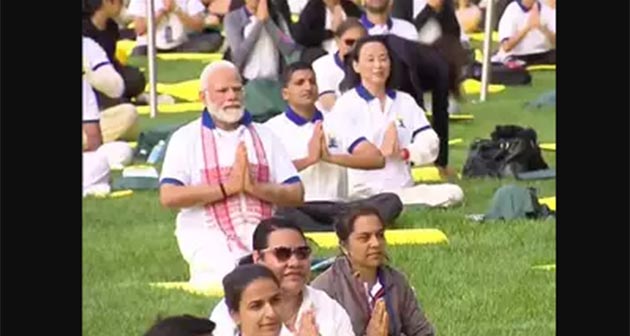
‘Yoga is truly universal and free from copyrights,’ says PM Modi as he leads Yoga session at UN

News Network
June 21, 2023

UNyoga.jpg

United Nations, June 21: Prime Minister Narendra Modi Wednesday described Yoga as "truly universal" and free from copyrights and patents as he led a historic event at the UN Headquarters to commemorate the 9th International Day of Yoga, attended by top UN officials, envoys from across and the world and prominent individuals.

Modi, who is here on the first leg of his maiden state visit to the US at the invitation of President Joe Biden and First Lady Jill Biden, began the celebration by paying respects to the bust of Mahatma Gandhi in the North Lawn of the UN headquarters. The bust was installed in December last year under India's presidency of the UN Security Council.

The prime minister, wearing an especially customised white yoga T-shirt and trousers, began his address with a 'Namaste' and thanked people for coming here from far away to attend the celebration.

"I'm delighted to see you all. And I thank you all for coming. Friends. I'm told that almost every nationality is represented here today," Modi said.

"Yoga comes from India and it is a very old tradition. Yoga is free from copyrights, patents and royalty payments. Yoga is adaptable to your age, gender and fitness level. Yoga is portable and is truly universal," Modi told the gathering.

Hundreds of yellow yoga mats were placed on the ground where yoga enthusiasts and practitioners, wearing customised white yoga T-shirts, joined the event.

LED screens playing videos of Indian culture and heritage were set up on the lawn.

"Yoga means to unite...I remember about nine years ago, right here, I had the honour to propose celebrating the International Day of yoga on 21st June. It was wonderful to see the entire world come together to support the idea," Modi said.

The historic yoga session was attended by top UN officials, ambassadors, envoys, delegates from Member States as well as prominent members of the global and diaspora community.

"I am excited for everyone who is participating in Yoga Day," said Linda Thomas-Greenfield, the US ambassador to the UN.

President of the 77th session of the United Nations General Assembly Csaba Korosi, Hollywood actor Richard Gere, Mayor of New York City Eric Adams and Deputy Secretary General of the United Nations Amina J Mohammed were among prominent personalities who attended the event.

"The feeling here is so open and embracing, I hope this feeling intoxicates the entire building. It's a really nice feeling here today," Gere said ahead of the event.

People from more than 180 countries participated in Prime Minister Modi-led Yoga Day celebrations here, representing different walks of life and comprising diplomats, artists, academicians and entrepreneurs among others, sources said.

"You can see the vibrations and excitement. Hundreds of people are lining up for International Yoga (Day celebrations) with Prime Minister Modi. Such a great feeling," said Dilip Chauhan, Deputy Commissioner for New York City Mayor's Office for International Affairs.

Ruchika Lal, Yoga and Meditation Instructor, Art of Living, said people are excited. "They have been waiting outside since 6 am," she said.

People were seen standing in queues outside UN headquarters to take part in the yoga session since early morning.

The first International Day of Yoga was commemorated in 2015 and has since then been marked with several sessions and events highlighting the benefits and universal appeal of Yoga at the UN, Times Square and iconic locations across the world.

The UN underlined that Yoga is an ancient physical, mental and spiritual practice that originated in India. The word ‘yoga’ is derived from Sanskrit and means to join or to unite, symbolising the union of body and consciousness. Today it is practised in various forms around the world and continues to grow in popularity.

Recognising its universal appeal, in December 2014, the UN proclaimed June 21 as the International Day of Yoga. The draft UNGA resolution establishing the International Day of Yoga was proposed by India and endorsed by a record 175 member states. The proposal was first introduced by Prime Minister Modi in his address during the opening of the 69th session of the UN General Assembly.

Earlier in a video message on the occasion of the International Day of Yoga, Modi said India has always nurtured traditions that unite, adopt and embrace and made a fervent appeal to eliminate contradictions, hurdles and resistances through yoga.

Modi said Indians have welcomed new ideas, conserved them and celebrated the country's rich diversity.

Yoga strengthens such feelings, expands the inner vision, and connects us with that consciousness which makes us feel the unity of the living being giving a basis of love for the living being,  the prime minister said.

"We have to eliminate our contradictions, blockages and resistances through Yoga. We have to present the spirit of ‘Ek Bharat, Shreshtha Bharat’ as an example to the world,” Modi said.

Modi also said the International Day of Yoga was special this year as researchers at India's research stations in the Arctic and Antarctica too were participating in the celebrations.

UN Secretary-General Antonio Guterres, in his message for Yoga Day, said yoga unites people. "It unites body and mind, humanity and nature and millions of people across the globe for whom it is a source of strength, harmony and peace," he said.

"In a dangerous and divided world, the benefits of this ancient practice are particularly precious. Yoga offers a haven of calm, it can reduce anxiety and promote mental well-being. It helps us to develop discipline and patience. It connects us to our planet, which so badly needs our protection," Guterres said.

He added that yoga reveals "our common humanity, helping us to understand that despite our differences, we are one. On this International Day of Yoga, let us embrace the spirit of unity and resolve to build a better, more harmonious world for people, the planet and ourselves."

Comments

Add new comment

  • Coastaldigest.com reserves the right to delete or block any comments.
  • Coastaldigset.com is not responsible for its readers’ comments.
  • Comments that are abusive, incendiary or irrelevant are strictly prohibited.
  • Please use a genuine email ID and provide your name to avoid reject.
News Network
February 4,2026

shettigar.jpg

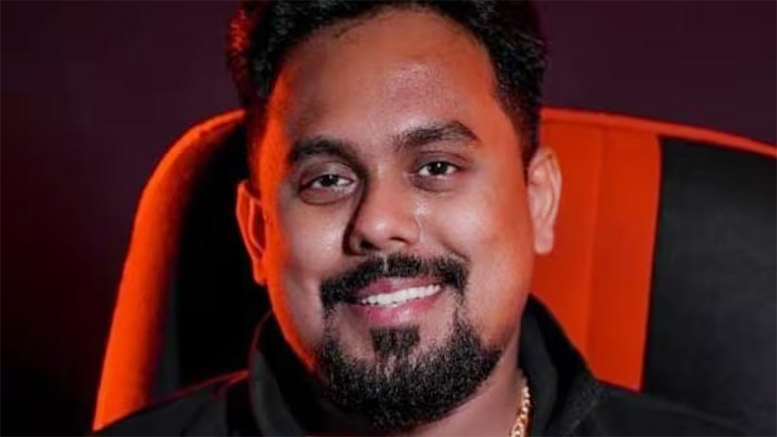
An Indian resident who won the Dh20 million (approximately Rs 50 crore) jackpot in Abu Dhabi's Big Ticket draw has told of his joy at sharing his life-changing fortune with a friend.

Shanthanu Shettigar, a shop manager in Muscat, regularly buys tickets for the monthly grand prize draw with one of his closest friends – and the pair won on February 3.

Mr Shettigar, 33, who is from Udyavar in Udupi district of the southern state of Karnataka and has lived in the Omani capital for eight years, said he was left speechless after learning of his success.

“When I first moved to Muscat, many of my colleagues were purchasing Big Ticket, which encouraged me to give it a try,” he said.

“I started buying tickets on my own, and later began sharing tickets with a close friend. The ticket that brought me this win was one we purchased together.”

“Like most people, I receive a lot of spam calls, and I was fully absorbed in my work as well. I knew the live draw was taking place tonight, but I never imagined my name would be announced,” he said.

“When I realised it was real and that I had won, I was honestly speechless. It still hasn’t fully sunk in, but I’m extremely happy.”

Mr Shettigar is not sure how he will spend his share of the money, but encouraged others to take part.

“This win was completely unexpected, so I want to take some time to think things through before deciding what to do next,” he said.

“I would definitely encourage others to participate with Big Ticket, whether with family or friends – you never know when your moment might come.”

The Big Ticket was established in 1992 with an initial first prize of Dh1 million. It is one of the most popular monthly raffles in the UAE.

It has transformed the lives of many people across the Emirates and beyond.

Entry to the Big Ticket Millionaire is Dh500. Tickets can be bought online or at counters at Zayed International Airport and Al Ain Airport.

Comments

Add new comment

  • Coastaldigest.com reserves the right to delete or block any comments.
  • Coastaldigset.com is not responsible for its readers’ comments.
  • Comments that are abusive, incendiary or irrelevant are strictly prohibited.
  • Please use a genuine email ID and provide your name to avoid reject.
News Network
January 23,2026

Mangaluru: The Karnataka Government Polytechnic (KPT), Mangaluru, has achieved autonomous status from the All India Council for Technical Education (AICTE), becoming the first government polytechnic in the country to receive such recognition in its 78-year history. The status was granted by AICTE, New Delhi, and subsequently approved by the Karnataka Board of Technical Education in October last year.

Officials said the autonomy was conferred a few months ago. Until recently, AICTE extended autonomous status only to engineering colleges, excluding diploma institutions. However, with a renewed national focus on skill development, several government polytechnics across India have now been granted autonomy.

KPT, the second-largest polytechnic in Karnataka, was established in 1946 with four branches and has since expanded to offer eight diploma programmes, including computer science and polymer technology. The institution is spread across a 19-acre campus.

Ravindra M Keni, the first dean of the institution, told The Times of India that AICTE had proposed autonomous status for polytechnic institutions that are over 25 years old. “Many colleges applied. In the first round, 100 institutions were shortlisted, which was further narrowed down to 15 in the second round. We have already completed one semester after becoming an autonomous institution,” he said. He added that nearly 500 students are admitted annually across eight three-year diploma courses.

Explaining the factors that helped KPT secure autonomy, Keni said the institution has consistently recorded 100 per cent admissions and placements for its graduates. He also noted its strong performance in sports, with the college emerging champions for 12 consecutive years, along with active student participation in NCC and NSS activities.

Autonomous status allows KPT to design industry-oriented curricula, conduct examinations, prepare question papers, and manage academic documentation independently. The institution can also directly collaborate with industries and receive priority funding from AICTE or the Ministry of Education. While academic autonomy has been granted, financial control will continue to rest with the state government.

“There will be separate committees for examinations, question paper setting, boards of studies, and boards of examiners. The institution will now have the freedom to conduct admissions without government notifications and issue its own marks cards,” Keni said, adding that new academic initiatives would be planned after a year of functioning under the autonomous framework.

Comments

Add new comment

  • Coastaldigest.com reserves the right to delete or block any comments.
  • Coastaldigset.com is not responsible for its readers’ comments.
  • Comments that are abusive, incendiary or irrelevant are strictly prohibited.
  • Please use a genuine email ID and provide your name to avoid reject.
News Network
January 23,2026

Karnataka Governor Thaawarchand Gehlot read only three lines from the 122-paragraph address prepared by the Congress-led state government while addressing the joint session of the Legislature on Thursday, effectively bypassing large sections critical of the BJP-led Union government.

The omitted portions of the customary Governor’s address outlined what the state government described as a “suppressive situation in economic and policy matters” under India’s federal framework. The speech also sharply criticised the Centre’s move to replace the Mahatma Gandhi National Rural Employment Guarantee Act (MGNREGA) with the Viksit Bharat–Guarantee for Rozgar and Ajeevika Mission (Gramin) Act, commonly referred to as the VB-GRAM (G) Act.

Governor Gehlot had earlier conveyed his objection to several paragraphs that were explicitly critical of the Union government. On Thursday, he confined himself to the opening lines — “I extend a warm welcome to all of you to the joint session of the State legislature. I am extremely pleased to address this august House” — before jumping directly to the concluding sentence of the final paragraph.

He ended the address by reading the last line of paragraph 122: “Overall, my government is firmly committed to doubling the pace of the State’s economic, social and physical development. Jai Hind — Jai Karnataka.”

According to the prepared speech, the Karnataka government demanded the scrapping of the VB-GRAM (G) Act, describing it as “contractor-centric” and detrimental to rural livelihoods, and called for the full restoration of MGNREGA. The state government argued that the new law undermines decentralisation, weakens labour protections, and centralises decision-making in violation of constitutional norms.

Key points from the unread sections of the speech:

•    Karnataka facing a “suppressive” economic and policy environment within the federal system

•    Repeal of MGNREGA described as a blow to rural livelihoods

•    VB-GRAM (G) Act accused of protecting corporate and contractor interests

•    New law alleged to weaken decentralised governance

•    Decision-making said to be imposed by the Centre without consulting states

•    Rights of Adivasis, women, backward classes and agrarian communities curtailed

•    Labourers allegedly placed under contractor control

•    States facing mounting fiscal stress due to central policies

•    VB-GRAM (G) Act accused of enabling large-scale corruption

Comments

Add new comment

  • Coastaldigest.com reserves the right to delete or block any comments.
  • Coastaldigset.com is not responsible for its readers’ comments.
  • Comments that are abusive, incendiary or irrelevant are strictly prohibited.
  • Please use a genuine email ID and provide your name to avoid reject.