Iran: Protesters killed in anti-govt rallies

Al Jazeera
December 31, 2017

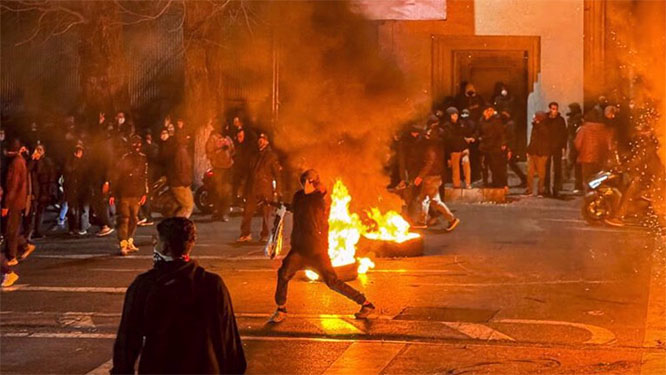
At least two protesters have been killed in rare anti-government protests in Iran, according to a semi-official Iranian news agency. 

The Mehr news agency said on Sunday that at least two people died on Saturday night in Dorud, a city in western Iran.

Habibollah Khojastepour, security deputy of the governor of Lorestan province, said the presence of "agitators" prevented a peaceful end to the protest, according to Mehr.

Khojastepour said neither police nor security forces fired at the protesters. He did not provide a reason for their deaths.

News of the fatalities came as Interior Minister Abdolrahman Rahmani Fazli warned demonstrators against disruptive behavior.

"Those who damage public property, disrupt order and break the law must be responsible for their behaviour and pay the price," Abdolrahman Rahmani Fazli said on state television early on Sunday.

Iranians began protesting on Thursday in the second city of Masshad, rallying against high prices.

The rallies have since gained momentum, spread to other cities, and are described as the largest in nearly a decade.

Saturday marked the third day of anti-government protests across Iran, when students and police clashed in Tehran.

Videos posted on Twitter by the New-York based Center for Human Rights in Iran appeared to show police in riot gear clashing with protesters outside the gates to the Tehran University.

A second video showed smoke-shrouded streets, purportedly from tear gas, in the same area.

Al Jazeera could not authenticate the footage, but semi-state news agency Fars also reported confrontations between police and protesters at Tehran University.

Meanwhile, tens of thousands of people across Iran attended preplanned pro-government rallies on Saturday to mark the end of unrest following the country's 2009 election.

State TV aired footage showing people in several cities waving flags and carrying banners bearing the image of Supreme Leader Ayatollah Ali Khamenei.

The large demonstrations, which were organised weeks ago, are held every year.

'They no longer fear security forces'

Potkin Azarmehr, a blogger who focuses on the secular pro-democracy struggle in Iran, told Al Jazeera that several groups have been protesting for some time "and now their slogans have become more radical". 

"They no longer seem to have that fear from security forces," he said.

Mahan Abedin, an Iran analyst at Middle East Eye, said the protests reflect the gap between ordinary Iranians and the political elite.

The protests appeared to be "articulated by people who ostensibly have purely economic motives", he said.

"I think in keeping with longstanding culture, inevitably these protests have become political.

"[President Hassan] Rouhani has the right attitude but his government riles people. This is a very elitist government, they are bureaucratic elites, technocratic elites - they are very distant from grievances of ordinary people."

Reports said activists on social media have called for a fourth day of protests on Sunday.

Meanwhile, the US has been quick to respond to developments, warning Tehran against arresting peaceful protesters.

US President Donald Trump has posted a series of tweets on Iran, most recently writing: "Oppressive regimes cannot endure forever. The world is watching!"

Under Trump's administration, Washington and Tehran have grown further apart, clashing on foreign policy issues such as the wars in Syria and Yemen and over the 2015 nuclear deal with world powers.

In response to Trump, Bahram Qassemi, spokesman for Iran's foreign ministry, called the US president's warnings "cheap, worthless and invalid", according to the semi-state news agency Fars.

"Iranian people feel no value for the opportunistic claims of the US officials and Mr. Trump, himself", Qassemi was quoted as saying.

Comments

Add new comment

  • Coastaldigest.com reserves the right to delete or block any comments.
  • Coastaldigset.com is not responsible for its readers’ comments.
  • Comments that are abusive, incendiary or irrelevant are strictly prohibited.
  • Please use a genuine email ID and provide your name to avoid reject.
News Network
February 1,2026

Bengaluru, Feb 1: For travelers landing at Kempegowda International Airport (KIA), the sleek, wood-paneled curves of Terminal 2 promise a world-class welcome. But the famed “Garden City” charm quickly withers at the curb. As India’s aviation sector swells to record numbers—handling over 43 million passengers in Bengaluru alone this past year—the “last mile” has turned into a marathon of frustration.

The Bengaluru Logjam: Rules vs Reality

While the city awaits the 2027 completion of the Namma Metro Blue Line, the interim has been chaotic. Recent “decongestion” rules at Terminal 1 have pushed app-based cab pickups to distant parking zones, forcing weary passengers into a 20-minute walk with luggage.

“I landed after ten months away and felt like a stranger in my own city,” says Ruchitha Jain, a Koramangala resident. “My driver couldn’t find me, staff couldn’t guide me, and the so-called ‘Premium’ lane is just a fancy tax on convenience.”

•    The Cost of Distance: A 40-km cab ride can now easily cross ₹1,500, driven by demand pricing and airport surcharges.

•    The Bus Gap: While Vayu Vajra remains a lifeline, its ₹300–₹400 fare is often cited as the most expensive airport bus service in the country.

A National Pattern of Disconnect

The struggle is not unique to Karnataka. From Chennai’s coast to Hyderabad’s plateau, India’s airports tell a familiar story: brilliant runways, broken exits.

City:    Primary Issue   |    Recent Development

Bengaluru:    Cab pickup restrictions & distance  |    App-based taxis shifted to far parking zones; long walks and fare spikes reported

Chennai:    Multi-Level Parking (MLCP) hike  |    Passengers report 40-minute walks to reach cab pickup points

Hyderabad:    “Taxi mafia” & touting  |    Over 440 touting cases reported; security presence intensified

Mumbai:    Fare scams  |     Tourists charged ₹18,000 for just 400 metres, triggering police action

In Hyderabad, travelers continue to battle entrenched local groups that intimidate Uber and Ola drivers, pushing passengers toward overpriced private taxis. Chennai flyers, meanwhile, complain that reaching the designated pickup zones now takes longer than short-haul flights from cities like Coimbatore.

The ‘Budget Day’ Hope

As Finance Minister Nirmala Sitharaman presents the Union Budget 2026 today, the aviation sector is watching closely. With the government’s renewed emphasis on multimodal integration, there is cautious hope for funding toward seamless airport-metro-bus hubs.

The vision is clear: a future where planes, trains, and metros speak the same language. Until then, passengers at KIA—and airports across India—will continue to discover that the hardest part of flying isn’t the thousands of kilometres in the air, but the last few on the ground.

Comments

Add new comment

  • Coastaldigest.com reserves the right to delete or block any comments.
  • Coastaldigset.com is not responsible for its readers’ comments.
  • Comments that are abusive, incendiary or irrelevant are strictly prohibited.
  • Please use a genuine email ID and provide your name to avoid reject.
News Network
January 20,2026

DGP.jpg

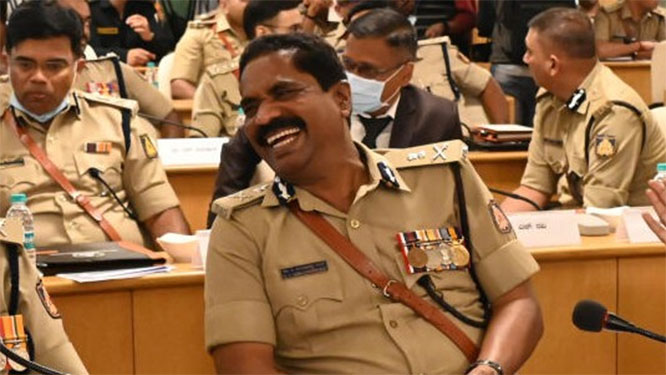
Karnataka DGP (Civil Rights Enforcement) K Ramachandra Rao was suspended with immediate effect, as per a state government order issued on Monday, 19 January. The order cited conduct unbecoming of a government servant and causing embarrassment to the state administration.

The Karnataka government suspended Rao after a purported video showed him in a compromising position with a woman inside his official chamber. The video went viral on social media. Rao rejected the videos outright, terming them "fabricated and false".

Who is K Ramachandra Rao?

Rao is a DGP-rank officer who was heading the Directorate of Civil Rights Enforcement until his suspension. He was promoted to DGP in September 2023 and assumed office in October 2023, the Sunday Guardian reported.

He also served as the Chairman and Managing Director of the Karnataka State Police Housing and Infrastructure Development Corporation Limited.

His stint as the Inspector General of Police (IGP) for the Southern Range was also marred by controversy. In 2014, during a cash seizure near Mysuru’s Yelwal, officials claimed the seized amount was ₹20 lakh, while the accused (Kerala-based merchants) claimed it was around ₹2.27 crore.

Rao, who was present during the seizure, denied all allegations. However, he was transferred soon after.

Allegations of collusion with a businessman surfaced, and a senior police officer was quoted by The Sunday Guardian as saying, “In Rao’s case, the CID has clearly mentioned that there was a great degree of lapse on the part of Rao and a deputy superintendent of police after it was brought to their notice that a few policemen, including a gunman attached to the IGP, were involved in the robbery.”

Rao had denied all wrongdoing in that incident. Despite past controversies, he rose to the state’s top police position, the Sunday Guardian reported.

Ranya Rao’s stepfather

Rao is the stepfather of Kannada actress Harshavardhini Ranya alias Ranya Rao, accused of orchestrating the illegal import of gold worth over ₹12.56 crore from Dubai to India along with two others — businessman Tarun Raju, and jewellery dealer Sahil Jain.

‘Obscene video’ controversy

A viral video showed Rao behaving inappropriately with a woman inside his office while in uniform.

The Karnataka government said in its Monday order that “vide videos and news reports widely broadcast on public news channels and media platforms, it is observed that Dr K Ramachandra Rao has acted in an obscene manner which is unbecoming of a Government Servant and also causing embarrassment to the Government.”

The order said the matter was examined by the state government, which found that the officer's conduct amounted to a violation of Rule 3 of the All India Services (Conduct) Rules, 1968.

The government said it is prima facie satisfied that "it is necessary to place Rao under suspension with immediate effect, pending inquiry".

During the suspension period, Rao will be entitled to subsistence allowance as per Rule 4 of the All India Services (Discipline and Appeal) Rules, 1969.

The order also places restrictions on his movement, stating that during the period of suspension, the officer must not leave headquarters under any circumstances without the written permission of the state government.

Comments

Add new comment

  • Coastaldigest.com reserves the right to delete or block any comments.
  • Coastaldigset.com is not responsible for its readers’ comments.
  • Comments that are abusive, incendiary or irrelevant are strictly prohibited.
  • Please use a genuine email ID and provide your name to avoid reject.
News Network
January 20,2026

iran.jpg

Iranian security and intelligence forces have captured more than 470 individuals in three provinces, identified as key figures behind the recent wave of violent unrest and terrorist activities linked to foreign-backed networks.

The Intelligence Ministry's provincial office in Khorasan Razavi announced on Monday the arrest of 192 armed terrorists, identified as the main agents behind recent riots in the region. 

According to an official statement, the detainees were involved in the killing of several security personnel and civilians, setting fire to mosques, public service facilities, and buses, as well as attacks on military and law enforcement centers.

The seized items from the group include several bulletproof vests, Kalashnikov rifles, hunting weapons, Winchester rifles, and various cold weapons such as daggers, swords, brass knuckles, tactical knives, crossbows, and chains.

Evidence indicates that some of the individuals were tied to hostile movements and terrorist organizations, with links overseas. Others were identified as members of violent criminal gangs, actively taking part in the unrest alongside their associates.

Simultaneously, in the western province of Lorestan, the IRGC announced the arrest of 134 individuals as the main leaders and influential field agents of a US-Israeli terrorist network.

The IRGC statement stated that these individuals formed terrorist cells during the recent unrest, committing "Daesh-like" acts.

They wounded security forces with firearms and cold weapons, and burned and destroyed public and private properties, including mosques, shops, banks, and private and public vehicles.

In the northwestern province of Zanjan, the police reported detaining 150 people identified as principal leaders and agents behind recent riots.

Authorities noted that these individuals were responsible for destroying public and private property and intentionally setting fire to vehicles in the province's squares.

Their crimes include shedding the blood of innocent people, destroying public and private property, attempting to enter military sites, disrupting public order, and spreading terror among citizens.

A variety of cold weapons were reportedly seized from the detainees.

What began late last month as peaceful protests over economic hardship across Iran turned violent after public statements by US and Israeli regime figures encouraged vandalism and disorder.

During the unrest, foreign-backed mercenaries rampaged through cities, killing security forces and civilians and damaging public property.

Comments

Add new comment

  • Coastaldigest.com reserves the right to delete or block any comments.
  • Coastaldigset.com is not responsible for its readers’ comments.
  • Comments that are abusive, incendiary or irrelevant are strictly prohibited.
  • Please use a genuine email ID and provide your name to avoid reject.