Jubilation in Zimbabwe as Mugabe era ends

Al Jazeera News
November 22, 2017

Nov 22: Zimbabwe's President Robert Mugabe has submitted his resignation after nearly four decades as the country's leader.

Mugabe defied demands to step down for almost a week after a military takeover and expulsion from his own ruling ZANU-PF party but stepped down on Tuesday, just as parliament started proceedings to impeach him.

Cheers broke out at a special session of parliament as speaker Jacob Mudenda read out Mugabe's resignation letter.

"I Robert Gabriel Mugabe in terms of section 96 of the constitution of Zimbabwe hereby formally tender my resignation ... with immediate effect," said Mudenda, reading the letter.

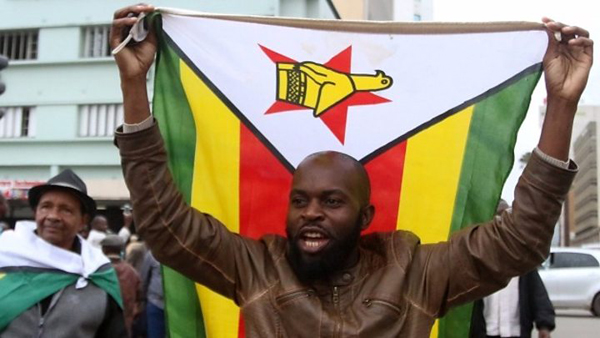
The news also sparked scenes of jubilation in the capital, Harare, as large crowds cheered, danced and sang celebrating Mugabe's departure for hours.

"People are coming out onto the streets, they are calling this day Independence Day," Al Jazeera's Haru Mutasa, reporting from Harare, said.

"It's getting chaotic," she added. "Some people still can't believe this has happened. People say they are really excited and hoping for a better future."

At Harare's Rainbow Towers, crowds cheered as a picture of Mugabe - hung in most public business premises - was taken down.

Celebrations also erupted in central Johannesburg, in neighbouring South Africa, as Zimbabweans there also took to the streets to cheer on the news.

Mugabe's resignation brought an end to the impeachment process initiated by ZANU-PF after its Central Committee voted to dismiss him as party leader.

New era

Mugabe, 93, led Zimbabwe's fight for independence in the 1970s.

He came to power in 1980 and his 37-year rule was criticised for repression of dissent, election rigging, and for causing the country's economic collapse.

"Ever since I was born, I have never thought that I would see this day," Anthony Mutambirwa, a Harare resident, told Al Jazeera as news of Mugabe's resignation spread.

"I'm so glad. For 37 years, we have been suffering."

Mugabe's departure capped a historic week which saw the military seizing power, intervening in party politics over his succession.

Even though Mugabe's resignation letter did not specify who will succeed him, the most likely successor is ousted Vice President Emmerson Mnangagwa, whose sacking on November 6 triggered the turmoil.

Before their falling out, Mnangagwa, who has close ties with the army, had for decades been a faithful Mugabe lieutenant.

Nicknamed "The Crocodile", he was often described as the president's enforcer and few would describe him as a democrat.

Mnangagwa is expected to become, within the next 48 hours, Zimbabwe's interim leader ahead of elections scheduled for next year.

"We expect Mnangagwa to play the game fairly," Paddington Japajapa, an opposition party member, told Al Jazeera in Harare.

"If he is not going to play the game fairly, we will take him on also. We are sick and tired of ZANU-PF's rule."

Mudenda, the speaker, said parliament would now ensure the "proper legal processes are put in place so that the country can proceed forward" and elect a new president.
'Overjoyed'

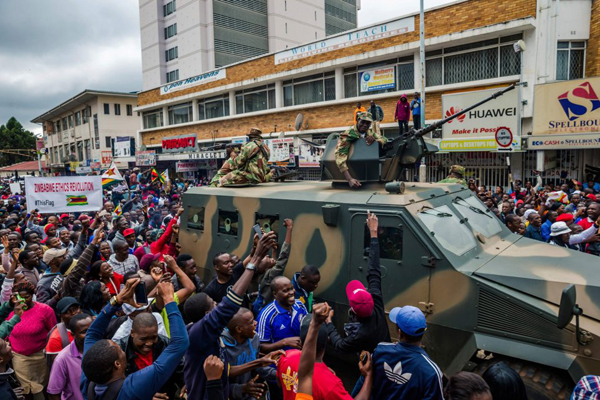
In a surprise move, Zimbabwe's military seized power on November 15, saying it wanted to "target criminals" around the 93-year-old who were leading the ruling ZANU-PF party and state astray.

Both the army and the influential war veterans' association were afraid Mugabe might hand power to his wife, Grace, seen as Mnangagwa's main opponent in the ZANU-PF's succession battle.

In a rare sign of solidarity between the people and the army, which has often been a pillar of support for Mugabe's rule, tens of thousands of Zimbabweans took to the streets on Saturday to express support for the military's operation.

"Over the years, the army has been accused of being implicit with Mugabe," said Al Jazeera's Mutasa.

"People wanted Mugabe to go, so the only way to do this was to work with the military."

Victor Chifodya, a former Harare councillor, said he was "overjoyed at the news" of Mugabe's resignation.

"Mugabe was a very divisive man but now people from all political parties have come together to make him resign," he told Al Jazeera.

"Now we can start a new Zimbabwe," added Chifodya.

However, some expressed concern about what a Mnangagwa presidency may bring.

"People don't know this, but he worked together with Mugabe for 57 years," Garikai Charambarara, a Harare resident, told Al Jazeera.

"Probably people are thinking he is one of the better devils, but, again, let's take it from there."

Comments

Add new comment

  • Coastaldigest.com reserves the right to delete or block any comments.
  • Coastaldigset.com is not responsible for its readers’ comments.
  • Comments that are abusive, incendiary or irrelevant are strictly prohibited.
  • Please use a genuine email ID and provide your name to avoid reject.
News Network
February 4,2026

shettigar.jpg

An Indian resident who won the Dh20 million (approximately Rs 50 crore) jackpot in Abu Dhabi's Big Ticket draw has told of his joy at sharing his life-changing fortune with a friend.

Shanthanu Shettigar, a shop manager in Muscat, regularly buys tickets for the monthly grand prize draw with one of his closest friends – and the pair won on February 3.

Mr Shettigar, 33, who is from Udyavar in Udupi district of the southern state of Karnataka and has lived in the Omani capital for eight years, said he was left speechless after learning of his success.

“When I first moved to Muscat, many of my colleagues were purchasing Big Ticket, which encouraged me to give it a try,” he said.

“I started buying tickets on my own, and later began sharing tickets with a close friend. The ticket that brought me this win was one we purchased together.”

“Like most people, I receive a lot of spam calls, and I was fully absorbed in my work as well. I knew the live draw was taking place tonight, but I never imagined my name would be announced,” he said.

“When I realised it was real and that I had won, I was honestly speechless. It still hasn’t fully sunk in, but I’m extremely happy.”

Mr Shettigar is not sure how he will spend his share of the money, but encouraged others to take part.

“This win was completely unexpected, so I want to take some time to think things through before deciding what to do next,” he said.

“I would definitely encourage others to participate with Big Ticket, whether with family or friends – you never know when your moment might come.”

The Big Ticket was established in 1992 with an initial first prize of Dh1 million. It is one of the most popular monthly raffles in the UAE.

It has transformed the lives of many people across the Emirates and beyond.

Entry to the Big Ticket Millionaire is Dh500. Tickets can be bought online or at counters at Zayed International Airport and Al Ain Airport.

Comments

Add new comment

  • Coastaldigest.com reserves the right to delete or block any comments.
  • Coastaldigset.com is not responsible for its readers’ comments.
  • Comments that are abusive, incendiary or irrelevant are strictly prohibited.
  • Please use a genuine email ID and provide your name to avoid reject.
News Network
January 23,2026

Karnataka Governor Thaawarchand Gehlot read only three lines from the 122-paragraph address prepared by the Congress-led state government while addressing the joint session of the Legislature on Thursday, effectively bypassing large sections critical of the BJP-led Union government.

The omitted portions of the customary Governor’s address outlined what the state government described as a “suppressive situation in economic and policy matters” under India’s federal framework. The speech also sharply criticised the Centre’s move to replace the Mahatma Gandhi National Rural Employment Guarantee Act (MGNREGA) with the Viksit Bharat–Guarantee for Rozgar and Ajeevika Mission (Gramin) Act, commonly referred to as the VB-GRAM (G) Act.

Governor Gehlot had earlier conveyed his objection to several paragraphs that were explicitly critical of the Union government. On Thursday, he confined himself to the opening lines — “I extend a warm welcome to all of you to the joint session of the State legislature. I am extremely pleased to address this august House” — before jumping directly to the concluding sentence of the final paragraph.

He ended the address by reading the last line of paragraph 122: “Overall, my government is firmly committed to doubling the pace of the State’s economic, social and physical development. Jai Hind — Jai Karnataka.”

According to the prepared speech, the Karnataka government demanded the scrapping of the VB-GRAM (G) Act, describing it as “contractor-centric” and detrimental to rural livelihoods, and called for the full restoration of MGNREGA. The state government argued that the new law undermines decentralisation, weakens labour protections, and centralises decision-making in violation of constitutional norms.

Key points from the unread sections of the speech:

•    Karnataka facing a “suppressive” economic and policy environment within the federal system

•    Repeal of MGNREGA described as a blow to rural livelihoods

•    VB-GRAM (G) Act accused of protecting corporate and contractor interests

•    New law alleged to weaken decentralised governance

•    Decision-making said to be imposed by the Centre without consulting states

•    Rights of Adivasis, women, backward classes and agrarian communities curtailed

•    Labourers allegedly placed under contractor control

•    States facing mounting fiscal stress due to central policies

•    VB-GRAM (G) Act accused of enabling large-scale corruption

Comments

Add new comment

  • Coastaldigest.com reserves the right to delete or block any comments.
  • Coastaldigset.com is not responsible for its readers’ comments.
  • Comments that are abusive, incendiary or irrelevant are strictly prohibited.
  • Please use a genuine email ID and provide your name to avoid reject.
News Network
February 1,2026

Bengaluru, Feb 1: For travelers landing at Kempegowda International Airport (KIA), the sleek, wood-paneled curves of Terminal 2 promise a world-class welcome. But the famed “Garden City” charm quickly withers at the curb. As India’s aviation sector swells to record numbers—handling over 43 million passengers in Bengaluru alone this past year—the “last mile” has turned into a marathon of frustration.

The Bengaluru Logjam: Rules vs Reality

While the city awaits the 2027 completion of the Namma Metro Blue Line, the interim has been chaotic. Recent “decongestion” rules at Terminal 1 have pushed app-based cab pickups to distant parking zones, forcing weary passengers into a 20-minute walk with luggage.

“I landed after ten months away and felt like a stranger in my own city,” says Ruchitha Jain, a Koramangala resident. “My driver couldn’t find me, staff couldn’t guide me, and the so-called ‘Premium’ lane is just a fancy tax on convenience.”

•    The Cost of Distance: A 40-km cab ride can now easily cross ₹1,500, driven by demand pricing and airport surcharges.

•    The Bus Gap: While Vayu Vajra remains a lifeline, its ₹300–₹400 fare is often cited as the most expensive airport bus service in the country.

A National Pattern of Disconnect

The struggle is not unique to Karnataka. From Chennai’s coast to Hyderabad’s plateau, India’s airports tell a familiar story: brilliant runways, broken exits.

City:    Primary Issue   |    Recent Development

Bengaluru:    Cab pickup restrictions & distance  |    App-based taxis shifted to far parking zones; long walks and fare spikes reported

Chennai:    Multi-Level Parking (MLCP) hike  |    Passengers report 40-minute walks to reach cab pickup points

Hyderabad:    “Taxi mafia” & touting  |    Over 440 touting cases reported; security presence intensified

Mumbai:    Fare scams  |     Tourists charged ₹18,000 for just 400 metres, triggering police action

In Hyderabad, travelers continue to battle entrenched local groups that intimidate Uber and Ola drivers, pushing passengers toward overpriced private taxis. Chennai flyers, meanwhile, complain that reaching the designated pickup zones now takes longer than short-haul flights from cities like Coimbatore.

The ‘Budget Day’ Hope

As Finance Minister Nirmala Sitharaman presents the Union Budget 2026 today, the aviation sector is watching closely. With the government’s renewed emphasis on multimodal integration, there is cautious hope for funding toward seamless airport-metro-bus hubs.

The vision is clear: a future where planes, trains, and metros speak the same language. Until then, passengers at KIA—and airports across India—will continue to discover that the hardest part of flying isn’t the thousands of kilometres in the air, but the last few on the ground.

Comments

Add new comment

  • Coastaldigest.com reserves the right to delete or block any comments.
  • Coastaldigset.com is not responsible for its readers’ comments.
  • Comments that are abusive, incendiary or irrelevant are strictly prohibited.
  • Please use a genuine email ID and provide your name to avoid reject.