



Washington, Jul 19: Venezuela's government has announced it will go ahead with a controversial election of a Constituent Assembly on July 30, despite a threat of economic sanctions by US President Donald Trump.
"Elections to the National Constituent Assembly is an act of political sovereignty. Nothing and nobody can stop it. The Constituent Assembly is happening" Foreign Minister Samuel Moncada said in a speech at the foreign ministry office.
Moncada vowed to carry out a "deep" review of Venezuela's relations with the US.
"The Venezuelan people are free and will respond united to the insolent threat made by a xenophobic and racist empire."
The new assembly Maduro wants to elect on July 30 would have the power to rewrite the constitution and detour the opposition-controlled legislature.
Following an unofficial vote on Sunday, in which millions of Venezuelans cast ballots to reject Maduro's proposal, Trump called Maduro "a bad leader who dreams of becoming a dictator".
Trump's administration is also planning targeted sanctions, likely against Defence Minister Vladimir Padrino Lopez and the Socialist Party's second highest figure Diosdado Cabello, for alleged human rights violations, US officials said, speaking on condition of anonymity.
Those sanctions could be rolled out as early as Tuesday, one of the officials told Reuters, but may be delayed as Trump's administration reviews all its options.
The sanctions would freeze the officials' US assets and prohibit anyone in the US from doing business with them.
It would be the first phase of new actions the Trump administration is considering, including possible targeted sanctions against Venezuela's vital oil sector.
Venezuela is the third largest foreign oil supplier to the US, after Canada and Saudi Arabia, exporting about 780,000 barrels per day of crude.
Trump unpopular in Venezuela
While that could bankrupt the Maduro administration and worsen already grave food shortages, hitting Venezuela's energy sector could also raise US domestic gasoline prices, which would be unpopular with Americans.
Any sanctions by Trump, who is largely unpopular abroad, could also be used by Maduro to bolster his accusations that Washington is trying to sabotage leftism in Latin America, and could unite the ruling Socialist Party just as fissures were emerging.
On Monday, the opposition coalition called for a 24-hour nationwide strike and massive protests in the days to come to force Maduro to step down before the end of his term in 2019.
Maduro has repeatedly said the new assembly to rewrite the constitution is the only way to recover it economically and achieve peace.
Brazil, European Union, UN, and the Organization of American States have also demanded Venezuela drop plans for the assembly.
On Tuesday, a group of 100 Colombian and Chilean senators filed a lawsuit against Maduro at the International Criminal Court at The Hague, accusing him of murder, persecution, torture and forced disappearance.
Venezuela has grappled with deadly political and economic crises as low crude oil prices have forced the government to cut back or eliminate its socialist programmes.
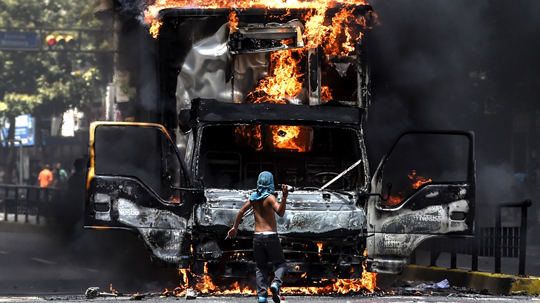
The crisis has fuelled public anger and triggered massive protests that have left at least 96 people dead since April.
The opposition has run a vigorous campaign to try to push Maduro out of office through early elections.
Venezuela's opposition also blames mismanagement by Maduro, who has stepped up the nationalisation of businesses, employed the military to control food distribution, and imposed currency controls.


Comments
Add new comment