



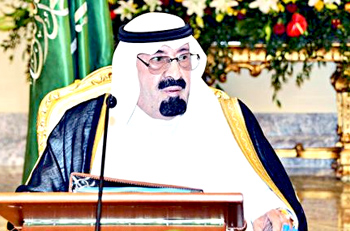
Media mustn’t influence public opinion negatively: Saudi King

May 7, 2014

Saudi_King
Jeddah, May 7: Custodian of the Two Holy Mosques King Abdullah reiterated the role of the media in promoting peace and stability across the world during the three-day Asia Media Summit 2014, which was inaugurated here on Tuesday.

“We hope this summit will strengthen media cooperation between Asian countries,” said the king in his keynote speech, which was read out by Culture and Information Minister Abdul Aziz Khoja.

King Abdullah reminded media personalities of their responsibility in disseminating accurate information and appealed to them to propagate sound ideas that encourage reconciliation and harmony.

“The message of Islam, which originated from this country, insists that good words should be the basis for disseminating noble values to improve human behavior in order to build a better civilization,” said the king.

The king cited a Qur’anic verse to reinforce his message. “Have you not considered how Allah presents an example, (making) a good word like a good tree, whose root is firmly fixed and its branches (high) in the sky? It produces its fruit all the time, by permission of its Lord.”

The king warned against using the media to negatively influence public opinion. “Countries around the world are exposed to extraneous cultural influences that shake the foundations of humanitarian and religious values because of the dissemination of irresponsible media content,” he said. “We request that media experts use their influence constructively.”

The king exhorted the media to respect religious values and fortify the fence of morality.

He also stressed the role of the media in ending the tragedies and clashes afflicting the world.

“It is no secret that man-made tragedy fills media outlets these days,” he said.

“This is where the role of responsible media reporting comes in.”

Riyadh Kamal Najm, president of the General Authority for Audio and Visual Media, said the summit offers a good opportunity for government officials and executives to exchange views on improving media management in Asia and other parts of the world.

He emphasized the growing role of media in educating the public. “Media organizations have played an important role in boosting development in the Third World countries,” he said.

Najm emphasized the need for powerful media organizations that can shape public opinion on various political, economic and social issues.

“We have achieved unprecedented progress through information technology, including computers and cellphones, which has changed the way people get information,” he said.

He called for the need to stop misusing information technology and social media sites. “We need regulations that can help weed out and check mischief-makers and troublemakers,” he said.

In her inaugural address, Rosarita Niken Widiastuti, president of the Asia-Pacific Institute for Broadcasting Development and director of Radio Republic Indonesia, thanked Saudi Arabia for hosting the summit and praised the Kingdom for playing a positive role in promoting media ethics.

The conference provides a platform for broadcasters in the region to share their thoughts on broadcasting and information. In attendance are decision-makers, media professionals, scholars and stakeholders of news and programming companies from Asia, Pacific, Africa, Europe, Middle East and North America.

Comments

Add new comment

  • Coastaldigest.com reserves the right to delete or block any comments.
  • Coastaldigset.com is not responsible for its readers’ comments.
  • Comments that are abusive, incendiary or irrelevant are strictly prohibited.
  • Please use a genuine email ID and provide your name to avoid reject.
News Network
November 28,2025

fire.jpg

Several Syrians were killed and more than two dozen others injured in Israeli strikes on the outskirts of Damascus, amid intensified incursions by the occupying regime since the fall of former president Bashar al-Assad and the rise of Hayat Tahrir al-Sham (HTS) rule.

Syrian state TV reported that the casualties occurred during an overnight Israeli assault involving helicopters and drones on the town of Beit Jinn in the Damascus countryside. The attack followed an Israeli military unit’s entry into the town, where they were surrounded by local residents, leading to gunfire and direct confrontations.

According to the report, “The occupation army’s helicopters and artillery shelled Beit Jinn, located at the foothills of Mount Hermon, resulting in 13 martyrs and 25 injured civilians.” The broadcaster did not specify the full extent of damage.

Al-Ikhbariyah Syria confirmed that the shelling coincided with Israeli soldiers entering Beit Jinn, while artillery pounded surrounding areas. The broadcaster stated that the escalation began after local residents clashed with an Israeli patrol that had infiltrated the southern town and “kidnapped” three young men.

Following a two-hour exchange of heavy fire, Israeli forces withdrew and repositioned on the hill of Butt al-Warda at the town’s outskirts.

Israeli media acknowledged that six soldiers were wounded in the clashes—three of them seriously—describing the confrontation as a “sudden ambush” that forced the deployment of reserve units and air support to secure an exit route. No further details were provided.

The aggression has fueled renewed displacement from Beit Jinn, with residents fleeing to nearby villages amid increasingly frequent Israeli attacks.

The raid came just a day after Israeli troops carried out another ground incursion into Umm al-Luqas village in Quneitra province. According to SANA, an Israeli unit in four vehicles entered the village, raided several homes, and later withdrew.

Syria condemned the repeated incursions as violations of the 1974 Disengagement Agreement and UN resolutions, urging the international community to enforce compliance and pressure Israel to halt its operations and withdraw fully.

Israel has expanded its attacks across Syrian territory following the collapse of the Assad government last year. Prime Minister Benjamin Netanyahu has reportedly instructed his forces to push deeper into Syrian territory and seize strategic positions.

Meanwhile, critics say the HTS-led interim government’s inaction and growing normalization gestures toward Israel have emboldened Tel Aviv to intensify its military operations. HTS, formerly linked to al-Qaeda, seized control of Damascus last December, formally ending Assad’s rule.

Comments

Add new comment

  • Coastaldigest.com reserves the right to delete or block any comments.
  • Coastaldigset.com is not responsible for its readers’ comments.
  • Comments that are abusive, incendiary or irrelevant are strictly prohibited.
  • Please use a genuine email ID and provide your name to avoid reject.