Over a million pilgrims pack Mount Arafat for climax of biggest covid-era Hajj

News Network
July 8, 2022

arafat.jpg

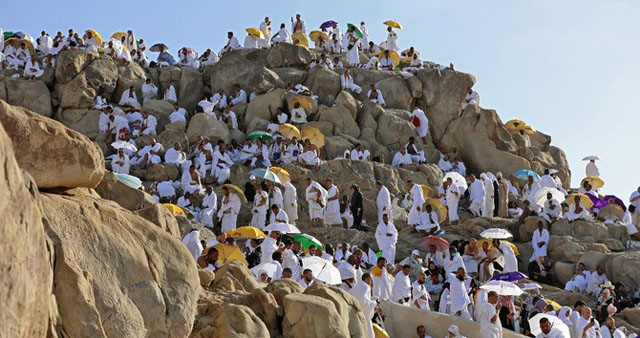
Mount Arafat, July 8: Huge crowds of robed Muslim pilgrims prayed on Saudi Arabia’s Mount Arafat on Friday, the climax of the biggest Hajj pilgrimage since the pandemic forced drastic cuts in numbers two years in a row.

Groups of worshippers, many holding umbrellas against the fierce sun, recited verses from the Qur'an on the rocky rise, where the Prophet Muhammad is believed to have given his final sermon.

Prayers on Mount Arafat, also known as the “Mount of Mercy,” are the highlight of the pilgrimage, capped this year at one million people including 850,000 from abroad after Covid greatly reduced numbers over 2020 and 2021.

Pilgrims, many of them in simple white robes and chanting “Oh God, here I am,” reached Mount Arafat on foot or in buses from the tents nearby where they spent the night.

After sunset, they will journey the short distance to Muzdalifah, where they will sleep under the stars before performing the symbolic “stoning of the devil” ceremony on Saturday.

“I am so happy to be here, like everyone else. This is the biggest Hajj in the coronavirus era, but it isn’t big enough yet,” Egyptian pilgrim Saad Farhat Khalil, 49, said.

“There are one million here today, but if the Saudis allowed more, 10 million would have came,” he added.

Entry roads were packed with worshippers as helicopters buzzed overhead and volunteers handed out bottles of water and collected rubbish in green plastic bags.

“Let’s keep the purest of all lands clean,” read a sign on a large garbage container.

The Hajj, usually one of the world’s largest annual religious gatherings, is among the five pillars of Islam and must be undertaken by all Muslims with the means at least once in their lives.

In 2019, as in previous years, some 2.5 million Muslims from around the world took part, a figure that dropped to a few thousand in 2020 and 60,000 in 2021.

Even though the crowds are back, Covid fears remain and the Hajj is taking place against the backdrop of a resurgence in the region, with some Gulf countries tightening restrictions to keep outbreaks in check.

All participants were required to submit proof of full vaccination and negative PCR tests. On reaching their white-tent encampment at Mina on Thursday, they were handed small bags containing masks and sanitiser.

The pilgrimage can be physically draining even in ideal conditions, but worshippers this year have faced an added challenge: scorching sun and temperatures rising to 42 degrees Celsius (108 degrees Fahrenheit).

Islam forbids men from wearing hats once the rites start, and many have been seen shielding themselves with umbrellas, prayer mats and even, in one case, a small bucket filled with water.

Women, meanwhile, are obliged to cover their heads with scarves.

“We can tolerate (the heat). We are here for the Hajj. The more we tolerate, the more our pilgrimage is accepted,” Laila, a 64-year-old Iraqi pilgrim who gave only her first name, told AFP in Makkah, where the rituals started.

Saudi officials have touted their preparations for the extreme conditions, highlighting the hundreds of hospital beds allocated for heatstroke patients and the “large number of misting fans” they have provided.

A truck has also been allocated to distribute umbrellas, water bottles and small fans.

Nevertheless, the National Center for Meteorology, which has set up an office in Mina, is sending warnings to pilgrims on their mobile phones, urging them to avoid outdoor rituals at certain times of the day, especially at noon.

On Saturday, Muslim pilgrims will take part in the “stoning,” the last major ritual of the Hajj which has previously led to deadly stampedes, as hundreds of thousands of participants converge on a small space.

After the stoning ritual, pilgrims return to the Grand Mosque in Makkah to perform a final “tawaf” or circling of the Kaaba, the cubic structure draped in a gold-embroidered black cloth that is the focal point of Islam.

Eid Al-Adha, the feast of the sacrifice that begins on Saturday, marks the end of Hajj.

Comments

Add new comment

  • Coastaldigest.com reserves the right to delete or block any comments.
  • Coastaldigset.com is not responsible for its readers’ comments.
  • Comments that are abusive, incendiary or irrelevant are strictly prohibited.
  • Please use a genuine email ID and provide your name to avoid reject.
News Network
February 4,2026

gaming.jpg

Ghaziabad: In a tragic incident, three sisters aged 12, 14 and 16 died after jumping from the ninth floor of their apartment in Uttar Pradesh’s Ghaziabad in the early hours of Wednesday. The girls allegedly took the extreme step after becoming deeply obsessed with an online Korean task-based game.

The incident occurred around 2.15 am at a high-rise apartment complex in Bharat City. Before jumping, the sisters — Pakhi (12), Prachi (14) and Vishika (16) — left behind a handwritten note that read, “Sorry, Papa.”

According to police, the girls went to the balcony, bolted the door from inside and jumped one after another. Their screams and the sound alerted their parents, neighbours and security guards. By the time the parents broke open the balcony door, all three had died.

“When we reached the spot, we confirmed that three minor girls, daughters of Chetan Kumar, had died after jumping from the building,” said Assistant Commissioner of Police Atul Kumar Singh.

Visuals from the scene on Wednesday morning showed the bodies lying on the ground, their mother wailing in grief, and stunned neighbours gathering at the complex.

Police said the sisters were heavily influenced by Korean culture and were addicted to an online “Korean love game”, though no specific game has been identified so far. Investigators are examining an eight-page suicide note written in a pocket diary, detailing the girls’ mobile and gaming activities.

“Read everything written in this diary because all of it is true. I’m really sorry. Sorry, Papa,” the note said, accompanied by a hand-drawn crying emoji.

Their father, Chetan Kumar, told police that the girls had even adopted Korean names and had gradually withdrawn from school and daily activities. “They used to say, ‘Korea is our life, Korea is our biggest love. We cannot give it up,’” he said, breaking down.

Police said the parents had recently restricted the girls’ mobile phone usage, which may have triggered distress. “The investigation has not revealed the name of any particular game, but it is evident that the girls were deeply influenced by Korean culture, as mentioned in the suicide note,” said senior police officer Nimish Patel.

The sisters reportedly did everything together, including eating and bathing. Their gaming addiction is believed to have begun during the COVID-19 pandemic, after which they became irregular at school and eventually stopped attending altogether.

Police also revealed that Chetan Kumar is married to two sisters and lives with both wives and their children, all daughters. Two of the deceased girls were daughters of one wife, while the third was their half-sister.

Further investigation is underway.

Comments

Add new comment

  • Coastaldigest.com reserves the right to delete or block any comments.
  • Coastaldigset.com is not responsible for its readers’ comments.
  • Comments that are abusive, incendiary or irrelevant are strictly prohibited.
  • Please use a genuine email ID and provide your name to avoid reject.
News Network
February 1,2026

Bengaluru, Feb 1: For travelers landing at Kempegowda International Airport (KIA), the sleek, wood-paneled curves of Terminal 2 promise a world-class welcome. But the famed “Garden City” charm quickly withers at the curb. As India’s aviation sector swells to record numbers—handling over 43 million passengers in Bengaluru alone this past year—the “last mile” has turned into a marathon of frustration.

The Bengaluru Logjam: Rules vs Reality

While the city awaits the 2027 completion of the Namma Metro Blue Line, the interim has been chaotic. Recent “decongestion” rules at Terminal 1 have pushed app-based cab pickups to distant parking zones, forcing weary passengers into a 20-minute walk with luggage.

“I landed after ten months away and felt like a stranger in my own city,” says Ruchitha Jain, a Koramangala resident. “My driver couldn’t find me, staff couldn’t guide me, and the so-called ‘Premium’ lane is just a fancy tax on convenience.”

•    The Cost of Distance: A 40-km cab ride can now easily cross ₹1,500, driven by demand pricing and airport surcharges.

•    The Bus Gap: While Vayu Vajra remains a lifeline, its ₹300–₹400 fare is often cited as the most expensive airport bus service in the country.

A National Pattern of Disconnect

The struggle is not unique to Karnataka. From Chennai’s coast to Hyderabad’s plateau, India’s airports tell a familiar story: brilliant runways, broken exits.

City:    Primary Issue   |    Recent Development

Bengaluru:    Cab pickup restrictions & distance  |    App-based taxis shifted to far parking zones; long walks and fare spikes reported

Chennai:    Multi-Level Parking (MLCP) hike  |    Passengers report 40-minute walks to reach cab pickup points

Hyderabad:    “Taxi mafia” & touting  |    Over 440 touting cases reported; security presence intensified

Mumbai:    Fare scams  |     Tourists charged ₹18,000 for just 400 metres, triggering police action

In Hyderabad, travelers continue to battle entrenched local groups that intimidate Uber and Ola drivers, pushing passengers toward overpriced private taxis. Chennai flyers, meanwhile, complain that reaching the designated pickup zones now takes longer than short-haul flights from cities like Coimbatore.

The ‘Budget Day’ Hope

As Finance Minister Nirmala Sitharaman presents the Union Budget 2026 today, the aviation sector is watching closely. With the government’s renewed emphasis on multimodal integration, there is cautious hope for funding toward seamless airport-metro-bus hubs.

The vision is clear: a future where planes, trains, and metros speak the same language. Until then, passengers at KIA—and airports across India—will continue to discover that the hardest part of flying isn’t the thousands of kilometres in the air, but the last few on the ground.

Comments

Add new comment

  • Coastaldigest.com reserves the right to delete or block any comments.
  • Coastaldigset.com is not responsible for its readers’ comments.
  • Comments that are abusive, incendiary or irrelevant are strictly prohibited.
  • Please use a genuine email ID and provide your name to avoid reject.
News Network
January 31,2026

Roy.jpg

Bengaluru: The shooting incident involving CJ Roy, founder of the Confident Group, has once again put the spotlight on a businessman whose life has swung between flamboyant global success and persistent controversy at home.

Though Roy’s business interests extended across continents, his roots lay firmly in Karnataka. An alumnus of Christ School in Bengaluru, he later moved to Tumakuru to pursue an engineering degree. Those familiar with his early years describe him as intensely ambitious, beginning his career as a salesman at a small electronics firm dealing in computers.

Roy’s entry into large-scale real estate came through the Crystal Group, where he worked closely with Latha Namboothiri and rose from manager to director. However, the launch of the Confident Group in 2005 was clouded by industry speculation. Insiders speak of a fallout involving alleged “benami” properties and claims of deception that ultimately led to his independent venture—an episode Roy spent years trying to distance himself from, according to associates.

A tale of two cities

Roy’s professional trajectory diverged sharply across geographies.

In Dubai, he built a reputation as a bold and efficient developer, completing massive luxury residential projects in record time—some reportedly within 11 months. His rapid project delivery and lavish lifestyle in the Emirates earned him admiration and visibility in the real estate sector.

In Bengaluru, however, his image remained far more fractured. Sources say Roy stayed away from the city for several years amid disputes over unpaid dues to vendors and suppliers. Several projects were allegedly stalled, with accusations of unfulfilled commitments to cement and steel suppliers continuing to follow him.

Roy’s return to Bengaluru’s business and social circles began around 2018, marked by a conscious attempt at rebranding. His appointment as Honorary Consul of the Slovak Republic added diplomatic legitimacy, which he complemented with visible CSR initiatives, including ambulance donations and high-profile charity events.

Heavy police presence in Langford Town

Following the incident, police personnel from the Central division were deployed outside the Confident Group building in Langford Town, which also houses the Slovak Honorary Consulate in Bengaluru.

The otherwise busy premises near Hosur Road wore a deserted look on Friday, reflecting the shock and uncertainty that followed the tragedy.

Comments

Add new comment

  • Coastaldigest.com reserves the right to delete or block any comments.
  • Coastaldigset.com is not responsible for its readers’ comments.
  • Comments that are abusive, incendiary or irrelevant are strictly prohibited.
  • Please use a genuine email ID and provide your name to avoid reject.