



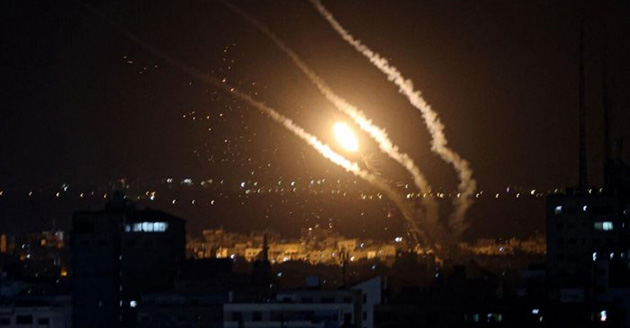
7 children, 4 women among 29 Palestinians killed in Israeli airstrike on blockaded Gaza

News Network
May 12, 2023

Israel.jpg

Gaza City, Apr 12: A high-profile commander of the Palestinian Islamic Jihad resistance movement has been killed when the Israeli military carried out airstrikes against targets in the besieged Gaza Strip, hours after the group announced the death of one of its military leaders in a pre-dawn strike carried out by the regime.

With this the death toll in blockaded Palestinian enclave has mounted to 29 including seven children and four women. 

Meanwhile, retaliatory rocket fire from the Gaza Strip killed one person in the central Israeli city of Rehovot and injured at least two others, Israeli police said. Three others sustained shrapnel injuries elsewhere in Israel.

Cairo was mediating efforts towards a truce between Israel and the Islamic Jihad militant group, while European Union foreign policy chief Josep Borrell called for "an immediate comprehensive ceasefire".

The United States stopped short of a clear call for a truce, but State Department spokesman Vedant Patel said the casualties were "tragic and heartbreaking", while urging that steps be "taken to ensure that violence is reduced".

German Foreign Minister Annalena Baerbock said "the bloodletting must end now", and the UN warned of "a negative impact on an already difficult humanitarian situation in Gaza".

A source close to Islamic Jihad later disclosed that "a final formula for a ceasefire" was said to be under discussion in Egypt. The Israeli army, however, said just before midnight (2100 GMT) that it was continuing to strike Islamic Jihad targets.

Gaza fighters have fired 620 rockets at Israel since Wednesday, the military said, adding that 179 had been intercepted by the Iron Dome missile defence system. The army said 25 percent of rockets fired from Gaza fell into the territory itself. 

Shops in Gaza were shuttered and the streets largely abandoned as Israeli military aircraft circled the territory, where several buildings lay in ruins.

Islamic Jihad confirmed it had lost five military leaders in strikes in recent days, including Ahmed Abu Deka -- the deputy of Ali Ghali, commander of a rocket launch unit, who was also killed by Israel on Thursday.

The Israeli army said it had fired at 191 targets across Gaza on Thursday.

The Popular Front for the Liberation of Palestine said four of its fighters had also been killed.

The United Nations Office for the Coordination of Humanitarian Affairs (OCHA) said Thursday evening that it had documented 26 dead on the Palestinian side -- 13 civilians, seven of them children, as well as four members of armed groups and nine others whose status was not yet determined.

In Gaza City's Al-Rimal district, Mamoun Radi, 48, said: "We hope that the wave of escalation will end, but we support revenge for the martyrs.

"Israel assassinated a leader of (Islamic) Jihad at dawn today because it does not want calm."

Across southern Israel, sirens wailed intermittently through the night and on Thursday morning.

Ashkelon resident Miriam Keren, 78, said a Gaza rocket had destroyed a workshop and damaged her house.

"All the shrapnel is in the room; the house was shaken very powerfully, the glasses fell, the walls were damaged," she said.

"Luckily, I have a safe room and I entered it immediately and closed the door.

"This isn't the first time the house was hit but I'm not afraid, neither was I yesterday. You're shocked for a moment, but it's not about fear. It's more unpleasant, very unpleasant."

An Islamic Jihad source said Mohammad al-Hindi, who heads the group's political bureau, arrived in Cairo on Thursday for talks with Egyptian intelligence officials.

An Egyptian source, meanwhile, told AFP a security delegation from Cairo would be in Tel Aviv later Thursday for talks with Israeli officials on a ceasefire.

Israeli officials confirmed Egypt's involvement in attempts to facilitate an understanding between the sides aimed at halting the hostilities.

Both Hamas, which rules Gaza, and Islamic Jihad are considered terrorist groups by Israel and the United States.

This week's Gaza clashes are the worst since a three-day escalation in August killed 49 Palestinians, with no Israeli fatalities.

Violence has also flared in the occupied West Bank, where the Israeli army has staged repeated raids against militants that have often flared into street clashes or gun battles.

On Thursday, two Palestinians died from their wounds after being shot by the Israeli army in a raid the day before in the West Bank city of Qabatiya, the Palestinian health ministry said.

The conflict has escalated since veteran leader Benjamin Netanyahu returned to power late last year, heading a coalition with extreme right and ultra-Orthodox parties.

Israel has also been shaken by its biggest domestic political crisis in decades, as mass protests have flared against plans to reform the justice system that have been spearheaded by Netanyahu, who is also battling corruption charges in court.


Comments

Add new comment

  • Coastaldigest.com reserves the right to delete or block any comments.
  • Coastaldigset.com is not responsible for its readers’ comments.
  • Comments that are abusive, incendiary or irrelevant are strictly prohibited.
  • Please use a genuine email ID and provide your name to avoid reject.
News Network
February 4,2026

Mangaluru: Urban local bodies and gram panchayats should make the use of Kannada on signboards mandatory while issuing trade licences to commercial establishments, Dakshina Kannada Deputy Commissioner Darshan HV said. He also called for regular inspections to ensure compliance.

Presiding over the District Kannada Awareness Committee meeting at the deputy commissioner’s office, Darshan said the city corporation would be directed to ensure that shops operating in malls prominently display their names in Kannada. “All commercial establishments, including shops, companies, offices and hotels, must mandatorily display their names in Kannada on signboards,” he said.

The deputy commissioner added that the National Highways Authority of India (NHAI) would be instructed to include Kannada on signboards along national highways. Banks, he said, would be directed through committee meetings to provide application forms in Kannada.

“Even if English-medium schools and colleges impart education in English, their signboards must display the institution’s name in Kannada. Steps will also be taken to ensure that private buses display place names in Kannada,” Darshan said.

During the meeting, committee members raised concerns over the closure of Kannada-medium schools in rural areas due to a shortage of teachers and stressed the need for immediate corrective measures. They also pointed out that several industries employ workers from other states while overlooking local candidates.

Members further demanded that nationalised banks provide deposit and withdrawal slips in Kannada. It was brought to the deputy commissioner’s notice that the presence of staff without knowledge of Kannada in rural branches of nationalised banks is causing hardship to local customers.

Meanwhile, MP Srinath, president of the District Kannada Sahitya Parishat, urged the district administration to allot land for the construction of a district Kannada Bhavana in Mangaluru.

Comments

Add new comment

  • Coastaldigest.com reserves the right to delete or block any comments.
  • Coastaldigset.com is not responsible for its readers’ comments.
  • Comments that are abusive, incendiary or irrelevant are strictly prohibited.
  • Please use a genuine email ID and provide your name to avoid reject.
News Network
January 23,2026

modIKERALA.jpg

Prime Minister Narendra Modi, during his visit to Thiruvananthapuram on Friday, January 23, indicated that the Bharatiya Janata Party (BJP) is aiming to expand its political footprint in Kerala ahead of the Assembly elections scheduled in the coming months.

Speaking at a BJP-organised public meeting, Modi drew parallels between the party’s early electoral gains in Gujarat and its recent victory in the Thiruvananthapuram Municipal Corporation. The civic body win, which ended decades of Left control, was cited by the Prime Minister as a possible starting point for the party’s broader ambitions in the state.

Recalling BJP’s political trajectory in Gujarat, Modi said the party was largely insignificant before 1987 and received little media attention. He pointed out that the BJP’s first major breakthrough came with its victory in the Ahmedabad Municipal Corporation that year.

“Just as our journey in Gujarat began with one city, Kerala’s journey has also started with a single city,” Modi said, suggesting that the party’s municipal-level success could translate into wider electoral acceptance.

The Prime Minister alleged that successive governments led by the Left Democratic Front (LDF) and the United Democratic Front (UDF) had failed to adequately develop Thiruvananthapuram. He accused both fronts of corruption and neglect, claiming that basic infrastructure and facilities were denied to the capital city for decades.

According to Modi, the BJP’s control of the civic body represents a shift driven by public dissatisfaction with the existing political alternatives. He asserted that the BJP administration in Thiruvananthapuram had begun working towards development, though no specific details or timelines were outlined.

Addressing the gathering at Putharikandam Maidan, Modi said the BJP intended to project Thiruvananthapuram as a “model city,” reiterating his party’s commitment to governance-led change.

The Prime Minister’s visit to Kerala also included the inauguration of several development projects and the flagging off of new train services, as the BJP intensifies its political outreach in the poll-bound state.

Comments

Add new comment

  • Coastaldigest.com reserves the right to delete or block any comments.
  • Coastaldigset.com is not responsible for its readers’ comments.
  • Comments that are abusive, incendiary or irrelevant are strictly prohibited.
  • Please use a genuine email ID and provide your name to avoid reject.
News Network
January 23,2026

Karnataka Governor Thaawarchand Gehlot read only three lines from the 122-paragraph address prepared by the Congress-led state government while addressing the joint session of the Legislature on Thursday, effectively bypassing large sections critical of the BJP-led Union government.

The omitted portions of the customary Governor’s address outlined what the state government described as a “suppressive situation in economic and policy matters” under India’s federal framework. The speech also sharply criticised the Centre’s move to replace the Mahatma Gandhi National Rural Employment Guarantee Act (MGNREGA) with the Viksit Bharat–Guarantee for Rozgar and Ajeevika Mission (Gramin) Act, commonly referred to as the VB-GRAM (G) Act.

Governor Gehlot had earlier conveyed his objection to several paragraphs that were explicitly critical of the Union government. On Thursday, he confined himself to the opening lines — “I extend a warm welcome to all of you to the joint session of the State legislature. I am extremely pleased to address this august House” — before jumping directly to the concluding sentence of the final paragraph.

He ended the address by reading the last line of paragraph 122: “Overall, my government is firmly committed to doubling the pace of the State’s economic, social and physical development. Jai Hind — Jai Karnataka.”

According to the prepared speech, the Karnataka government demanded the scrapping of the VB-GRAM (G) Act, describing it as “contractor-centric” and detrimental to rural livelihoods, and called for the full restoration of MGNREGA. The state government argued that the new law undermines decentralisation, weakens labour protections, and centralises decision-making in violation of constitutional norms.

Key points from the unread sections of the speech:

•    Karnataka facing a “suppressive” economic and policy environment within the federal system

•    Repeal of MGNREGA described as a blow to rural livelihoods

•    VB-GRAM (G) Act accused of protecting corporate and contractor interests

•    New law alleged to weaken decentralised governance

•    Decision-making said to be imposed by the Centre without consulting states

•    Rights of Adivasis, women, backward classes and agrarian communities curtailed

•    Labourers allegedly placed under contractor control

•    States facing mounting fiscal stress due to central policies

•    VB-GRAM (G) Act accused of enabling large-scale corruption

Comments

Add new comment

  • Coastaldigest.com reserves the right to delete or block any comments.
  • Coastaldigset.com is not responsible for its readers’ comments.
  • Comments that are abusive, incendiary or irrelevant are strictly prohibited.
  • Please use a genuine email ID and provide your name to avoid reject.