



Amidst growing India-UAE ties, Sangh Parivar seeks to promote Hindu culture in Arab land

News Network
February 13, 2024

hinduabudhabi.jpg

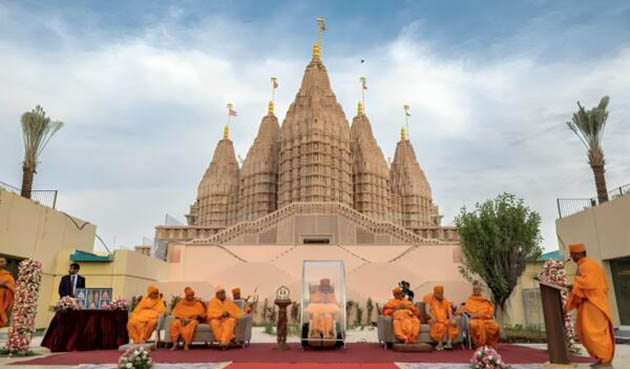
Prime Minister Narendra Modi, who last month opened the doors to a controversial Ayodhya temple in India where a centuries-old mosque once stood, is all set to inaugurate another Hindu religious site this week— in the Arab land. 

The pink sandstone temple in the United Arab Emirates has been built on a 27-acre plot granted on lease by President Sheikh Mohammed bin Zayed Al Nahyan for as long as “the sun shines.” In an election year, the imposing edifice offers Modi a headline-grabbing opportunity to portray himself as a global leader with the ability to draw big foreign investments.

Interestingly, Indian expatriate Hindus are the third largest Religious group in the UAE and constitute around 6.6%-15% of the population in the nation. 

Most of the Hindu diaspora in UAE are Indian, especially from Tamil Nadu, Kerala, Maharashtra, and Punjab. The other Hindus are from Nepal, Pakistan, Bangladesh, Sri Lanka, and Bhutan.

Meanwhile, the Sangh Parivar (the Rashtriya Swayamsevak Sangh and its affiliates), which has been trying to promote Hindu culture in Arab land for decades through Indian expats, has seized the opportunity of growing friendship between the rulers of two countries to achieve its goals.

Investment pledges or memorandums of understanding between the two countries are expected to be announced during Modi’s visit. The prime minister will also address more than 40,000 people from the South Asian nation in a stadium in Abu Dhabi on February 13.

It’s a unique mix of religion, politics and money. Throngs of people waving flags gathered to greet the UAE president, known as MBZ, as he was welcomed by Modi at the airport of his home state Gujarat last month.

While Islam is the UAE’s state religion, Bharatiya Janata Party (BJP) has long had a strained relationship with India’s Muslim population. Still, Emirati officials said there is a growing appreciation in Abu Dhabi of India’s rising geopolitical importance as well as its position as the world’s fastest growing major economy. That would make it strategically important for the UAE to navigate around any differences in opinion with New Delhi, they said.

Modi has said that MBZ is like a brother to him, Brahmaviharidas Swami, the Hindu priest heading the temple said on a zoom call, standing in front of the site clad in saffron robes. “The relationship between India and the region has never been stronger.”

There are big business considerations. India is one of the largest customers of Middle Eastern oil. The country is also buying more liquefied natural gas from the region.

Meanwhile, sovereign wealth funds in the UAE and other parts of the Gulf have emerged as prominent investors in the South Asian nation. Royal Group — the private investment firm of UAE national security adviser Sheikh Tahnoon bin Zayed Al Nahyan — has long had an affinity for India, with executives there calling it the potential growth engine of the coming decade. In recent days, his artificial intelligence firm set up a new entity called G42 India Enterprises Holding RSC Ltd. within Abu Dhabi Global Market, filings show.

The UAE is weighing provisional pledges to invest as much as $50 billion in India, its second-largest trading partner, people familiar with the matter told Bloomberg News last year. While it’s unclear if all those investments will ultimately come through and when any agreements might be announced, they would offer Modi another opportunity showcase the international ties.

“These funds are coming into India not as an assistance but on a bet that India will do really well over the next few decades,” said Rajeev Misra, an Indian-born financier, who has over the years been entrusted with billions of dollars from Middle Eastern funds. “To tap this golden opportunity a system has to be put into place in India, which can guide the money to the right opportunities.”

Close Connections

Politically, the countries have grown closer in recent years. Modi’s latest visit will mark his seventh trip to the Gulf nation since he took over as prime minister in 2014. The last Indian premier to visit the UAE before him was Indira Gandhi in 1981.

In 2021, the Gulf nation helped broker a peace deal between India and Pakistan. More recently, the UAE was one of the countries invited to join the BRICS bloc, of which India is a part. Modi is increasingly being courted by global leaders, including US President Joe Biden.

“Both UAE and India stand to gain economically and geopolitically from the close relationship built over the recent years,” said Thomas Mathew, a New Delhi-based retired bureaucrat and international relations analyst. “The US and western bloc is also pushing to strengthen the bond as it helps in containing China which has ambitions in the region.”

Other Middle Eastern countries have also looked to strengthen ties with India. Saudi Arabia announced its intention to invest $100 billion in the country in 2019 and during a September visit Crown Prince Mohammed bin Salman discussed ways to quicken the implementation of those plans.

The UAE and India have historically enjoyed close ties. A third of the Gulf country’s population hails from India and Dubai counts Indians as among the top buyers of real estate in the city. The UAE was expected to be the top destination for migrating high net worth Indians in 2023, according to immigration firm Henley & Partners.

Billionaires Gautam Adani and Mukesh Ambani are among India’s wealthy to have made big investments in the Middle Eastern country. In turn, they’ve also managed to draw funding from state-backed entities in the region.

Against this backdrop, the treatment of Muslims in the country is an issue that “Abu Dhabi should voice behind closed doors,” said Abdulkhaleq Abdulla, an Emirati academic. “It’s not enough to encroach on the broader economic ties, security partnerships and overall national interest.”

To be sure, many of the pledges or MOUs from Middle Eastern countries remain promises and limited amounts have actually reached Indian shores so far.

Other big plans for deepening ties have also been slow to take off on the ground. The India-Middle East-Europe Economic Corridor — a project that envisages building new rail links across the Arabian peninsula — was intended to further strengthen the relationship between the countries.

Comments

Add new comment

  • Coastaldigest.com reserves the right to delete or block any comments.
  • Coastaldigset.com is not responsible for its readers’ comments.
  • Comments that are abusive, incendiary or irrelevant are strictly prohibited.
  • Please use a genuine email ID and provide your name to avoid reject.
News Network
January 23,2026

Mangaluru: The Karnataka Government Polytechnic (KPT), Mangaluru, has achieved autonomous status from the All India Council for Technical Education (AICTE), becoming the first government polytechnic in the country to receive such recognition in its 78-year history. The status was granted by AICTE, New Delhi, and subsequently approved by the Karnataka Board of Technical Education in October last year.

Officials said the autonomy was conferred a few months ago. Until recently, AICTE extended autonomous status only to engineering colleges, excluding diploma institutions. However, with a renewed national focus on skill development, several government polytechnics across India have now been granted autonomy.

KPT, the second-largest polytechnic in Karnataka, was established in 1946 with four branches and has since expanded to offer eight diploma programmes, including computer science and polymer technology. The institution is spread across a 19-acre campus.

Ravindra M Keni, the first dean of the institution, told The Times of India that AICTE had proposed autonomous status for polytechnic institutions that are over 25 years old. “Many colleges applied. In the first round, 100 institutions were shortlisted, which was further narrowed down to 15 in the second round. We have already completed one semester after becoming an autonomous institution,” he said. He added that nearly 500 students are admitted annually across eight three-year diploma courses.

Explaining the factors that helped KPT secure autonomy, Keni said the institution has consistently recorded 100 per cent admissions and placements for its graduates. He also noted its strong performance in sports, with the college emerging champions for 12 consecutive years, along with active student participation in NCC and NSS activities.

Autonomous status allows KPT to design industry-oriented curricula, conduct examinations, prepare question papers, and manage academic documentation independently. The institution can also directly collaborate with industries and receive priority funding from AICTE or the Ministry of Education. While academic autonomy has been granted, financial control will continue to rest with the state government.

“There will be separate committees for examinations, question paper setting, boards of studies, and boards of examiners. The institution will now have the freedom to conduct admissions without government notifications and issue its own marks cards,” Keni said, adding that new academic initiatives would be planned after a year of functioning under the autonomous framework.

Comments

Add new comment

  • Coastaldigest.com reserves the right to delete or block any comments.
  • Coastaldigset.com is not responsible for its readers’ comments.
  • Comments that are abusive, incendiary or irrelevant are strictly prohibited.
  • Please use a genuine email ID and provide your name to avoid reject.
News Network
January 23,2026

Karnataka Governor Thaawarchand Gehlot read only three lines from the 122-paragraph address prepared by the Congress-led state government while addressing the joint session of the Legislature on Thursday, effectively bypassing large sections critical of the BJP-led Union government.

The omitted portions of the customary Governor’s address outlined what the state government described as a “suppressive situation in economic and policy matters” under India’s federal framework. The speech also sharply criticised the Centre’s move to replace the Mahatma Gandhi National Rural Employment Guarantee Act (MGNREGA) with the Viksit Bharat–Guarantee for Rozgar and Ajeevika Mission (Gramin) Act, commonly referred to as the VB-GRAM (G) Act.

Governor Gehlot had earlier conveyed his objection to several paragraphs that were explicitly critical of the Union government. On Thursday, he confined himself to the opening lines — “I extend a warm welcome to all of you to the joint session of the State legislature. I am extremely pleased to address this august House” — before jumping directly to the concluding sentence of the final paragraph.

He ended the address by reading the last line of paragraph 122: “Overall, my government is firmly committed to doubling the pace of the State’s economic, social and physical development. Jai Hind — Jai Karnataka.”

According to the prepared speech, the Karnataka government demanded the scrapping of the VB-GRAM (G) Act, describing it as “contractor-centric” and detrimental to rural livelihoods, and called for the full restoration of MGNREGA. The state government argued that the new law undermines decentralisation, weakens labour protections, and centralises decision-making in violation of constitutional norms.

Key points from the unread sections of the speech:

•    Karnataka facing a “suppressive” economic and policy environment within the federal system

•    Repeal of MGNREGA described as a blow to rural livelihoods

•    VB-GRAM (G) Act accused of protecting corporate and contractor interests

•    New law alleged to weaken decentralised governance

•    Decision-making said to be imposed by the Centre without consulting states

•    Rights of Adivasis, women, backward classes and agrarian communities curtailed

•    Labourers allegedly placed under contractor control

•    States facing mounting fiscal stress due to central policies

•    VB-GRAM (G) Act accused of enabling large-scale corruption

Comments

Add new comment

  • Coastaldigest.com reserves the right to delete or block any comments.
  • Coastaldigset.com is not responsible for its readers’ comments.
  • Comments that are abusive, incendiary or irrelevant are strictly prohibited.
  • Please use a genuine email ID and provide your name to avoid reject.
News Network
February 3,2026

Bengaluru: Following reports of fresh Nipah virus (NiV) cases in West Bengal and heightened vigilance across parts of Southeast Asia, the Karnataka Health Department has placed the state on high alert and activated emergency preparedness protocols.

Health officials said enhanced surveillance measures have been initiated after two healthcare workers in Barasat, West Bengal, tested positive for the virus earlier this month. While no cases have been reported in Karnataka so far, authorities said the state’s past exposure to Nipah outbreaks and high inter-state mobility warranted preventive action.

Officials have directed district health teams to intensify monitoring, particularly at hospitals and points of entry, and to ensure early detection and isolation of suspected cases.

High Mortality Virus with Multiple Transmission Routes

Nipah virus is a zoonotic disease that can spread from animals to humans and has a reported fatality rate ranging between 60 and 75 per cent. Fruit bats, also known as flying foxes, are the natural reservoirs of the virus and can transmit it by contaminating food sources with saliva or urine.

Known modes of transmission include:

•    Contaminated food: Consumption of fruits partially eaten by bats or raw date-palm sap
•    Animal contact: Exposure to infected pigs or other animals
•    Human-to-human transmission: Close contact with body fluids of infected persons, particularly in healthcare settings

Symptoms and Disease Progression

The incubation period typically ranges from 4 to 14 days, though delayed onset has also been reported. Early symptoms often resemble common viral infections, making prompt clinical suspicion critical.

•    Initial symptoms: Fever, headache, body aches, fatigue, sore throat
•    Progressive symptoms: Drowsiness, disorientation, altered mental state
•    Severe stage: Seizures, neck stiffness and acute encephalitis, which can rapidly progress to coma

Public Health Advisory

The Health Department has issued precautionary guidelines urging the public to adopt risk-avoidance practices to prevent any local spillover.

Do’s
•    Wash fruits thoroughly before consumption
•    Drink boiled and cooled water
•    Use protective equipment while handling livestock
•    Maintain strict hand hygiene

Don’ts
•    Avoid fruits found on the ground or showing bite marks
•    Do not consume beverages made from raw tree sap, including toddy
•    Avoid areas with dense bat populations
•    Do not handle sick or dead animals

Preparedness Measures

Officials confirmed that isolation wards are being readied in major government hospitals and that medical staff are being sensitised to identify early warning signs.

“There is no cause for panic, but there is a need for heightened vigilance,” a senior health official said, adding that there is currently no approved vaccine or specific antiviral treatment for Nipah, and care remains largely supportive.

Comments

Add new comment

  • Coastaldigest.com reserves the right to delete or block any comments.
  • Coastaldigset.com is not responsible for its readers’ comments.
  • Comments that are abusive, incendiary or irrelevant are strictly prohibited.
  • Please use a genuine email ID and provide your name to avoid reject.