Amidst growing India-UAE ties, Sangh Parivar seeks to promote Hindu culture in Arab land

News Network
February 13, 2024

hinduabudhabi.jpg

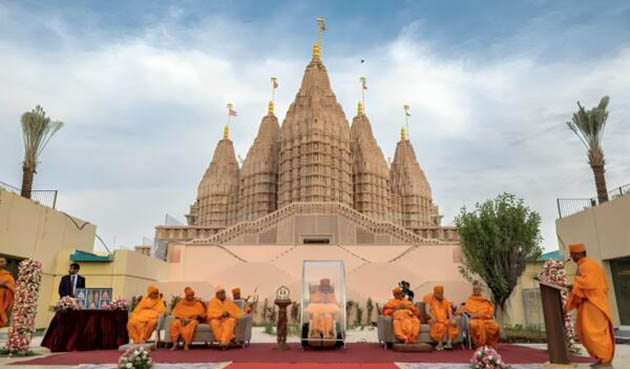
Prime Minister Narendra Modi, who last month opened the doors to a controversial Ayodhya temple in India where a centuries-old mosque once stood, is all set to inaugurate another Hindu religious site this week— in the Arab land. 

The pink sandstone temple in the United Arab Emirates has been built on a 27-acre plot granted on lease by President Sheikh Mohammed bin Zayed Al Nahyan for as long as “the sun shines.” In an election year, the imposing edifice offers Modi a headline-grabbing opportunity to portray himself as a global leader with the ability to draw big foreign investments.

Interestingly, Indian expatriate Hindus are the third largest Religious group in the UAE and constitute around 6.6%-15% of the population in the nation. 

Most of the Hindu diaspora in UAE are Indian, especially from Tamil Nadu, Kerala, Maharashtra, and Punjab. The other Hindus are from Nepal, Pakistan, Bangladesh, Sri Lanka, and Bhutan.

Meanwhile, the Sangh Parivar (the Rashtriya Swayamsevak Sangh and its affiliates), which has been trying to promote Hindu culture in Arab land for decades through Indian expats, has seized the opportunity of growing friendship between the rulers of two countries to achieve its goals.

Investment pledges or memorandums of understanding between the two countries are expected to be announced during Modi’s visit. The prime minister will also address more than 40,000 people from the South Asian nation in a stadium in Abu Dhabi on February 13.

It’s a unique mix of religion, politics and money. Throngs of people waving flags gathered to greet the UAE president, known as MBZ, as he was welcomed by Modi at the airport of his home state Gujarat last month.

While Islam is the UAE’s state religion, Bharatiya Janata Party (BJP) has long had a strained relationship with India’s Muslim population. Still, Emirati officials said there is a growing appreciation in Abu Dhabi of India’s rising geopolitical importance as well as its position as the world’s fastest growing major economy. That would make it strategically important for the UAE to navigate around any differences in opinion with New Delhi, they said.

Modi has said that MBZ is like a brother to him, Brahmaviharidas Swami, the Hindu priest heading the temple said on a zoom call, standing in front of the site clad in saffron robes. “The relationship between India and the region has never been stronger.”

There are big business considerations. India is one of the largest customers of Middle Eastern oil. The country is also buying more liquefied natural gas from the region.

Meanwhile, sovereign wealth funds in the UAE and other parts of the Gulf have emerged as prominent investors in the South Asian nation. Royal Group — the private investment firm of UAE national security adviser Sheikh Tahnoon bin Zayed Al Nahyan — has long had an affinity for India, with executives there calling it the potential growth engine of the coming decade. In recent days, his artificial intelligence firm set up a new entity called G42 India Enterprises Holding RSC Ltd. within Abu Dhabi Global Market, filings show.

The UAE is weighing provisional pledges to invest as much as $50 billion in India, its second-largest trading partner, people familiar with the matter told Bloomberg News last year. While it’s unclear if all those investments will ultimately come through and when any agreements might be announced, they would offer Modi another opportunity showcase the international ties.

“These funds are coming into India not as an assistance but on a bet that India will do really well over the next few decades,” said Rajeev Misra, an Indian-born financier, who has over the years been entrusted with billions of dollars from Middle Eastern funds. “To tap this golden opportunity a system has to be put into place in India, which can guide the money to the right opportunities.”

Close Connections

Politically, the countries have grown closer in recent years. Modi’s latest visit will mark his seventh trip to the Gulf nation since he took over as prime minister in 2014. The last Indian premier to visit the UAE before him was Indira Gandhi in 1981.

In 2021, the Gulf nation helped broker a peace deal between India and Pakistan. More recently, the UAE was one of the countries invited to join the BRICS bloc, of which India is a part. Modi is increasingly being courted by global leaders, including US President Joe Biden.

“Both UAE and India stand to gain economically and geopolitically from the close relationship built over the recent years,” said Thomas Mathew, a New Delhi-based retired bureaucrat and international relations analyst. “The US and western bloc is also pushing to strengthen the bond as it helps in containing China which has ambitions in the region.”

Other Middle Eastern countries have also looked to strengthen ties with India. Saudi Arabia announced its intention to invest $100 billion in the country in 2019 and during a September visit Crown Prince Mohammed bin Salman discussed ways to quicken the implementation of those plans.

The UAE and India have historically enjoyed close ties. A third of the Gulf country’s population hails from India and Dubai counts Indians as among the top buyers of real estate in the city. The UAE was expected to be the top destination for migrating high net worth Indians in 2023, according to immigration firm Henley & Partners.

Billionaires Gautam Adani and Mukesh Ambani are among India’s wealthy to have made big investments in the Middle Eastern country. In turn, they’ve also managed to draw funding from state-backed entities in the region.

Against this backdrop, the treatment of Muslims in the country is an issue that “Abu Dhabi should voice behind closed doors,” said Abdulkhaleq Abdulla, an Emirati academic. “It’s not enough to encroach on the broader economic ties, security partnerships and overall national interest.”

To be sure, many of the pledges or MOUs from Middle Eastern countries remain promises and limited amounts have actually reached Indian shores so far.

Other big plans for deepening ties have also been slow to take off on the ground. The India-Middle East-Europe Economic Corridor — a project that envisages building new rail links across the Arabian peninsula — was intended to further strengthen the relationship between the countries.


Comments

Add new comment

  • Coastaldigest.com reserves the right to delete or block any comments.
  • Coastaldigset.com is not responsible for its readers’ comments.
  • Comments that are abusive, incendiary or irrelevant are strictly prohibited.
  • Please use a genuine email ID and provide your name to avoid reject.
coastaldigest.com news network
November 28,2025

roadshow.jpg

Udupi district transformed into a sea of saffron and celebration on Friday, November 28, as Prime Minister Narendra Modi’s roadshow swept through the coastal temple town. Thousands of residents lined the streets, turning the event into a vibrant public spectacle filled with cheers, flags, and festive energy.

The procession route—from the helipad to the historic Sri Krishna Math—was decked with buntings, saffron flags, and multilayered security barricades. One of the district’s largest-ever security deployments was put in place for the high-profile visit, with over 3,000 police personnel on duty. The arrangement included ten SPs, 27 DSPs, 49 inspectors, 127 sub-inspectors, 232 assistant sub-inspectors, 1,608 constables, and 39 women staff.

Six platoons of the Karnataka State Reserve Police, six Quick Response Teams, bomb detection units, and dog squads were stationed across Udupi. Enhanced surveillance covered Adi Udupi, Bannanje bus stand, and the Sri Krishna Math parking zone, with combing operations carried out along the roadshow corridor.

At the 800-year-old Sri Krishna Math, preparations reached a ceremonial peak. Paryaya Puttige Math seer Sugunendra Teertha Swamiji said the Prime Minister would take part in the Laksha Kantha Geetha Parayana, a mass chanting of the Bhagavad Gita by one lakh devotees, and inaugurate the new Suvarna Teertha Mantapa.

“He will first offer floral tributes to saint-poet Kanakadasa and then unveil the golden covering over the Kanakana Kindi,” the seer said.

The Prime Minister will also receive a Poorna Kumbha welcome and have darshan of Lord Sri Krishna, Mukhyaprana Devaru, and the Suvarna Paduke. Union Minister Pralhad Joshi, Karnataka Governor Thaawarchand Gehlot, Minister Bairathi Suresh, Dharmadhikari D. Veerendra Heggade, and seers from the Ashta Maths are expected to join the ceremony.

Ahead of his arrival, the Prime Minister posted on X that he felt “honoured” to attend the spiritually significant gathering. “This is a special occasion that brings together people from different sections of society for a recital of the Gita. This Matha has a very special significance in our cultural life,” he wrote, noting the institution’s long-standing legacy rooted in the teachings of Sri Madhvacharya.

roadshow2.jpg

Comments

Add new comment

  • Coastaldigest.com reserves the right to delete or block any comments.
  • Coastaldigset.com is not responsible for its readers’ comments.
  • Comments that are abusive, incendiary or irrelevant are strictly prohibited.
  • Please use a genuine email ID and provide your name to avoid reject.
News Network
November 24,2025

israelsyra.jpg

Israeli forces have pushed over the Syrian frontier, erecting a checkpoint and stopping vehicles in the southwestern city of Quneitra, in yet another breach of the Arab country’s sovereignty.

The violation took place on Sunday, when the troops made their way across the border, setting up the outpost near the Ain al-Bayda junction in northern Quneitra, Syrian outlets reported.

According to the al-Ikhbariya paper, an Israeli detachment positioned itself at the junction, halting cars and conducting searches.

The Syrian Arab News Agency (SANA) reported that three Israeli military vehicles then moved further into the northern countryside, deploying between the town of Jubata al-Khashab and the villages of Ofaniya and Ain al-Bayda. The agency added that a separate Israeli unit mounted a new incursion in the central region, approaching the villages of Umm Batina and al-Ajraf.

Residents said such activities have surged in recent months, pointing to Israeli advances onto farmland, leveling of extensive forested areas, arrests, and spread of mobile checkpoints.

The Israeli regime began markedly increasing its military aggression against Syria last year.

The escalation coincided with increasingly ferocious onslaughts throughout the country by the so-called Hay'at Tahrir al-Sham (HTS) Takfiri terrorist group, which the government of President Bashar al-Assad had confined to northwestern Syria. The HTS, however, managed to overthrow the government as the Israeli attacks would pummel the country’s civilian and defensive infrastructure.

Various reports have shown that, during the escalation, the regime conducted more than 1,000 airstrikes on the Syrian territory and over 400 ground raids into the south.

Following the collapse of the Assad government, Tel Aviv also widened its grip over the occupied Golan Heights by taking control of a demilitarized buffer zone, in defiance of a 1974 Disengagement Agreement. Earlier this month, senior Israeli officials, including Prime Minister Benjamin Netanyahu, visited the buffer zone, prompting expressions of alarm on the part of the United Nations.

The United States, the regime’s biggest ally, has, meanwhile, been fraternizing the HTS head Abu Mohammed al-Jolani amid the widely reported prospect of rapprochement with Tel Aviv.

Comments

Add new comment

  • Coastaldigest.com reserves the right to delete or block any comments.
  • Coastaldigset.com is not responsible for its readers’ comments.
  • Comments that are abusive, incendiary or irrelevant are strictly prohibited.
  • Please use a genuine email ID and provide your name to avoid reject.
News Network
November 21,2025

Bengaluru, Nov 21: The Karnataka government is facing pressure to overhaul its employment system after a high-level Cabinet sub-committee recommended the complete phase-out of job outsourcing in government offices, boards, and corporations by March 2028. The move is aimed at tackling a systemic issue that has led to the potential violation of constitutional reservation policies and the exploitation of workers.

The Call for Systemic Change

With over three lakh vacant posts currently being filled through private agencies on an outsource, insource, or daily wage basis, the sub-committee highlighted a significant lapse. "As a result, reservations are not being followed as per the Constitution and state laws. It’s an urgent need to take serious steps to change the system. It has been recommended to completely stop the system of outsourcing by March 2028," the panel stated in a document.

The practice of outsourcing involves private companies hiring workers to perform duties for a government agency. Critics argue this model results in lesser salaries, a lack of social security benefits (otherwise available to permanent government employees), and a failure to adhere to the provisions of Articles 14 and 15 of the Constitution, which guarantee equality before the law and prohibit discrimination.

The 'Bidar Model' as a Stop-Gap Solution

To regulate the current mode of employment and reduce worker exploitation until the 2028 deadline, the government plans to establish workers’ services multi-purpose cooperative societies across all districts, following the successful "Bidar Model."

The Bidar District Services of Labour Multi-purpose Cooperative Society Ltd., which operates under the District Commissioner, is cited as a successful example of providing a measure of social security to outsourced staff. Labour Department officials argue this society ensures workers receive their due wages and statutory facilities like ESI (Employees' State Insurance) and PF (Provident Fund), in exchange for a 1% service fee collected from the employees.

legislative push and Priority Insourcing

The recommendations, led by the sub-committee headed by Law and Parliamentary Affairs Minister H K Patil, are set to be discussed at the next Cabinet meeting. The committee has proposed the introduction of the Karnataka Outsourced Employees (Regulation, Placement and Welfare) Bill 2025.

In a move addressing immediate concerns, Labour Minister Santosh Lad, a member of the sub-committee, has reportedly assured that steps will be taken over the next 2-3 years to insource workers in "life-threatening services" on a priority basis. This includes essential personnel like pourakarmikas (sanitation workers), drivers, electrical staff in the Energy Department, and Health Department staff handling contagious diseases. The transition aims to grant these workers the long-term security and benefits they currently lack under the outsourcing system. 

Comments

Add new comment

  • Coastaldigest.com reserves the right to delete or block any comments.
  • Coastaldigset.com is not responsible for its readers’ comments.
  • Comments that are abusive, incendiary or irrelevant are strictly prohibited.
  • Please use a genuine email ID and provide your name to avoid reject.