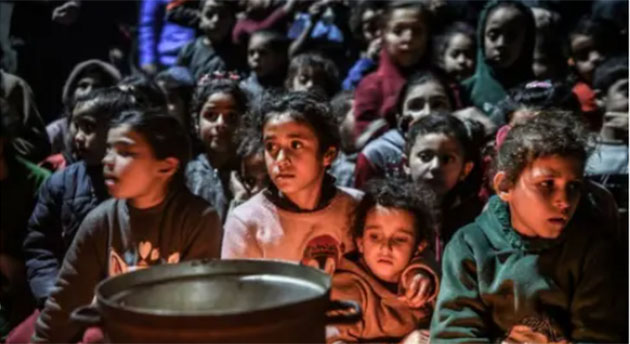
Gaza children, who survived off animal feed, going without food for days as inhuman Israel blocks aid convoys

News Network
February 10, 2024

gaza.jpg

People living in the isolated north of Gaza have revealed that children are going without food for days, as aid convoys are increasingly denied permits to enter thanks to Israeli army’s inhuman blockade. Some residents have resorted to grinding animal feed into flour to survive, but even stocks of those grains are now dwindling, they say.

People have also described digging down into the soil to access water pipes, for drinking and washing.

The UN has warned that acute malnutrition among young children in the north has risen sharply, and is now above the critical threshold of 15%.

The UN's humanitarian coordination agency, Ocha, says more than half the aid missions to the north of Gaza were denied access last month, and that there is increasing interference from Israeli forces in how and where aid is delivered.

It says 300,000 people estimated to be living in northern areas are largely cut off from assistance, and face a growing risk of famine.

A spokesman for the Israeli military agency tasked with coordinating aid access in Gaza said in a briefing last month that there was "no starvation in Gaza. Period." The agency, Cogat, has repeatedly said it does not limit the amount of humanitarian aid sent to Gaza.

The BBC spoke to three people living in Gaza City and Beit Lahia, and viewed footage and interviews filmed by local journalists in Jabalia.

Mahmoud Shalabi, a local medical aid worker in Beit Lahia, said people had been grinding grains used for animal feed into flour, but that even that was now running out.

"People are not finding it in the market," he said. "It's unavailable nowadays in the north of Gaza, and Gaza City."

He also said stocks of tinned food were disappearing.

"What we had was actually from the six or seven days of truce [in November], and whatever aid was allowed into the north of Gaza has actually been consumed by now. What people are eating right now is basically rice, and only rice."

The World Food Programme (WFP) told the BBC this week that four out of the last five aid convoys into the north had been stopped by Israeli forces, meaning a gap of two weeks between deliveries to Gaza City.

'Serious risk of famine'

"We know there is a very serious risk of famine in Gaza if we don't provide very significant volumes of food assistance on a regular basis," said the WFP regional chief, Matt Hollingworth.

The UN Office for the Coordination of Humanitarian Affairs (Ocha) said there had been a sharp increase in the number of aid missions denied access to northern Gaza: with 56% of deliveries denied access in January, up from 14% in October to December.

It also said the Israeli military "at times required justifications" for quantities of fuel destined for health facilities, and "imposed reductions on the volume of assistance, such as the quantity of food".

A famine risk assessment, carried out by several UN agencies, estimated that almost a third of residents in northern areas could now be facing a "catastrophic" lack of food, though restrictions on accessing the area make real-time measurements very difficult.

Families in northern areas are also struggling to find reliable water supplies.

"Many of us are now drinking unpotable water. There are no pipes; we have to dig for water," explained Mahmoud Salah in Beit Lahia.

Video filmed in the Jabalia neighbourhood north of Gaza City shows residents sitting among the rubble of bombed out streets, digging down into the earth to tap large underground water pipes.

"We get water here once every 15 days," Yusuf al-Ayoti said. "The water is dirty. Our children are inflamed and their teeth are eroded from the dirty water. There is sand in it, and it's very salty."

After four months of war, the makeshift solutions for bridging the hunger gaps are wearing thin. And there are few ways to restock Gaza's larder.

The territory was reliant on food aid before the war; now much of its agricultural industry has been ruined or abandoned.


Comments

Add new comment

  • Coastaldigest.com reserves the right to delete or block any comments.
  • Coastaldigset.com is not responsible for its readers’ comments.
  • Comments that are abusive, incendiary or irrelevant are strictly prohibited.
  • Please use a genuine email ID and provide your name to avoid reject.
News Network
January 23,2026

modIKERALA.jpg

Prime Minister Narendra Modi, during his visit to Thiruvananthapuram on Friday, January 23, indicated that the Bharatiya Janata Party (BJP) is aiming to expand its political footprint in Kerala ahead of the Assembly elections scheduled in the coming months.

Speaking at a BJP-organised public meeting, Modi drew parallels between the party’s early electoral gains in Gujarat and its recent victory in the Thiruvananthapuram Municipal Corporation. The civic body win, which ended decades of Left control, was cited by the Prime Minister as a possible starting point for the party’s broader ambitions in the state.

Recalling BJP’s political trajectory in Gujarat, Modi said the party was largely insignificant before 1987 and received little media attention. He pointed out that the BJP’s first major breakthrough came with its victory in the Ahmedabad Municipal Corporation that year.

“Just as our journey in Gujarat began with one city, Kerala’s journey has also started with a single city,” Modi said, suggesting that the party’s municipal-level success could translate into wider electoral acceptance.

The Prime Minister alleged that successive governments led by the Left Democratic Front (LDF) and the United Democratic Front (UDF) had failed to adequately develop Thiruvananthapuram. He accused both fronts of corruption and neglect, claiming that basic infrastructure and facilities were denied to the capital city for decades.

According to Modi, the BJP’s control of the civic body represents a shift driven by public dissatisfaction with the existing political alternatives. He asserted that the BJP administration in Thiruvananthapuram had begun working towards development, though no specific details or timelines were outlined.

Addressing the gathering at Putharikandam Maidan, Modi said the BJP intended to project Thiruvananthapuram as a “model city,” reiterating his party’s commitment to governance-led change.

The Prime Minister’s visit to Kerala also included the inauguration of several development projects and the flagging off of new train services, as the BJP intensifies its political outreach in the poll-bound state.

Comments

Add new comment

  • Coastaldigest.com reserves the right to delete or block any comments.
  • Coastaldigset.com is not responsible for its readers’ comments.
  • Comments that are abusive, incendiary or irrelevant are strictly prohibited.
  • Please use a genuine email ID and provide your name to avoid reject.
News Network
February 1,2026

Bengaluru: The Karnataka High Court has refused to quash an investigation against a WhatsApp group administrator accused of allowing the circulation of obscene and offensive images depicting Hindutva politicians and idols in 2021.

Justice M Nagaprasanna observed that, prima facie, the ingredients of the offence under Section 295A of the Indian Penal Code were made out. “The offence under Section 295A of the IPC is met to every word of its ingredient, albeit prima facie,” the judge said.

The petitioner, Sirajuddin, a resident of Belthangady taluk in Dakshina Kannada district, had challenged the FIR registered against him at the CEN (Cyber, Economics and Narcotics) police station, Mangaluru, for offences under Section 295A of the IPC and Section 67 of the Information Technology Act. Section 295A relates to punishment for deliberate and malicious acts intended to outrage the religious feelings of any class of citizens.

According to the complaint filed by K Jayaraj Salian, also a resident of Belthangady taluk, he received a WhatsApp group link from an unknown source and was added to the group after accessing it. The group reportedly had six administrators and around 250 participants, where obscene and offensive images depicting Hindu deities and certain political figures were allegedly circulated repeatedly.

Sirajuddin was arrested in connection with the case and later released on bail on February 16, 2021. He argued before the court that he was being selectively targeted, while other administrators—including the creator of the group—were neither arrested nor investigated. He also contended that the Magistrate could not have taken cognisance of the offence under Section 295A without prior sanction under Section 196(1) of the CrPC.

Rejecting the argument, Justice Nagaprasanna held that prior sanction is required only at the stage of taking cognisance, and not at the stage of registration of the crime or during investigation.

The judge noted that the State had produced the entire investigation material before the court. “A perusal of the material reveals depictions of Hindu deities in an extraordinarily obscene, demeaning and profane manner. The content is such that its reproduction in a judicial order would itself be inappropriate,” the court said, adding that the material, on its face, had the tendency to outrage religious feelings and disturb communal harmony.

Observing that the case was still at the investigation stage, the court said it could not interdict the probe at this juncture. However, it expressed concern that the investigating officer appeared to have not proceeded uniformly against all administrators. The court clarified that if the investigation revealed the active involvement of any member in permitting the circulation of such content, they must also be proceeded against.

“At this investigative stage, any further observation by this Court would be unnecessary,” the order concluded.

Comments

Add new comment

  • Coastaldigest.com reserves the right to delete or block any comments.
  • Coastaldigset.com is not responsible for its readers’ comments.
  • Comments that are abusive, incendiary or irrelevant are strictly prohibited.
  • Please use a genuine email ID and provide your name to avoid reject.
News Network
February 3,2026

wind.jpg

Dakshina Kannada MP Capt Brijesh Chowta has urged the Centre to give high priority to offshore wind energy generation along the Mangaluru coast, citing its strategic importance to India’s green energy and port-led development goals.

Raising the issue in the Lok Sabha under Rule 377, Chowta said studies by the National Institute of Oceanography have identified the Mangaluru coastline as part of India’s promising offshore wind ‘Zone-2’, covering nearly 6,490 sq km. He noted that the region’s relatively low exposure to cyclones and earthquakes makes it suitable for long-term offshore wind projects and called for its development as a dedicated offshore wind energy zone.

Highlighting the role of New Mangalore Port, Chowta said its modern infrastructure, multiple berths and heavy cargo-handling capacity position it well as a logistics hub for transporting and assembling large wind energy equipment.

He also pointed to the presence of major industrial units such as MRPL, OMPL, UPCL and the Mangaluru SEZ, which could serve as direct buyers of green power through power purchase agreements, improving project viability and speeding up execution.

With Karnataka’s peak power demand crossing 18,000 MW in early 2025, Chowta stressed the need to diversify renewable energy sources. He added that offshore wind projects in the Arabian Sea are strategically safer compared to the cyclone-prone Bay of Bengal.

Calling the project vital to India’s target of 500 GW of renewable energy by 2030, Chowta urged the Ministry of New and Renewable Energy to initiate resource assessments, pilot projects and stakeholder consultations at the earliest.

Comments

Add new comment

  • Coastaldigest.com reserves the right to delete or block any comments.
  • Coastaldigset.com is not responsible for its readers’ comments.
  • Comments that are abusive, incendiary or irrelevant are strictly prohibited.
  • Please use a genuine email ID and provide your name to avoid reject.