



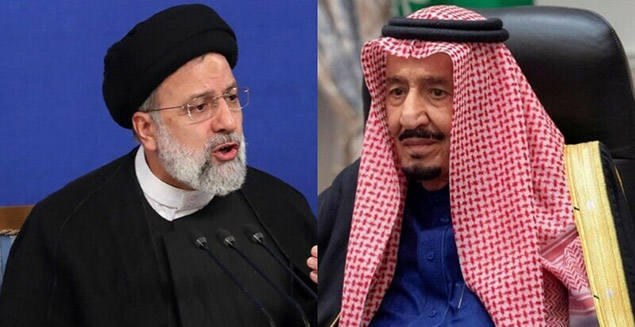
Iran president welcomes invitation from King Salman to visit Saudi Arabia

News Network
March 20, 2023

saudiking.jpg

Iranian President Ebrahim Raisi has favourably received an invitation from Saudi Arabia’s King Salman to visit the kingdom following the reconciliation deal between the two countries, an Iranian official has said.

“In a letter to President Raisi … the King of Saudi Arabia welcomed the deal between the two brotherly countries [and] invited him to Riyadh,” tweeted Mohammad Jamshidi, the Iranian president’s deputy chief of staff for political affairs, adding to this Sunday message that “Raisi welcomed the invitation”.

The two regional heavyweights announced on March 10 a Chinese-brokered deal to restore ties seven years after they were severed.

Riyadh cut relations after Iranian protesters attacked Saudi diplomatic missions in 2016 following the Saudi execution of Shia cleric Nimr al-Nimr – just one in a series of flashpoints between the two long-standing regional rivals.

The deal is expected to see Shia-majority Iran and mainly Sunni Muslim Saudi Arabia reopen their embassies and missions within two months and implement security and economic cooperation deals signed more than 20 years ago.

Iranian Foreign Minister Hossein Amir-Abdollahian told reporters on Sunday that the two countries had agreed to hold a meeting between their top diplomats.

He added that three locations for the talks had been suggested, without specifying where.

Al Jazeera’s Ali Hashem, reporting from Tehran, said that Amir-Abdollahian stressed “that both countries are exchanging technical teams to inspect the embassies in Tehran and Riyadh and see whether they’re ready for both missions to be deployed there”.

“The Iranians suggested, according to Amir-Abdollahian, three locations for the meeting. The exchange took place now through the Swiss embassy, and not through the Chinese. This could indicate that there are several channels between the Iranians and Saudis right now,” Hashem said.

The detente between Saudi Arabia, the world’s biggest oil exporter, and Iran, strongly at odds with Western governments over its nuclear activities, has the potential to reshape relations across a region characterised by turbulence for decades.

Iran and Saudi Arabia support rival sides in several conflict zones – including Yemen, where the Houthi rebels are aligned with Tehran and where a military coalition supporting the government is led by Riyadh.

The two sides also vie for influence in Syria, Lebanon and Iraq.

A number of Gulf countries followed Riyadh’s action in 2016 and scaled back ties with Tehran, though the United Arab Emirates and Kuwait recently restored ties.

Amir-Abdollahian said Iran also hoped steps would be made to normalise its ties with Bahrain, a close Saudi ally that followed Riyadh in severing diplomatic ties with Iran in 2016.

In the past, Bahrain accused Iran of having trained and backed a Shia-led uprising in the Sunni-ruled kingdom in order to topple the Manama government. Tehran denies this.

“An agreement was reached two months ago for Iranian and Bahraini technical delegations to visit the embassies of the two countries. We hope that some obstacles between Iran and Bahrain will be removed and we will take basic steps to reopen the embassies,” Amir-Abdollahian said.

There was no immediate comment from Manama.

Bahrain, together with other Gulf Arab states, welcomed the agreement between Riyadh and Tehran to restore relations.

In September, Iran welcomed an Emirati ambassador after a six-year absence, and a month earlier it said Kuwait had sent its first ambassador to Tehran since 2016.

Iran’s top security official Ali Shamkhani also held talks with United Arab Emires President Mohammed bin Zayed Al Nahyan in Abu Dhabi on Thursday in yet another sign of the shifting relations in the region. 

Comments

Add new comment

  • Coastaldigest.com reserves the right to delete or block any comments.
  • Coastaldigset.com is not responsible for its readers’ comments.
  • Comments that are abusive, incendiary or irrelevant are strictly prohibited.
  • Please use a genuine email ID and provide your name to avoid reject.
News Network
February 1,2026

Bengaluru, Feb 1: For travelers landing at Kempegowda International Airport (KIA), the sleek, wood-paneled curves of Terminal 2 promise a world-class welcome. But the famed “Garden City” charm quickly withers at the curb. As India’s aviation sector swells to record numbers—handling over 43 million passengers in Bengaluru alone this past year—the “last mile” has turned into a marathon of frustration.

The Bengaluru Logjam: Rules vs Reality

While the city awaits the 2027 completion of the Namma Metro Blue Line, the interim has been chaotic. Recent “decongestion” rules at Terminal 1 have pushed app-based cab pickups to distant parking zones, forcing weary passengers into a 20-minute walk with luggage.

“I landed after ten months away and felt like a stranger in my own city,” says Ruchitha Jain, a Koramangala resident. “My driver couldn’t find me, staff couldn’t guide me, and the so-called ‘Premium’ lane is just a fancy tax on convenience.”

•    The Cost of Distance: A 40-km cab ride can now easily cross ₹1,500, driven by demand pricing and airport surcharges.

•    The Bus Gap: While Vayu Vajra remains a lifeline, its ₹300–₹400 fare is often cited as the most expensive airport bus service in the country.

A National Pattern of Disconnect

The struggle is not unique to Karnataka. From Chennai’s coast to Hyderabad’s plateau, India’s airports tell a familiar story: brilliant runways, broken exits.

City:    Primary Issue   |    Recent Development

Bengaluru:    Cab pickup restrictions & distance  |    App-based taxis shifted to far parking zones; long walks and fare spikes reported

Chennai:    Multi-Level Parking (MLCP) hike  |    Passengers report 40-minute walks to reach cab pickup points

Hyderabad:    “Taxi mafia” & touting  |    Over 440 touting cases reported; security presence intensified

Mumbai:    Fare scams  |     Tourists charged ₹18,000 for just 400 metres, triggering police action

In Hyderabad, travelers continue to battle entrenched local groups that intimidate Uber and Ola drivers, pushing passengers toward overpriced private taxis. Chennai flyers, meanwhile, complain that reaching the designated pickup zones now takes longer than short-haul flights from cities like Coimbatore.

The ‘Budget Day’ Hope

As Finance Minister Nirmala Sitharaman presents the Union Budget 2026 today, the aviation sector is watching closely. With the government’s renewed emphasis on multimodal integration, there is cautious hope for funding toward seamless airport-metro-bus hubs.

The vision is clear: a future where planes, trains, and metros speak the same language. Until then, passengers at KIA—and airports across India—will continue to discover that the hardest part of flying isn’t the thousands of kilometres in the air, but the last few on the ground.

Comments

Add new comment

  • Coastaldigest.com reserves the right to delete or block any comments.
  • Coastaldigset.com is not responsible for its readers’ comments.
  • Comments that are abusive, incendiary or irrelevant are strictly prohibited.
  • Please use a genuine email ID and provide your name to avoid reject.
News Network
January 23,2026

Karnataka Governor Thaawarchand Gehlot read only three lines from the 122-paragraph address prepared by the Congress-led state government while addressing the joint session of the Legislature on Thursday, effectively bypassing large sections critical of the BJP-led Union government.

The omitted portions of the customary Governor’s address outlined what the state government described as a “suppressive situation in economic and policy matters” under India’s federal framework. The speech also sharply criticised the Centre’s move to replace the Mahatma Gandhi National Rural Employment Guarantee Act (MGNREGA) with the Viksit Bharat–Guarantee for Rozgar and Ajeevika Mission (Gramin) Act, commonly referred to as the VB-GRAM (G) Act.

Governor Gehlot had earlier conveyed his objection to several paragraphs that were explicitly critical of the Union government. On Thursday, he confined himself to the opening lines — “I extend a warm welcome to all of you to the joint session of the State legislature. I am extremely pleased to address this august House” — before jumping directly to the concluding sentence of the final paragraph.

He ended the address by reading the last line of paragraph 122: “Overall, my government is firmly committed to doubling the pace of the State’s economic, social and physical development. Jai Hind — Jai Karnataka.”

According to the prepared speech, the Karnataka government demanded the scrapping of the VB-GRAM (G) Act, describing it as “contractor-centric” and detrimental to rural livelihoods, and called for the full restoration of MGNREGA. The state government argued that the new law undermines decentralisation, weakens labour protections, and centralises decision-making in violation of constitutional norms.

Key points from the unread sections of the speech:

•    Karnataka facing a “suppressive” economic and policy environment within the federal system

•    Repeal of MGNREGA described as a blow to rural livelihoods

•    VB-GRAM (G) Act accused of protecting corporate and contractor interests

•    New law alleged to weaken decentralised governance

•    Decision-making said to be imposed by the Centre without consulting states

•    Rights of Adivasis, women, backward classes and agrarian communities curtailed

•    Labourers allegedly placed under contractor control

•    States facing mounting fiscal stress due to central policies

•    VB-GRAM (G) Act accused of enabling large-scale corruption

Comments

Add new comment

  • Coastaldigest.com reserves the right to delete or block any comments.
  • Coastaldigset.com is not responsible for its readers’ comments.
  • Comments that are abusive, incendiary or irrelevant are strictly prohibited.
  • Please use a genuine email ID and provide your name to avoid reject.
News Network
February 5,2026

Bengaluru: As air quality continues to worsen across several parts of the city, hospitals in Bengaluru are reporting a steady rise in patients suffering from respiratory illnesses such as asthma, bronchitis and Chronic Obstructive Pulmonary Disease (COPD), health officials and doctors said.

Data from the Suvarna Arogya Suraksha Trust (SAST) shows that 3,891 patients received treatment for respiratory ailments between April and November 2024. The figure rose to 4,187 during the same period in 2025.

Private hospitals, too, are witnessing a 10–15 per cent year-on-year increase in such cases.

While doctors caution that the rise cannot be attributed solely to air pollution, a significant number of patients are non-smokers with no prior history of respiratory disease.

“Nearly 70 per cent of the patients we see are non-smokers with no previous respiratory issues. When other causes are ruled out, air pollution emerges as the most likely factor,” said Dr Manjunath PH, consultant interventional pulmonologist at a hospital in Kengeri.

Doctors noted that patient footfall spikes during the winter months and around Deepavali, when air quality typically worsens.

“There is a clear correlation between poor air quality and the rise in cases. People commonly present with persistent cough, breathlessness and irritation of the respiratory tract, indicating the impact of polluted air on their health,” said Dr Sheetal Chaurasia, consultant in pulmonary medicine at a private hospital in Whitefield.

Dr Chaurasia added that respiratory tract infections are also on the rise.

“Poor air quality leads to chronic airway inflammation, making the airways more vulnerable to infections. We are seeing an increase in both upper and lower respiratory tract infections,” she said.

Patients with pre-existing respiratory conditions remain the worst affected.

“For those already diagnosed with respiratory illnesses, deteriorating air quality significantly worsens the condition. Both the frequency and severity of attacks increase sharply,” said Dr Vandana P, a pulmonologist at a hospital on Bannerghatta Road.

Doctors also flagged a worrying trend of rising respiratory problems among younger adults and children.

To reduce exposure, they advised people to wear masks while travelling on two-wheelers or autos and ensure adequate ventilation at home to minimise indoor air pollution.

Comments

Add new comment

  • Coastaldigest.com reserves the right to delete or block any comments.
  • Coastaldigset.com is not responsible for its readers’ comments.
  • Comments that are abusive, incendiary or irrelevant are strictly prohibited.
  • Please use a genuine email ID and provide your name to avoid reject.