



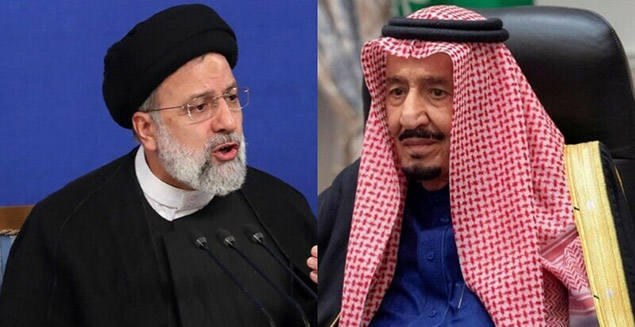
Iranian President Ebrahim Raisi has favourably received an invitation from Saudi Arabia’s King Salman to visit the kingdom following the reconciliation deal between the two countries, an Iranian official has said.
“In a letter to President Raisi … the King of Saudi Arabia welcomed the deal between the two brotherly countries [and] invited him to Riyadh,” tweeted Mohammad Jamshidi, the Iranian president’s deputy chief of staff for political affairs, adding to this Sunday message that “Raisi welcomed the invitation”.
The two regional heavyweights announced on March 10 a Chinese-brokered deal to restore ties seven years after they were severed.
Riyadh cut relations after Iranian protesters attacked Saudi diplomatic missions in 2016 following the Saudi execution of Shia cleric Nimr al-Nimr – just one in a series of flashpoints between the two long-standing regional rivals.
The deal is expected to see Shia-majority Iran and mainly Sunni Muslim Saudi Arabia reopen their embassies and missions within two months and implement security and economic cooperation deals signed more than 20 years ago.
Iranian Foreign Minister Hossein Amir-Abdollahian told reporters on Sunday that the two countries had agreed to hold a meeting between their top diplomats.
He added that three locations for the talks had been suggested, without specifying where.
Al Jazeera’s Ali Hashem, reporting from Tehran, said that Amir-Abdollahian stressed “that both countries are exchanging technical teams to inspect the embassies in Tehran and Riyadh and see whether they’re ready for both missions to be deployed there”.
“The Iranians suggested, according to Amir-Abdollahian, three locations for the meeting. The exchange took place now through the Swiss embassy, and not through the Chinese. This could indicate that there are several channels between the Iranians and Saudis right now,” Hashem said.
The detente between Saudi Arabia, the world’s biggest oil exporter, and Iran, strongly at odds with Western governments over its nuclear activities, has the potential to reshape relations across a region characterised by turbulence for decades.
Iran and Saudi Arabia support rival sides in several conflict zones – including Yemen, where the Houthi rebels are aligned with Tehran and where a military coalition supporting the government is led by Riyadh.
The two sides also vie for influence in Syria, Lebanon and Iraq.
A number of Gulf countries followed Riyadh’s action in 2016 and scaled back ties with Tehran, though the United Arab Emirates and Kuwait recently restored ties.
Amir-Abdollahian said Iran also hoped steps would be made to normalise its ties with Bahrain, a close Saudi ally that followed Riyadh in severing diplomatic ties with Iran in 2016.
In the past, Bahrain accused Iran of having trained and backed a Shia-led uprising in the Sunni-ruled kingdom in order to topple the Manama government. Tehran denies this.
“An agreement was reached two months ago for Iranian and Bahraini technical delegations to visit the embassies of the two countries. We hope that some obstacles between Iran and Bahrain will be removed and we will take basic steps to reopen the embassies,” Amir-Abdollahian said.
There was no immediate comment from Manama.
Bahrain, together with other Gulf Arab states, welcomed the agreement between Riyadh and Tehran to restore relations.
In September, Iran welcomed an Emirati ambassador after a six-year absence, and a month earlier it said Kuwait had sent its first ambassador to Tehran since 2016.
Iran’s top security official Ali Shamkhani also held talks with United Arab Emires President Mohammed bin Zayed Al Nahyan in Abu Dhabi on Thursday in yet another sign of the shifting relations in the region.

Comments
Add new comment