



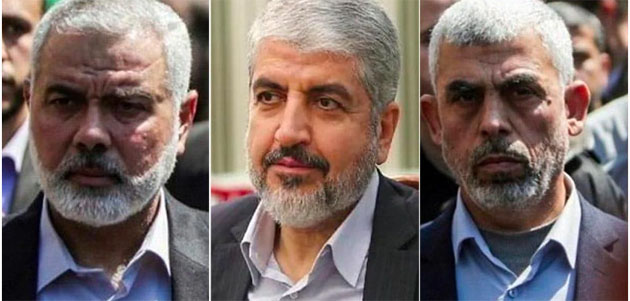
Israel seeks to assassinate Hamas leaders around the world after war on Gaza

News Network
December 2, 2023

hamas.jpg

The Israeli regime's top spy agencies reportedly seek to “assassinate” Hamas leaders around the world after its brutal war on the Gaza Strip that has already killed more than 15,000 Palestinians ends. 

With orders from Israeli prime minister Benjamin Netanyahu, the regime’s top spy agencies, including Mossad, are working on plans to assassinate Hamas leaders living in Lebanon, Turkey, Qatar, and other Persian Gulf countries, The Wall Street Journal cites unnamed Israeli officials on Thursday. 

"The question now for Israeli leaders isn't about whether to try to kill Hamas leaders elsewhere in the world, but where—and how, the officials said," wrote the newspaper.

The report claimed that there had been calls to immediately assassinate Khaled Meshaal, one of the top Hamas leaders, after the Palestinian resistance group launched the Al-Aqsa Storm Operation against the regime on October 7.

Israel’s prime minister hinted at the regime’s plans for assassinations abroad in an address in late November, when he said that he had “instructed the Mossad to act against the heads of Hamas wherever they are.”

Israel has a long history of conducting assassination operations outside its borders in violation of international law, sovereignty of other countries, and human rights.

Israel’s minister of military affairs Yoav Gallant also threatened Hamas leaders back then, saying, “The struggle is worldwide.”

Efraim Halevy, a former Mossad director, however, told the Journal that the regime’s plan “is not supported by everyone.”

"Pursuing Hamas on a worldwide scale and trying to systematically remove all its leaders from this world is a desire to exact revenge, not a desire to achieve a strategic aim."

After Israel was caught off guard by Hamas operation on the occupied territories, it started a brutal bombing campaign against the besieged Gaza Strip. The regime has so far killed more than 15,000 Palestinians, about 40 percent of whom are children. 

Some of the big names that may feature in Mossad's kill list are Ismail Haniyeh, Mohammed Deif, Yahya Sinwar and Khaled Mashal. 

Ismail Haniyeh

Haniyeh, 60, is a politician who is a former Palestinian prime minister. He was elected as the head of Hamas' political bureau in 2017.  In 2006, while serving as the Palestinian PM, Haniyeh was the subject of an assassination plot using a poison-filled letter. 

Haniyeh lives in voluntary exile, splitting his time between Qatar and Turkey. 

Mohammed Deif

Deif heads Hamas' military wing, the Ezzdine al-Qassam Brigades, and is Israel's public enemy number one. Israeli authorities have tried to assassinate him at least six times, as per reports. He has also been on the US list of "international terrorists" since 2015.

The audio message at the start of the October 7 Hamas attack on Israel, dubbed the "Al-Aqsa Flood", carried Deif's voice. His current whereabouts are unknown but Israel believes he is fighting alongside Hamas fighters in the Gaza Strip.

Yahya Sinwar

Sinwar, 61, is a former commander of the Ezzdine al-Qassam Brigades and was elected in 2017 as head of Hamas in Gaza. He has spent 23 years in Israeli jails before his release in 2011 in a prisoner exchange involving French-Israeli soldier Gilad Shalit who was held captive by Hamas.

Some of the Israeli hostages taken to Gaza have spoken about encountering Sinwar during their captivity. 

Khaled Mashal

Mashal is a founding member of Hamas Politburo and was the chairman until 2017. His current whereabouts are believed to be in Qatar.

Mashal was at the centre of a sensational assassination attempt in Jordan in 1997 when Mossad agents, posing as Canadian tourists, sprayed a deadly toxin into one of his ears. The Mossad kill-team was captured and Mashal fell into a coma.

US President Bill Clinton had to intervene and the then Mossad chief Danny Yatom had to fly to Amman with an antidote.


Comments

Add new comment

  • Coastaldigest.com reserves the right to delete or block any comments.
  • Coastaldigset.com is not responsible for its readers’ comments.
  • Comments that are abusive, incendiary or irrelevant are strictly prohibited.
  • Please use a genuine email ID and provide your name to avoid reject.
News Network
January 23,2026

modIKERALA.jpg

Prime Minister Narendra Modi, during his visit to Thiruvananthapuram on Friday, January 23, indicated that the Bharatiya Janata Party (BJP) is aiming to expand its political footprint in Kerala ahead of the Assembly elections scheduled in the coming months.

Speaking at a BJP-organised public meeting, Modi drew parallels between the party’s early electoral gains in Gujarat and its recent victory in the Thiruvananthapuram Municipal Corporation. The civic body win, which ended decades of Left control, was cited by the Prime Minister as a possible starting point for the party’s broader ambitions in the state.

Recalling BJP’s political trajectory in Gujarat, Modi said the party was largely insignificant before 1987 and received little media attention. He pointed out that the BJP’s first major breakthrough came with its victory in the Ahmedabad Municipal Corporation that year.

“Just as our journey in Gujarat began with one city, Kerala’s journey has also started with a single city,” Modi said, suggesting that the party’s municipal-level success could translate into wider electoral acceptance.

The Prime Minister alleged that successive governments led by the Left Democratic Front (LDF) and the United Democratic Front (UDF) had failed to adequately develop Thiruvananthapuram. He accused both fronts of corruption and neglect, claiming that basic infrastructure and facilities were denied to the capital city for decades.

According to Modi, the BJP’s control of the civic body represents a shift driven by public dissatisfaction with the existing political alternatives. He asserted that the BJP administration in Thiruvananthapuram had begun working towards development, though no specific details or timelines were outlined.

Addressing the gathering at Putharikandam Maidan, Modi said the BJP intended to project Thiruvananthapuram as a “model city,” reiterating his party’s commitment to governance-led change.

The Prime Minister’s visit to Kerala also included the inauguration of several development projects and the flagging off of new train services, as the BJP intensifies its political outreach in the poll-bound state.

Comments

Add new comment

  • Coastaldigest.com reserves the right to delete or block any comments.
  • Coastaldigset.com is not responsible for its readers’ comments.
  • Comments that are abusive, incendiary or irrelevant are strictly prohibited.
  • Please use a genuine email ID and provide your name to avoid reject.
News Network
January 23,2026

Mangaluru: The Karnataka Government Polytechnic (KPT), Mangaluru, has achieved autonomous status from the All India Council for Technical Education (AICTE), becoming the first government polytechnic in the country to receive such recognition in its 78-year history. The status was granted by AICTE, New Delhi, and subsequently approved by the Karnataka Board of Technical Education in October last year.

Officials said the autonomy was conferred a few months ago. Until recently, AICTE extended autonomous status only to engineering colleges, excluding diploma institutions. However, with a renewed national focus on skill development, several government polytechnics across India have now been granted autonomy.

KPT, the second-largest polytechnic in Karnataka, was established in 1946 with four branches and has since expanded to offer eight diploma programmes, including computer science and polymer technology. The institution is spread across a 19-acre campus.

Ravindra M Keni, the first dean of the institution, told The Times of India that AICTE had proposed autonomous status for polytechnic institutions that are over 25 years old. “Many colleges applied. In the first round, 100 institutions were shortlisted, which was further narrowed down to 15 in the second round. We have already completed one semester after becoming an autonomous institution,” he said. He added that nearly 500 students are admitted annually across eight three-year diploma courses.

Explaining the factors that helped KPT secure autonomy, Keni said the institution has consistently recorded 100 per cent admissions and placements for its graduates. He also noted its strong performance in sports, with the college emerging champions for 12 consecutive years, along with active student participation in NCC and NSS activities.

Autonomous status allows KPT to design industry-oriented curricula, conduct examinations, prepare question papers, and manage academic documentation independently. The institution can also directly collaborate with industries and receive priority funding from AICTE or the Ministry of Education. While academic autonomy has been granted, financial control will continue to rest with the state government.

“There will be separate committees for examinations, question paper setting, boards of studies, and boards of examiners. The institution will now have the freedom to conduct admissions without government notifications and issue its own marks cards,” Keni said, adding that new academic initiatives would be planned after a year of functioning under the autonomous framework.

Comments

Add new comment

  • Coastaldigest.com reserves the right to delete or block any comments.
  • Coastaldigset.com is not responsible for its readers’ comments.
  • Comments that are abusive, incendiary or irrelevant are strictly prohibited.
  • Please use a genuine email ID and provide your name to avoid reject.
News Network
January 23,2026

Karnataka Governor Thaawarchand Gehlot read only three lines from the 122-paragraph address prepared by the Congress-led state government while addressing the joint session of the Legislature on Thursday, effectively bypassing large sections critical of the BJP-led Union government.

The omitted portions of the customary Governor’s address outlined what the state government described as a “suppressive situation in economic and policy matters” under India’s federal framework. The speech also sharply criticised the Centre’s move to replace the Mahatma Gandhi National Rural Employment Guarantee Act (MGNREGA) with the Viksit Bharat–Guarantee for Rozgar and Ajeevika Mission (Gramin) Act, commonly referred to as the VB-GRAM (G) Act.

Governor Gehlot had earlier conveyed his objection to several paragraphs that were explicitly critical of the Union government. On Thursday, he confined himself to the opening lines — “I extend a warm welcome to all of you to the joint session of the State legislature. I am extremely pleased to address this august House” — before jumping directly to the concluding sentence of the final paragraph.

He ended the address by reading the last line of paragraph 122: “Overall, my government is firmly committed to doubling the pace of the State’s economic, social and physical development. Jai Hind — Jai Karnataka.”

According to the prepared speech, the Karnataka government demanded the scrapping of the VB-GRAM (G) Act, describing it as “contractor-centric” and detrimental to rural livelihoods, and called for the full restoration of MGNREGA. The state government argued that the new law undermines decentralisation, weakens labour protections, and centralises decision-making in violation of constitutional norms.

Key points from the unread sections of the speech:

•    Karnataka facing a “suppressive” economic and policy environment within the federal system

•    Repeal of MGNREGA described as a blow to rural livelihoods

•    VB-GRAM (G) Act accused of protecting corporate and contractor interests

•    New law alleged to weaken decentralised governance

•    Decision-making said to be imposed by the Centre without consulting states

•    Rights of Adivasis, women, backward classes and agrarian communities curtailed

•    Labourers allegedly placed under contractor control

•    States facing mounting fiscal stress due to central policies

•    VB-GRAM (G) Act accused of enabling large-scale corruption

Comments

Add new comment

  • Coastaldigest.com reserves the right to delete or block any comments.
  • Coastaldigset.com is not responsible for its readers’ comments.
  • Comments that are abusive, incendiary or irrelevant are strictly prohibited.
  • Please use a genuine email ID and provide your name to avoid reject.