Israeli genocide leaves 1.10 lakh Gazans killed, injured or missing: Euro-Med

News Network
February 5, 2024

gaza.jpg

A Geneva-based human rights organization has provided a gruesome report on the vast trail of death and destruction left by four months of Israel's genocidal war on the besieged Gaza Strip. 

"Approximately 110,000 Palestinians are reported killed, missing and injured, leaving many suffering long-term disabilities four months into Israel’s genocide in the Gaza Strip," Euro-Med Human Rights Monitor said in a statement issued on Sunday.

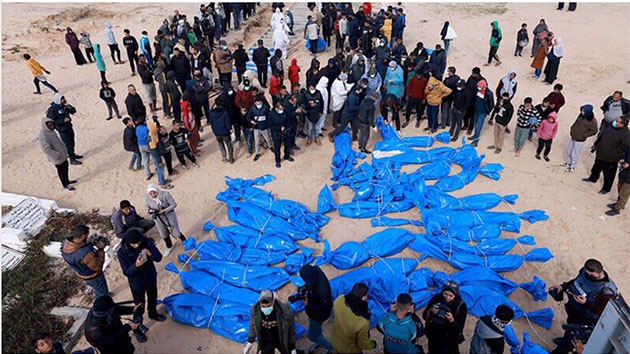
According to Euro-Med's report, the figure includes a total of 35,096 fatalities -- 32,220 of whom civilians -- including 12,345 children, 7,656 women, 309 health personnel, 41 civil defense personnel, and 121 journalists.

The death toll provided by the rights organization encompasses those who have been trapped beneath the debris of buildings hit by Israeli air and artillery strikes for more than 14 consecutive days and are, therefore, presumed dead.

Euro-Med said the number of those wounded throughout the Israeli war of aggression stands at 67,240, including hundreds who have suffered critical injuries.

Israel not heeding ICJ's ruling

Euro-Med's report added that the Israeli atrocities continue unabated despite an interim ruling that was issued by the International Court of Justice last week, obliging the regime to take all possible measures to prevent genocide against Gaza's population.

"Within a week of the International Court of Justice’s ruling, the Israeli army killed over 1,048 Palestinians—most of them civilians—and injured over 1,800 others, and carried out 108 massacres," the rights organization said.

It added that continuation of the regime's crimes is "against international humanitarian law, [and] the 1949 Geneva Convention, and amounts to war crimes according to the Rome Statute, which governs the International Criminal Court."

The rights organization also urged the international community to act swiftly "to impose a binding executive decision on the International Court of Justice’s ruling, establish an immediate ceasefire [in Gaza], [and] guarantee the safety of civilians and their return to their homes."

Mass displacements

Throughout its unrelenting aggression, the Israeli military has uprooted about two million Palestinians, approximately 90 percent of the total population of Gaza, from their homes and residential areas amid a lack of safe shelters, the Euro-Med said.

It added that the regime's displacement spree has led to complete destruction of 79,200 housing units and partial damage to 207,000 units.

"...Israel has targeted more than 245 square kilometers, [which accounts for] 67 percent of the entire Gaza Strip. This includes all of Gaza City and the Strip’s northern regions, where residents have been ordered to evacuate since late October. The majority of them have not yet been able to return; neither have residents of large areas in the central and southern sections of the Strip that Israel had designated as safe areas," the report said.

Elsewhere in its report, the rights organization warned that the Israeli military aggression is apparently aimed at re-occupying Gaza -- from which the regime withdrew in 2005.

"Israel continues to escalate its military assaults against Palestinian civilians in an apparent attempt to expand its territory to include the entire Gaza Strip [by] uprooting the vast majority of the Strip’s population in violation of international law. This likely amounts to war crimes, crimes against humanity, and genocide," the rights group said.

It also emphasized that the regime is deliberately targeting civilian infrastructure in order to cause as many casualties, material losses, and as much general destruction as possible as a form of retaliation and collective punishment.

According to Euro-Med Monitor’s team, the facilities targeted by Israel during its ongoing attacks include 334 schools, 1,720 industrial facilities, 183 health facilities, 478 mosques, three churches, 171 press offices, and 199 archaeological sites.

 

Comments

Add new comment

  • Coastaldigest.com reserves the right to delete or block any comments.
  • Coastaldigset.com is not responsible for its readers’ comments.
  • Comments that are abusive, incendiary or irrelevant are strictly prohibited.
  • Please use a genuine email ID and provide your name to avoid reject.
News Network
January 20,2026

KCFabudhabi.jpg

KCF, a global socio-cultural organisation of Karnataka expatriates, is actively involved in education, humanitarian initiatives and community well-being across several countries. The awardees were selected following a structured evaluation of nominations by the Annual Council Program Committee, based on the depth, consistency and long-term impact of their social service.

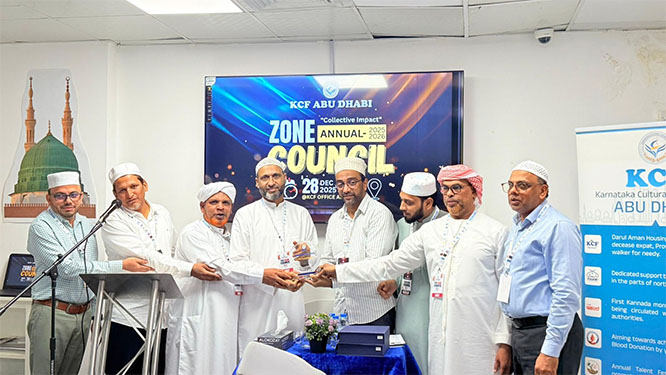
One of the award recipients, Abdul Razak Haji, a prominent UAE-based entrepreneur from the Qamcon Group of Companies, was honoured for his significant contributions to society. Through both his professional journey and personal initiatives, he has supported numerous employees and families, while also extending assistance in education, housing for the underprivileged and various charitable causes, largely carried out quietly over the years. His award was presented earlier during the Annual Council Program held at the KCF Abu Dhabi office.

The second award was conferred on Latheef Kakkinje, a young social worker based in Abu Dhabi, in recognition of his active involvement in community engagement programmes, sports initiatives, talent festivals and family-oriented social activities. His consistent volunteering efforts and commitment to humanitarian causes were highly appreciated by the selection committee.

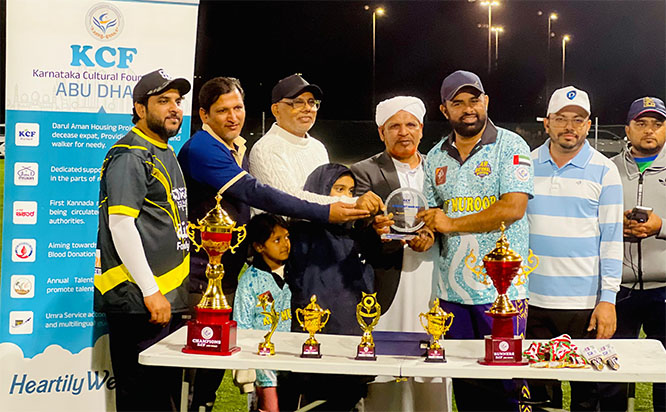
The award presentation ceremony for Latheef Kakkinje was held at the Zayed Cricket Stadium (Astro Turf Ground) in the presence of Kedumbady Ibrahim Saqafi, President of KCF UAE; Ibrahim, General Secretary; Kabeer Bayambady, President of KCF Abu Dhabi; Ummer Ishwaramangila, General Secretary; along with other members of the KCF Abu Dhabi cabinet.

Congratulating both awardees, KCF leaders reiterated the organisation’s commitment to recognising individuals who selflessly work for social upliftment and community service.

KCFabudhabi1.jpg

Comments

Add new comment

  • Coastaldigest.com reserves the right to delete or block any comments.
  • Coastaldigset.com is not responsible for its readers’ comments.
  • Comments that are abusive, incendiary or irrelevant are strictly prohibited.
  • Please use a genuine email ID and provide your name to avoid reject.
News Network
January 20,2026

Mangaluru: In a major step towards strengthening rural innovation, the Office of the Principal Scientific Adviser (PSA) to the Government of India is supporting the establishment of RuTAGe Smart Village Centres (RSVCs) across the country through collaborations with academic institutions, civil society organisations and philanthropic partners.

As part of this national initiative, Nitte (Deemed to be University) will set up the first RSVCs in the region at Nitte GP in Udupi district and at the Nitte Health Centre, Sevanjali Trust, Farangipete, in Dakshina Kannada district. The centres will be inaugurated on January 21. In South India, the programme is being implemented by the Section Infin-8 Foundation (SI-8).

Speaking to reporters on Monday, SI-8 founder-director Vishwas US said experts from Nitte University and SI-8 would work closely with farmers, students, youth and local entrepreneurs to adapt and deploy technologies tailored to local needs.

Project head Prof Iddya Karunasagar, representing Nitte DU, said the RSVCs at Nitte and Farangipete would serve as demonstration hubs for a wide range of agriculture, energy, skill-development and assistive technologies. These include solar dryers for fruits, vegetables and crops; soil-testing solutions; power weeders and women-friendly farm tools; wind-powered devices for rural artisans; grain storage systems; grass-cutting and tree-climbing equipment; and liquid fertiliser production using cowshed waste.

SI-8 CEO Aravind C Kumar said the centres would also provide access to digital and knowledge-based platforms such as ISRO applications, government scheme portals, market linkage tools and gamified learning resources, along with assistive technologies for persons with visual impairments.

Highlighting the broader impact of the initiative, Principal Scientific Adviser Prof Ajay Kumar Sood said it demonstrated how applied research could bridge the rural–urban divide and help create self-reliant, technology-enabled villages.

The initiative has been made possible through philanthropic support from Dr NC Murthy of ACM Business Solutions, LLC, USA. Dr Sapna Poti, Director (Strategic Alliances) at the Office of the Principal Scientific Adviser, said the long-term objective is to build self-sufficient, technology-driven communities capable of generating sustainable livelihoods on their own.

Comments

Add new comment

  • Coastaldigest.com reserves the right to delete or block any comments.
  • Coastaldigset.com is not responsible for its readers’ comments.
  • Comments that are abusive, incendiary or irrelevant are strictly prohibited.
  • Please use a genuine email ID and provide your name to avoid reject.
News Network
January 23,2026

Karnataka Governor Thaawarchand Gehlot read only three lines from the 122-paragraph address prepared by the Congress-led state government while addressing the joint session of the Legislature on Thursday, effectively bypassing large sections critical of the BJP-led Union government.

The omitted portions of the customary Governor’s address outlined what the state government described as a “suppressive situation in economic and policy matters” under India’s federal framework. The speech also sharply criticised the Centre’s move to replace the Mahatma Gandhi National Rural Employment Guarantee Act (MGNREGA) with the Viksit Bharat–Guarantee for Rozgar and Ajeevika Mission (Gramin) Act, commonly referred to as the VB-GRAM (G) Act.

Governor Gehlot had earlier conveyed his objection to several paragraphs that were explicitly critical of the Union government. On Thursday, he confined himself to the opening lines — “I extend a warm welcome to all of you to the joint session of the State legislature. I am extremely pleased to address this august House” — before jumping directly to the concluding sentence of the final paragraph.

He ended the address by reading the last line of paragraph 122: “Overall, my government is firmly committed to doubling the pace of the State’s economic, social and physical development. Jai Hind — Jai Karnataka.”

According to the prepared speech, the Karnataka government demanded the scrapping of the VB-GRAM (G) Act, describing it as “contractor-centric” and detrimental to rural livelihoods, and called for the full restoration of MGNREGA. The state government argued that the new law undermines decentralisation, weakens labour protections, and centralises decision-making in violation of constitutional norms.

Key points from the unread sections of the speech:

•    Karnataka facing a “suppressive” economic and policy environment within the federal system

•    Repeal of MGNREGA described as a blow to rural livelihoods

•    VB-GRAM (G) Act accused of protecting corporate and contractor interests

•    New law alleged to weaken decentralised governance

•    Decision-making said to be imposed by the Centre without consulting states

•    Rights of Adivasis, women, backward classes and agrarian communities curtailed

•    Labourers allegedly placed under contractor control

•    States facing mounting fiscal stress due to central policies

•    VB-GRAM (G) Act accused of enabling large-scale corruption

Comments

Add new comment

  • Coastaldigest.com reserves the right to delete or block any comments.
  • Coastaldigset.com is not responsible for its readers’ comments.
  • Comments that are abusive, incendiary or irrelevant are strictly prohibited.
  • Please use a genuine email ID and provide your name to avoid reject.