'A new history starts now': Leaders of two Koreas begin summit

Agencies
April 27, 2018

Seoul, Apr 27: Smiling and holding hands, North Korean leader Kim Jong Un and South Korean President Moon Jae-in met at the heavily fortified demilitarised zone between the countries on Friday in the first summit for the two Koreas in over a decade.

Scenes of Moon and Kim joking and walking together marked a striking contrast to last year's barrage of North Korean missile tests and its largest ever nuclear test that led to sweeping international sanctions and fears of a fresh conflict on the Korean peninsula.

The dramatic meeting, aimed at ending their decades-long conflict, comes weeks before Kim is due to meet U.S. President Donald Trump.

"We are at a starting line today, where a new history of peace, prosperity and inter-Korean relations is being written," Kim said before the two Korean leaders and their top aides began talks.

Moon and Kim are expected to discuss denuclearisation and exchanges between the Koreas and also will plant a memorial tree at the border truce village of Panmunjom. Just days before the summit, Kim said North Korea would suspend nuclear and long-range missile tests and dismantle its only known nuclear test site.

But there is widespread scepticism about whether Kim is ready to abandon the hard-earned nuclear arsenal his country has defended and developed for decades as what it says is a necessary deterrent against U.S. invasion.

Two earlier summits between the leaders of North and South Korea, in Pyongyang in 2000 and 2007, failed to halt the North's weapons programmes or improve relations in a lasting way.

"Today, rather than create results we won't be able to carry out like in the past, we should make good results by talking frankly about current issues, issues of interest," Kim said.

FIRST ACROSS THE LINE

Moon greeted Kim at the military demarcation line, making Kim the first North Korean leader to set foot in the South since the 1950-53 Korean War.

In an unplanned move, Kim invited Moon to step briefly across into North Korea, before the two leaders crossed back into South Korea holding hands.

The two were handed flowers by a South Korean children, residents of a village situated in the demilitarised zone.

The pair were met on a red carpet by a South Korean honour guard in historical costumes and playing traditional music.

Kim wore glasses and his trademark black Mao suit, while the rest of the North Korean delegation appeared in military uniforms or Western attire.

"A new history starts now. An age of peace, from the starting point of history," Kim wrote in Korean in a guest book in the South's Peace House before talks began.

"I hope we will be able to talk frankly and come to an agreement to give a big present for the Koreans and the people around the world who wish for peace," Moon said as the two began their official talks.

Minutes before Kim entered Peace House, a North Korean security team conducted a sweep for explosives and listening devices, and sprayed apparent disinfectant in the air, on the chairs, and on the guest book.

The United States is hopeful talks between Kim and Moon will make progress on achieving peace and prosperity, the White House said in a statement as the two men began their summit.

The White House also said it looks forward to continuing discussions with South Korea in preparation for the planned meeting of Trump and Kim in the coming weeks.

Just months ago, Trump and Kim were trading threats and insults as the North made rapid advances in pursuit of nuclear-armed missiles capable of hitting the United States.

Earlier Friday, North Korea's official KCNA news agency said Kim would "open-heartedly discuss with Moon Jae-in all the issues arising in improving inter-Korean relations and achieving peace, prosperity and reunification of the Korean peninsula."

Moon travelled to the meeting in a large motorcade, stopping briefly to greet dozens of summit supporters waving South Korean flags near the presidental Blue House in Seoul.

Hundreds of demonstrators were seen gathering in downtown Seoul from early morning to protest or support the summit.

UNENDING HOSTILITIES

The two countries expect to release a joint statement late on Friday - possibly called the Panmunjom Declaration - that could address denuclearisation and peace, and an improvement in relations, South Korean officials said.

Impoverished North Korea and the rich, democratic South are technically still at war because the Korean War ended in a truce, not a peace treaty.

The United States stations 28,500 troops in South Korea as a legacy of the Cold War conflict, which pitted the South, the United States and United Nations forces against the communist North, backed by China and Russia.

Kim and Trump are expected to meet in late May or June, with Trump saying on Thursday he was considering several possible dates and venues.

The White House released two photographs of then Secretary of State-designate and CIA chief Mike Pompeo's meeting with Kim in North Korea over the Easter weekend to discuss the planned summit. It was Kim's first known meeting with a U.S. official.

The latest Korean summit has particular significance not least because of its venue: the Demilitarised Zone, a 160-mile (260-km) long, 2.5-mile (4-km) wide strip of land created in the 1953 armistice to serve as a buffer between the South and North.

Comments

Add new comment

  • Coastaldigest.com reserves the right to delete or block any comments.
  • Coastaldigset.com is not responsible for its readers’ comments.
  • Comments that are abusive, incendiary or irrelevant are strictly prohibited.
  • Please use a genuine email ID and provide your name to avoid reject.
coastaldigest.com news network
February 5,2026

protestkerala.jpg

Mangaluru: The KSRTC Mangaluru division has rolled back the fare hike on buses operating on the Mangaluru–Kasaragod route following the suspension of toll collection at the Arikkady toll plaza near Kumbala in Kasaragod district.

The fare revision had been implemented after the National Highways Authority of India (NHAI) began toll collection at the Arikkady plaza on NH-66. As a result, fares for ordinary and Rajahamsa services were increased by ₹7 and ₹10, respectively, raising the bus fare from Mangaluru to Kasaragod from ₹81 to ₹88.

Senior Divisional Controller of KSRTC’s Mangaluru division, Rajesh Shetty, said the fares were reduced after toll collection at the Arikkady plaza was stopped. “The tollgate began operations on January 13, and the toll amount was deducted from the FASTag accounts of KSRTC buses operating on the route. Following an order from the central government to suspend toll collection, KSRTC has also withdrawn the additional fare with immediate effect,” he said.

At present, vehicles travelling on the Mangaluru–Kasaragod route pay toll only at the Talapady toll plaza. The toll for light motor vehicles (LMVs) at Talapady is ₹80 for a same-day return, while heavy vehicles, including buses, are charged ₹250. At Arikkady, the toll rates were ₹130 for LMVs (same-day return) and ₹450 for buses.

Protests against Arikkady toll plaza

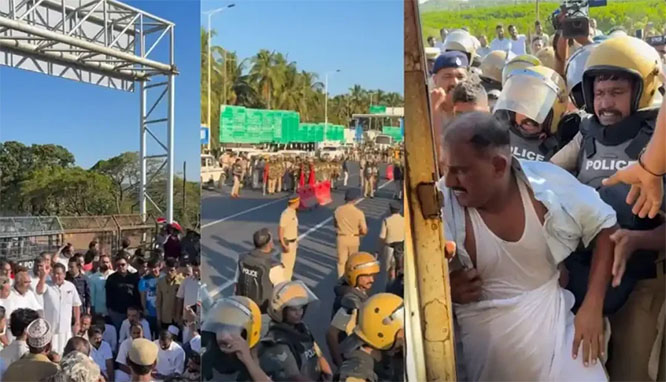
The Arikkady toll plaza witnessed widespread protests from January 12, the day toll collection commenced. On the second day, an action committee led by Manjeshwar MLA A K M Ashraf launched an indefinite protest at the site. Except for the BJP, leaders and workers of most major political parties participated in the agitation.

On the night of January 14, a large number of protesters gathered at the plaza and vandalised property, following which authorities temporarily suspended toll operations. The BJP later also expressed opposition to the toll plaza and criticised NHAI’s decision. 

Comments

Add new comment

  • Coastaldigest.com reserves the right to delete or block any comments.
  • Coastaldigset.com is not responsible for its readers’ comments.
  • Comments that are abusive, incendiary or irrelevant are strictly prohibited.
  • Please use a genuine email ID and provide your name to avoid reject.
News Network
January 23,2026

Karnataka Governor Thaawarchand Gehlot read only three lines from the 122-paragraph address prepared by the Congress-led state government while addressing the joint session of the Legislature on Thursday, effectively bypassing large sections critical of the BJP-led Union government.

The omitted portions of the customary Governor’s address outlined what the state government described as a “suppressive situation in economic and policy matters” under India’s federal framework. The speech also sharply criticised the Centre’s move to replace the Mahatma Gandhi National Rural Employment Guarantee Act (MGNREGA) with the Viksit Bharat–Guarantee for Rozgar and Ajeevika Mission (Gramin) Act, commonly referred to as the VB-GRAM (G) Act.

Governor Gehlot had earlier conveyed his objection to several paragraphs that were explicitly critical of the Union government. On Thursday, he confined himself to the opening lines — “I extend a warm welcome to all of you to the joint session of the State legislature. I am extremely pleased to address this august House” — before jumping directly to the concluding sentence of the final paragraph.

He ended the address by reading the last line of paragraph 122: “Overall, my government is firmly committed to doubling the pace of the State’s economic, social and physical development. Jai Hind — Jai Karnataka.”

According to the prepared speech, the Karnataka government demanded the scrapping of the VB-GRAM (G) Act, describing it as “contractor-centric” and detrimental to rural livelihoods, and called for the full restoration of MGNREGA. The state government argued that the new law undermines decentralisation, weakens labour protections, and centralises decision-making in violation of constitutional norms.

Key points from the unread sections of the speech:

•    Karnataka facing a “suppressive” economic and policy environment within the federal system

•    Repeal of MGNREGA described as a blow to rural livelihoods

•    VB-GRAM (G) Act accused of protecting corporate and contractor interests

•    New law alleged to weaken decentralised governance

•    Decision-making said to be imposed by the Centre without consulting states

•    Rights of Adivasis, women, backward classes and agrarian communities curtailed

•    Labourers allegedly placed under contractor control

•    States facing mounting fiscal stress due to central policies

•    VB-GRAM (G) Act accused of enabling large-scale corruption

Comments

Add new comment

  • Coastaldigest.com reserves the right to delete or block any comments.
  • Coastaldigset.com is not responsible for its readers’ comments.
  • Comments that are abusive, incendiary or irrelevant are strictly prohibited.
  • Please use a genuine email ID and provide your name to avoid reject.
News Network
February 3,2026

wind.jpg

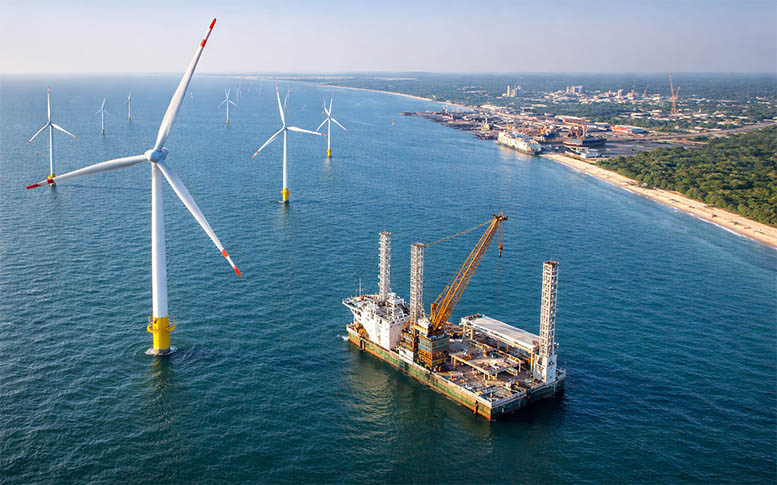
Dakshina Kannada MP Capt Brijesh Chowta has urged the Centre to give high priority to offshore wind energy generation along the Mangaluru coast, citing its strategic importance to India’s green energy and port-led development goals.

Raising the issue in the Lok Sabha under Rule 377, Chowta said studies by the National Institute of Oceanography have identified the Mangaluru coastline as part of India’s promising offshore wind ‘Zone-2’, covering nearly 6,490 sq km. He noted that the region’s relatively low exposure to cyclones and earthquakes makes it suitable for long-term offshore wind projects and called for its development as a dedicated offshore wind energy zone.

Highlighting the role of New Mangalore Port, Chowta said its modern infrastructure, multiple berths and heavy cargo-handling capacity position it well as a logistics hub for transporting and assembling large wind energy equipment.

He also pointed to the presence of major industrial units such as MRPL, OMPL, UPCL and the Mangaluru SEZ, which could serve as direct buyers of green power through power purchase agreements, improving project viability and speeding up execution.

With Karnataka’s peak power demand crossing 18,000 MW in early 2025, Chowta stressed the need to diversify renewable energy sources. He added that offshore wind projects in the Arabian Sea are strategically safer compared to the cyclone-prone Bay of Bengal.

Calling the project vital to India’s target of 500 GW of renewable energy by 2030, Chowta urged the Ministry of New and Renewable Energy to initiate resource assessments, pilot projects and stakeholder consultations at the earliest.

Comments

Add new comment

  • Coastaldigest.com reserves the right to delete or block any comments.
  • Coastaldigset.com is not responsible for its readers’ comments.
  • Comments that are abusive, incendiary or irrelevant are strictly prohibited.
  • Please use a genuine email ID and provide your name to avoid reject.