Kambala season begins to enthuse local folks in coastal Karnataka

News Network
December 17, 2022

kambala.jpg

Kambala, the traditional buffalo race event popular in the coastal Karnataka districts of Dakshina Kannada, Udupi and Kasaragod of Kerala, has embarked on a new season, entertaining tourists and the rural population in the region known as Tulu Nadu.

The first kambala (buffalo race in slushy paddy fields) of the season was set in motion at Kakkepadavu in Bantwal taluk of DK district on November 26.

Priest Raghavendra Bhat performed the rituals and temple pujari Yogindra Bhat inaugurated the ‘Sathya Dharma Kambala’ at the venue, which entered its decennial year. A total of 22 competitive kambalas have been tentatively scheduled for the 2022-23 season till April 8 next year, according to district Kambala committee president Rohit Hegde Yermal.

The last Kambala has been scheduled at Panapila in Moodbidri on April 8, 2023.

The events to be held at Bolangala near Mudipu and Panapila are the two new Kambalas which have been added to the season’s calendar. The kambala track at Bolangala is getting ready while the track at Panapila has already been prepared, sources said. Kambalas are usually held at 18 to 20 places in the region on behalf of the committee every year.

The number rose to 22 this season due to the apparent enthusiasm among the youth who are more attracted to the event in recent years. The sixth edition of Mangaluru Kambala under the aegis of Capt Brijesh Chowta will be held on January 22 at the Goldfinch city ground. Former MLC Capt Ganesh Karnik said Kambala sport needs to be preserved for future generations and youth need to be actively taking part in it.

The rich culture of the coastal belt through Kambala should be maintained, he said, seeking the support of all for the sixth Mangaluru kambala.

Two Kambalas at Katapadi (Beedu kambala) to be held on February 11, 2023, and Aikala (Bava Kambala) on January 28 are more than 100 years old and were once traditional events which later turned into competitive ones.

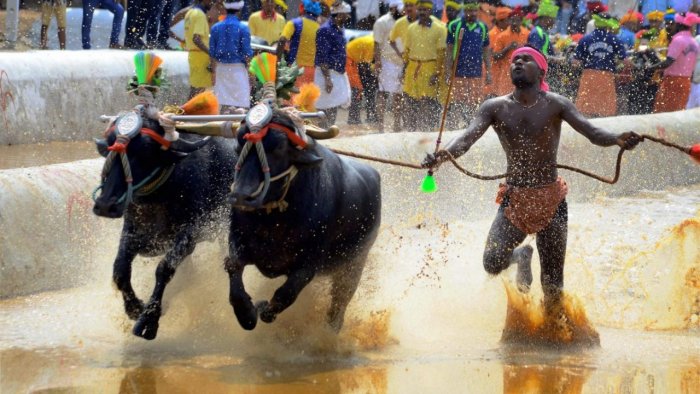
The competitive kambala events are held on two parallel race tracks filled with slushy fields. Buffalo owners and farmers in the region take good care of their buffalos and the best of them are well fed, oiled and nurtured for a race in kambala. Buffaloes are usually raced in pairs during a kambala event, held together with ploughs and ropes. The best of Kambala buffaloes can cover a 140-meter race track in around 12 seconds. The jockey or kambala runner is the man commanding the buffaloes and races along with them and only the most athletic youth can handle the animals.

The runner stands on a wooden plank (known as halage) supported to the setup that holds two buffaloes together (called Negilu). The Kambala runner controls the buffaloes with a whip or ropes.

The runner also entertains spectators by splashing water as high as possible during the race. Two teams of buffaloes along with their jockeys race towards the finish line on the two parallel race tracks. Race goes on all day and winners qualify for the next rounds. Kambala events usually begin in November after the October paddy harvest is done. More than 45 villages in coastal Karnataka celebrate the traditional, non-competitive kambala race every year. Major Kambala events are held at Aikala, Katapadi, Pilikula, Mangaluru, Moodbidri, Puttur, Paivalike, Kakkepadavu, Kulur, Surathkal, Uppinangadi, Vamanjoor and Venur.

Kambala has become an organised rural sport, with elaborate planning and scheduling to accommodate competitions at different places. While traditional Kambala was non-competitive with pairs running one by one, in the modern event, the contest generally takes place between two pairs of buffaloes. The winning pair of buffaloes were usually rewarded with coconuts and bananas. At present, winning owners earn gold and silver coins and in many competitions, cash prizes are also awarded. The length of the kambala tracks varies from 133.5 metre to 150 metre and has width from 15 feet to 17 feet.

The competitions are held in six categories of Kane halage, adda halage, hagga senior, hagga junior, naegilu hiriya and naegilu kiriya. More pairs of buffalos are expected this year for the hagga junior competitions as many youngsters are showing more interest in taking part in the events, a Kambala committee member said. The kambalas for the 2021-22 season, which began on November 27 last year, had to be temporarily cancelled due to the weekend curfew and other Covid-19 restrictions, after holding only six of the 19 scheduled events.

The events resumed on February 5, 2022 after the lifting of the curfew with a renewed calendar, listing 11 kambalas between February 5 and April 16. The kambala committee counts at least 100 jockeys taking part in the events in the region. Of them, 8 to 10 are top performers while around 20 have already displayed their brilliance in the sport. One of the jockeys, Srinivas Gowda, a construction worker, had shot into the limelight in 2020, when he covered 142.5 metres in 13.62 seconds, which when back-calculated, equates to 100-metre run in around 9.55 seconds. It was 0.03 seconds faster than Usain Bolt’s record time of 9.58 seconds. Many compared his feat to that of Bolt and Gowda was termed as the ‘Usain Bolt of Kambala.’

Later, he himself said putting him on the same plane as Usain Bolt would be a bit of a stretch. The race involves the athlete maintaining momentum with some help from his racing buffaloes.

Kambala had also stirred controversy in the past with the charge of ill-treatment of animals. In 2016, the event was banned for the first time by the High Court, based on a petition by animal rights activists group PETA. Just like the row over jallikattu in Tamil Nadu, a heated debate followed with arguments of people supporting the event and those against the rural sport. The state government later brought an ordinance in 2017 to pave the way for the continuance of kambala. The Prevention of Cruelty to Animals (Karnataka second amendment) Act, 2017, permits kambala to be organised with restrictions to protect the animals from mistreatment. The Supreme Court has also issued several guidelines to ensure that kambala buffaloes are not harmed, tortured or ill-treated during the races. 

Comments

Add new comment

  • Coastaldigest.com reserves the right to delete or block any comments.
  • Coastaldigset.com is not responsible for its readers’ comments.
  • Comments that are abusive, incendiary or irrelevant are strictly prohibited.
  • Please use a genuine email ID and provide your name to avoid reject.
News Network
February 3,2026

manjeshwar.jpg

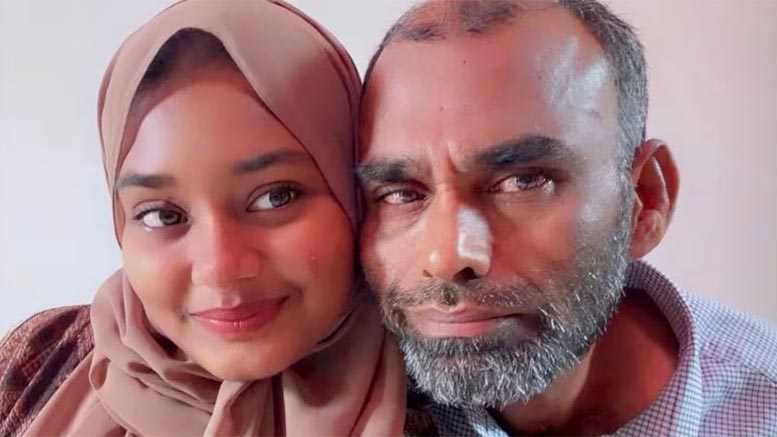
Kasaragod: An 18-year-old girl was stabbed to death at Thuminad in Manjeshwar panchayat on Monday, allegedly by her father following a domestic dispute. 

The victim has been identified as K U Mariyamath Jumaila. Her father, Umar Farooq, has been taken into police custody, Manjeshwar Station House Officer Inspector Ajith Kumar P said.

According to the police, Umar Farooq had been working in a West Asian country and returned home about three months ago. 

Family tensions reportedly escalated after his wife, Thahira (41), decided to seek a divorce and asked him to leave her life. Kasaragod district panchayat member Harshad Vorkady alleged that Umer was addicted to marijuana and frequently caused disturbances at home.

On Monday, Thahira asked Umar to come to her sister’s house in Thuminad to discuss the dispute. Jumaila accompanied her mother. 

Manjeshwar panchayat member Illiyas Thuminad said Umar arrived along with his brother, following which Thahira handed over gold ornaments and property documents to him and asked him to sever ties with her.

However, the police said a property dispute had been ongoing between Umar Farooq and his sister-in-law’s husband. During a heated argument, Umar allegedly attempted to attack the man with a sharp weapon. When Jumaila intervened to stop the assault, she was stabbed in the neck.

The teenager collapsed after bleeding profusely and was rushed to a private hospital in Mangaluru, where doctors declared her dead. Her body was later shifted to Mangalpady Taluk Hospital for post-mortem examination.

Jumaila was a former student of Sirajul Huda English Medium Higher Secondary School, Manjeshwar. 

Comments

Add new comment

  • Coastaldigest.com reserves the right to delete or block any comments.
  • Coastaldigset.com is not responsible for its readers’ comments.
  • Comments that are abusive, incendiary or irrelevant are strictly prohibited.
  • Please use a genuine email ID and provide your name to avoid reject.
News Network
February 1,2026

Bengaluru, Feb 1: For travelers landing at Kempegowda International Airport (KIA), the sleek, wood-paneled curves of Terminal 2 promise a world-class welcome. But the famed “Garden City” charm quickly withers at the curb. As India’s aviation sector swells to record numbers—handling over 43 million passengers in Bengaluru alone this past year—the “last mile” has turned into a marathon of frustration.

The Bengaluru Logjam: Rules vs Reality

While the city awaits the 2027 completion of the Namma Metro Blue Line, the interim has been chaotic. Recent “decongestion” rules at Terminal 1 have pushed app-based cab pickups to distant parking zones, forcing weary passengers into a 20-minute walk with luggage.

“I landed after ten months away and felt like a stranger in my own city,” says Ruchitha Jain, a Koramangala resident. “My driver couldn’t find me, staff couldn’t guide me, and the so-called ‘Premium’ lane is just a fancy tax on convenience.”

•    The Cost of Distance: A 40-km cab ride can now easily cross ₹1,500, driven by demand pricing and airport surcharges.

•    The Bus Gap: While Vayu Vajra remains a lifeline, its ₹300–₹400 fare is often cited as the most expensive airport bus service in the country.

A National Pattern of Disconnect

The struggle is not unique to Karnataka. From Chennai’s coast to Hyderabad’s plateau, India’s airports tell a familiar story: brilliant runways, broken exits.

City:    Primary Issue   |    Recent Development

Bengaluru:    Cab pickup restrictions & distance  |    App-based taxis shifted to far parking zones; long walks and fare spikes reported

Chennai:    Multi-Level Parking (MLCP) hike  |    Passengers report 40-minute walks to reach cab pickup points

Hyderabad:    “Taxi mafia” & touting  |    Over 440 touting cases reported; security presence intensified

Mumbai:    Fare scams  |     Tourists charged ₹18,000 for just 400 metres, triggering police action

In Hyderabad, travelers continue to battle entrenched local groups that intimidate Uber and Ola drivers, pushing passengers toward overpriced private taxis. Chennai flyers, meanwhile, complain that reaching the designated pickup zones now takes longer than short-haul flights from cities like Coimbatore.

The ‘Budget Day’ Hope

As Finance Minister Nirmala Sitharaman presents the Union Budget 2026 today, the aviation sector is watching closely. With the government’s renewed emphasis on multimodal integration, there is cautious hope for funding toward seamless airport-metro-bus hubs.

The vision is clear: a future where planes, trains, and metros speak the same language. Until then, passengers at KIA—and airports across India—will continue to discover that the hardest part of flying isn’t the thousands of kilometres in the air, but the last few on the ground.

Comments

Chandramohan
 - 
Friday, 6 Feb 2026

Sir, I request the airport authorities to introduce a free transport services from terminal 1 to terminal 2 as is very difficult for the passengers to reach terminal 2 along with their luggage. Also a trolley should be provided to reach the counter. Hope the authorities would help the passengers as soon as possible.

Add new comment

  • Coastaldigest.com reserves the right to delete or block any comments.
  • Coastaldigset.com is not responsible for its readers’ comments.
  • Comments that are abusive, incendiary or irrelevant are strictly prohibited.
  • Please use a genuine email ID and provide your name to avoid reject.
News Network
February 5,2026

In an era where digital distractions are the primary rival to academic excellence, the Karnataka Education Department is taking the fight directly to the living room. As the SSLC (Class 10) annual examinations loom, officials have launched a localized "digital strike" to ensure students aren't losing their competitive edge to scrolling or soap operas.

The 7-to-9 Lockdown

The department has issued a formal directive urging—and in some cases, enforcing via home visits—a total blackout of mobile phones and television sets between 7:00 PM and 9:00 PM. This two-hour window is being designated as "sacred study time" across the state until the examinations conclude on April 2.

Key Pillars of the Initiative:

•    Doorstep Advocacy: Teachers are transitioning from classrooms to living rooms, meeting parents to explain the psychological benefits of a distraction-free environment.

•    Parental Accountability: The campaign shifts the burden of discipline from the student to the household, asking parents to lead by example and switch off their own devices.

•    The Timeline: The focus remains sharp on the upcoming exam block, scheduled from March 18 to April 2.

"The objective is simple: uninterrupted focus. We are reclaiming the evening hours for the students, ensuring their environment is as prepared as their minds," stated a senior department official.

Student vs. Reality

While the student community has largely welcomed the "forced focus"—with many admitting they lack the willpower to ignore notifications—the move has sparked a debate on enforceability. Without a "TV Police," the success of this initiative rests entirely on the shoulders of parents and the persuasive power of visiting educators.

Comments

Add new comment

  • Coastaldigest.com reserves the right to delete or block any comments.
  • Coastaldigset.com is not responsible for its readers’ comments.
  • Comments that are abusive, incendiary or irrelevant are strictly prohibited.
  • Please use a genuine email ID and provide your name to avoid reject.