



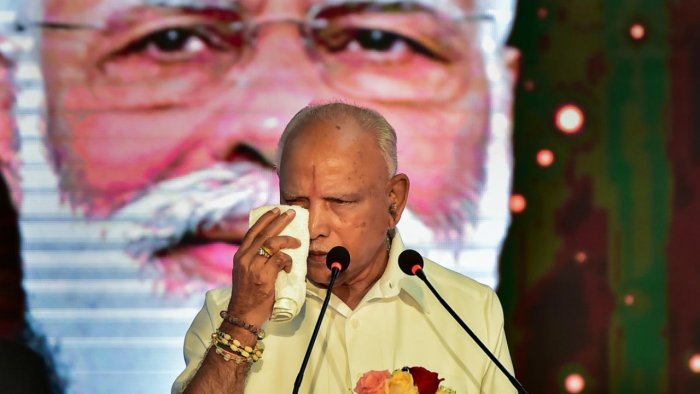
Karnataka BJP’s seasoned oarsman relents, but too early for political obituary

News Network
July 26, 2021

karnaCM.jpg

Bengaluru, July 26: There seems to be no "closure" for B S Yediyurappa, the BJP's "comeback man" in Karnataka, as he could never complete a full term in office, despite becoming the Chief Minister four times, surmounting odds.

It's also too early to write a political obituary of the 78-year old Lingayat strongman and the 24X7 politician, the face of the party in the State for decades.

From the humdrum existence as a government clerk and a hardware store owner to becoming the chief minister four times, Yediyurappa has navigated the choppy waters of politics with the consummate ease of a seasoned oarsman.

In a repeat of sorts, it is a "cut short" tenure for the rarely smiling and ever grim-looking Yediyurappa as he is stepping down less than two years ahead of the end of the current tenure, ascending to power, exactly two years ago after a murky legal battle and weeks of political drama.

For the architect of the BJP's first ever government to the south of Vindhyas, age is being seen as a primary factor for his exit from the top job, with an unwritten rule in the BJP of keeping out those above 75 years from elective offices; also the high command wants to make way for the fresh leadership, ahead of the Assembly polls, likely by mid-2023.

Among the other reasons that might have contributed to his exit include rumblings within the party with complaints about his "authoritative" style of functioning, his younger son and state BJP Vice President B Y Vijayendra's alleged interference in the administration, and allegations of corruption.

Yediyurappa's tenure as Chief Minister includes seven days during his first term in November 2007; three years and two months from May 2008; for three days in May 2018, following the Assembly polls, which was his third term; and finally for exactly two years since July 26, 2019, his fourth tenure.

A hardboiled RSS swayamsevak, Bookanakere Siddalingappa Yediyurappa was born on February 27, 1943 at Bookanakere in K R Pet Taluk of Mandya district to Siddalingappa and Puttathayamma.

Fondly called "Raja Huli" (King Tiger) by his followers, he joined the RSS when he was barely 15, and cut his political teeth in the Jana Sangh, the BJP's forerunner, in his hometown Shikaripura in Shivamogga district.

He became the Jana Sangh's Shikaripura taluk chief in the early 1970s.

Yediyurappa, who began his electoral politics as Purasabha president in Shikaripura, was first elected to the Legislative Assembly from Shikaripura in 1983 and went on to win eight times from there.

Widely credited for BJP's growth in Karnataka, along with being party's state unit president, he has also served as opposition Leader in the Legislative Assembly, member of Legislative Council, as also member of parliament.

A Bachelor of Arts, he was jailed during the Emergency, worked as a clerk in the social welfare department before taking up a similar job at a rice mill in Shikaripura before he set up his hardware shop in Shivamogga.

He married Maitradevi, daughter of the rice mill owner, where he worked, on March 5, 1967 and has two sons and three daughters. 

His elder son B Y Raghavendra is a MP from Shivamogga Lok Sabha constituency.

Always seen in his trademark white safari suit, according to those close to him, he had keen interest in watching Kannada movies.

Yediyurappa is also seen as BJP's only leader with a "mass leader" stature in South India, and wields considerable influence over the Veerashaiva-Lingayat community, which is estimated to form about 16 per cent of the states population, and is considered to be the BJPs core support base in the state.

He could have landed in the hot seat in 2004 when the BJP emerged as the single largest party, but the Congress and JD(S) of former prime minister H D Deve Gowda formed an alliance, and a government was formed under Dharam Singh.

Known for his political acumen, Yediyurappa joined hands with H D Kumaraswamy, Deve Gowda's son, in 2006 and brought down the Dharam Singh government.

Under a rotational chief ministership arrangement, Kumaraswamy became the CM and Yediyurappa his deputy.

Yediyurappa became CM for the first time in November 2007 but his term lasted just seven days as Kumaraswamy reneged on a power sharing pact and walked out of the alliance.

He became the chief minister once again after the BJP came to power in May 2008 but had to step down in July 2011 following his indictment by the then Lokayukta N Santosh Hegde in an illegal mining case.

In the 2008 polls, Yediyurappa had led the party to victory, and the first BJP government in the south was formed under him, with the help of "Operation Kamala" (Operation Lotus)- an alleged attempt of the BJP to engineer defection of opposition legislators to ensure the stability of the government.

On October 15, 2011, he surrendered before the Lokayukta court after it issued a warrant against him in connection with alleged land scams, and was in jail for a week.

Sulking after having been made to quit, Yediyurappa broke his decades-long association with the BJP and formed the Karnataka Janata Paksha. However, ploughing a lonely furrow, he failed to make the KJP a force to reckon with in state politics but wrecked the BJP's chances of retaining power in the 2013 polls, winning six seats and polling about 10 per cent votes.

As Yediyurappa faced an uncertain future and the BJP looked for a leader with a formidable reputation to lend its campaign the required heft ahead of the 2014 Lok Sabha polls, the two cosied up to each other, leading to the KJP's merger with the BJP on January 9, 2014.

In the Lok Sabha election, the BJP won 19 of the state's 28 seats, a remarkable turnaround for the party which had secured only 19.9 per cent votes in the Assembly polls just a year ago leading to the fall of its first government.

Notwithstanding the corruption taint, Yediyurappa's status and clout grew in the BJP.

On October 26, 2016, he got a huge relief when a special CBI court acquitted him, his two sons and son-in-law in a Rs 40 crore illegal mining case, which had cost him the chief ministership in 2011.

In January 2016, the Karnataka High Court quashed all 15 FIRs against Yediyurappa lodged by Lokayukta police under the Prevention of Corruption Act.

In April that year, he was appointed the state BJP chief for the fourth time.

The Lingayat leader, however, continued to be dogged by controversies, with some cases against him still pending before courts.

The BJP declared him its chief ministerial candidate in the 2018 assembly polls, ignoring the taunts by the Congress.

As the polls threw up a hung verdict, with no party getting a clear majority in the 225-member House (including Speaker), the Governor invited Yediyurappa, the leader of the single largest party, to form the government and gave him 15 days to prove the majority.

However,the Supreme Court asked him to prove the majority in the House within 24 hours following a plea by the Congress-JD(S) challenging the Governor's decision to invite the BJP to form the government.

The three-day-old BJP government collapsed on May 19, 2018, minutes before the scheduled trust vote, with him resigning in a tame anti-climax and hours later Kumaraswamy, the chief ministerial candidate of the newly formed JD(S)- Congress alliance, was invited to form the government.

In the next over one year period, the BJP under Yediyurappa managed to keep the coalition government on tenterhooks as the ruling combine constantly feared poaching of MLAs.

In its best ever performance the BJP also won 25 out of 28 Lok Sabha seats in 2019 parliamentary polls.

The resignation of 17 rebel Congress-JD(S) MLAs came as a blow to the alliance and it collapsed, losing the trust vote on July 23, 2019, paving the way for his return.

Determined to regain the reins of power, amid uncertainties about his political future with growing age, Yediyurappa is said to have played a key role in engineering the defection of the 17 Congress-JD(S) rebels.

Sixteen of them had subsequently joined the BJP.

He ensured that most of them won the bypolls in December that year on a BJP ticket, and 12 are currently Ministers in his Cabinet, as promised.

Though in the last two years, BJP won most of the bye-elections under Yediyurappa's leadership, repeated floods, alleged shortcomings in Covid management and growing disgruntlement within the party and the government, threw challenges to administration.

With growing age and strong central leadership, his declining sway over the party and administration, marred his final tenure, bringing him the criticism of being a "weak CM" from the Opposition parties.

Comments

Add new comment

  • Coastaldigest.com reserves the right to delete or block any comments.
  • Coastaldigset.com is not responsible for its readers’ comments.
  • Comments that are abusive, incendiary or irrelevant are strictly prohibited.
  • Please use a genuine email ID and provide your name to avoid reject.
News Network
January 20,2026

DGP.jpg

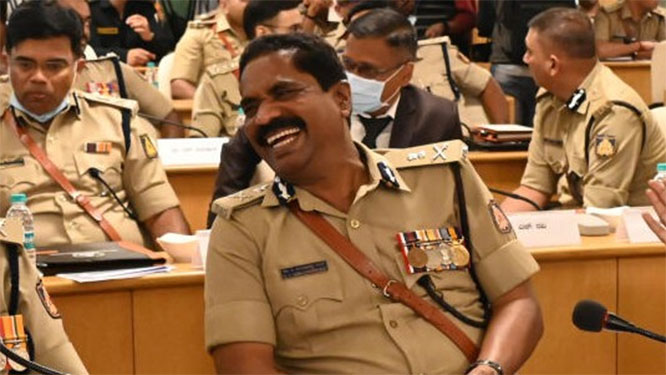
Karnataka DGP (Civil Rights Enforcement) K Ramachandra Rao was suspended with immediate effect, as per a state government order issued on Monday, 19 January. The order cited conduct unbecoming of a government servant and causing embarrassment to the state administration.

The Karnataka government suspended Rao after a purported video showed him in a compromising position with a woman inside his official chamber. The video went viral on social media. Rao rejected the videos outright, terming them "fabricated and false".

Who is K Ramachandra Rao?

Rao is a DGP-rank officer who was heading the Directorate of Civil Rights Enforcement until his suspension. He was promoted to DGP in September 2023 and assumed office in October 2023, the Sunday Guardian reported.

He also served as the Chairman and Managing Director of the Karnataka State Police Housing and Infrastructure Development Corporation Limited.

His stint as the Inspector General of Police (IGP) for the Southern Range was also marred by controversy. In 2014, during a cash seizure near Mysuru’s Yelwal, officials claimed the seized amount was ₹20 lakh, while the accused (Kerala-based merchants) claimed it was around ₹2.27 crore.

Rao, who was present during the seizure, denied all allegations. However, he was transferred soon after.

Allegations of collusion with a businessman surfaced, and a senior police officer was quoted by The Sunday Guardian as saying, “In Rao’s case, the CID has clearly mentioned that there was a great degree of lapse on the part of Rao and a deputy superintendent of police after it was brought to their notice that a few policemen, including a gunman attached to the IGP, were involved in the robbery.”

Rao had denied all wrongdoing in that incident. Despite past controversies, he rose to the state’s top police position, the Sunday Guardian reported.

Ranya Rao’s stepfather

Rao is the stepfather of Kannada actress Harshavardhini Ranya alias Ranya Rao, accused of orchestrating the illegal import of gold worth over ₹12.56 crore from Dubai to India along with two others — businessman Tarun Raju, and jewellery dealer Sahil Jain.

‘Obscene video’ controversy

A viral video showed Rao behaving inappropriately with a woman inside his office while in uniform.

The Karnataka government said in its Monday order that “vide videos and news reports widely broadcast on public news channels and media platforms, it is observed that Dr K Ramachandra Rao has acted in an obscene manner which is unbecoming of a Government Servant and also causing embarrassment to the Government.”

The order said the matter was examined by the state government, which found that the officer's conduct amounted to a violation of Rule 3 of the All India Services (Conduct) Rules, 1968.

The government said it is prima facie satisfied that "it is necessary to place Rao under suspension with immediate effect, pending inquiry".

During the suspension period, Rao will be entitled to subsistence allowance as per Rule 4 of the All India Services (Discipline and Appeal) Rules, 1969.

The order also places restrictions on his movement, stating that during the period of suspension, the officer must not leave headquarters under any circumstances without the written permission of the state government.

Comments

Add new comment

  • Coastaldigest.com reserves the right to delete or block any comments.
  • Coastaldigset.com is not responsible for its readers’ comments.
  • Comments that are abusive, incendiary or irrelevant are strictly prohibited.
  • Please use a genuine email ID and provide your name to avoid reject.
News Network
February 1,2026

Bengaluru: The Karnataka High Court has refused to quash an investigation against a WhatsApp group administrator accused of allowing the circulation of obscene and offensive images depicting Hindutva politicians and idols in 2021.

Justice M Nagaprasanna observed that, prima facie, the ingredients of the offence under Section 295A of the Indian Penal Code were made out. “The offence under Section 295A of the IPC is met to every word of its ingredient, albeit prima facie,” the judge said.

The petitioner, Sirajuddin, a resident of Belthangady taluk in Dakshina Kannada district, had challenged the FIR registered against him at the CEN (Cyber, Economics and Narcotics) police station, Mangaluru, for offences under Section 295A of the IPC and Section 67 of the Information Technology Act. Section 295A relates to punishment for deliberate and malicious acts intended to outrage the religious feelings of any class of citizens.

According to the complaint filed by K Jayaraj Salian, also a resident of Belthangady taluk, he received a WhatsApp group link from an unknown source and was added to the group after accessing it. The group reportedly had six administrators and around 250 participants, where obscene and offensive images depicting Hindu deities and certain political figures were allegedly circulated repeatedly.

Sirajuddin was arrested in connection with the case and later released on bail on February 16, 2021. He argued before the court that he was being selectively targeted, while other administrators—including the creator of the group—were neither arrested nor investigated. He also contended that the Magistrate could not have taken cognisance of the offence under Section 295A without prior sanction under Section 196(1) of the CrPC.

Rejecting the argument, Justice Nagaprasanna held that prior sanction is required only at the stage of taking cognisance, and not at the stage of registration of the crime or during investigation.

The judge noted that the State had produced the entire investigation material before the court. “A perusal of the material reveals depictions of Hindu deities in an extraordinarily obscene, demeaning and profane manner. The content is such that its reproduction in a judicial order would itself be inappropriate,” the court said, adding that the material, on its face, had the tendency to outrage religious feelings and disturb communal harmony.

Observing that the case was still at the investigation stage, the court said it could not interdict the probe at this juncture. However, it expressed concern that the investigating officer appeared to have not proceeded uniformly against all administrators. The court clarified that if the investigation revealed the active involvement of any member in permitting the circulation of such content, they must also be proceeded against.

“At this investigative stage, any further observation by this Court would be unnecessary,” the order concluded.

Comments

Add new comment

  • Coastaldigest.com reserves the right to delete or block any comments.
  • Coastaldigset.com is not responsible for its readers’ comments.
  • Comments that are abusive, incendiary or irrelevant are strictly prohibited.
  • Please use a genuine email ID and provide your name to avoid reject.
News Network
January 23,2026

Mangaluru: The Karnataka Government Polytechnic (KPT), Mangaluru, has achieved autonomous status from the All India Council for Technical Education (AICTE), becoming the first government polytechnic in the country to receive such recognition in its 78-year history. The status was granted by AICTE, New Delhi, and subsequently approved by the Karnataka Board of Technical Education in October last year.

Officials said the autonomy was conferred a few months ago. Until recently, AICTE extended autonomous status only to engineering colleges, excluding diploma institutions. However, with a renewed national focus on skill development, several government polytechnics across India have now been granted autonomy.

KPT, the second-largest polytechnic in Karnataka, was established in 1946 with four branches and has since expanded to offer eight diploma programmes, including computer science and polymer technology. The institution is spread across a 19-acre campus.

Ravindra M Keni, the first dean of the institution, told The Times of India that AICTE had proposed autonomous status for polytechnic institutions that are over 25 years old. “Many colleges applied. In the first round, 100 institutions were shortlisted, which was further narrowed down to 15 in the second round. We have already completed one semester after becoming an autonomous institution,” he said. He added that nearly 500 students are admitted annually across eight three-year diploma courses.

Explaining the factors that helped KPT secure autonomy, Keni said the institution has consistently recorded 100 per cent admissions and placements for its graduates. He also noted its strong performance in sports, with the college emerging champions for 12 consecutive years, along with active student participation in NCC and NSS activities.

Autonomous status allows KPT to design industry-oriented curricula, conduct examinations, prepare question papers, and manage academic documentation independently. The institution can also directly collaborate with industries and receive priority funding from AICTE or the Ministry of Education. While academic autonomy has been granted, financial control will continue to rest with the state government.

“There will be separate committees for examinations, question paper setting, boards of studies, and boards of examiners. The institution will now have the freedom to conduct admissions without government notifications and issue its own marks cards,” Keni said, adding that new academic initiatives would be planned after a year of functioning under the autonomous framework.

Comments

Add new comment

  • Coastaldigest.com reserves the right to delete or block any comments.
  • Coastaldigset.com is not responsible for its readers’ comments.
  • Comments that are abusive, incendiary or irrelevant are strictly prohibited.
  • Please use a genuine email ID and provide your name to avoid reject.