



5 'guarantees' of Congress in Karnataka may cost state exchequer Rs 50,000 crore

News Network
May 17, 2023

Congpromieses.jpg

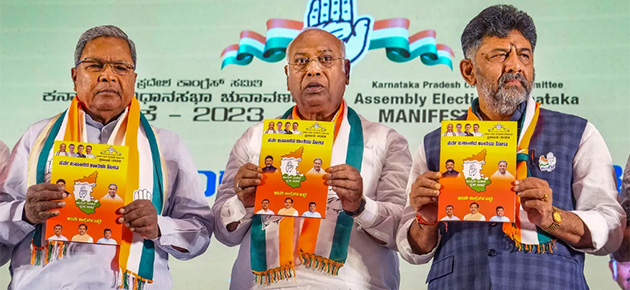
Bengaluru, May 17: The implementation of the five 'guarantees' announced by the Congress may cost the state exchequer an estimated Rs 50,000 crore annually.

Key party leaders who spoke about the cost of the welfare measures insisted that one could not call them "freebies" as they were tools of empowerment.

The 'guarantees' found resonance with voters of the May 10 Assembly elections, particularly with women, and played a key role in the party's resounding victory, political analysts noted.

The Congress bagged 135 seats in the 224-member Assembly, and ousted the BJP from power, with the erstwhile ruling party winning in just 66 constituencies, while the Janata Dal (Secular) managed to get only 19 seats.

Some BJP leaders have alleged that implementation of the 'guarantees' would push the State into financial bankruptcy, and have also claimed that the Congress would not honour its pre-poll promises fully.

During campaigning, Rahul Gandhi and other Congress leaders had repeatedly said that if voted to power, the party's government in its maiden Cabinet meeting on the first day of assuming power would pass orders approving the 'guarantees' to facilitate their swift implementation.

The five schemes that the Congress guaranteed it would implement are 'Gruha Jyothi' -- to provide 200 units electricity free to every household; 'Gruha Lakshmi' -- to grant Rs 2,000 to every woman head of a family; 'Anna Bhagya' -- to distribute 10 kg rice to every member of BPL families every month; 'Yuva Nidhi' -- to sanction Rs 3,000 dole to unemployed graduates and Rs 1,500 to unemployed diploma holders for two years (in the 18-25 age-group); and 'Shakti' -- to enable free travel for women across Karnataka in state buses.

In an interview on Wednesday, vice chairman of the Congress manifesto drafting committee Professor K E Radhakrishna said the implementation of the five guarantee schemes will not cost more than Rs 50,000 crore annually.

"I can authoritatively say that all these guarantee schemes put together will not be more than Rs 50,000 crore," he said.

Radhakrishna, who has the distinction of drafting five manifestos for the Congress, said even some of the Congress leaders have the perception that these schemes cannot be implemented.

"Some of our leaders have that perception but we are very sure because I have worked out the financial implications. It is not more than Rs 50,000 crore. Even Rs 50,000 crore is not a charity. It's empowerment," he said.

Explaining the way these schemes will be implemented, the educationist noted that the total budget of Karnataka government is about Rs three lakh crore. At least 60 per cent of revenue of any good economy is spent on sustained development, Radhakrishna said, adding that it goes to paying salary of government employees and to implement empowerment programmes.

"Revenue moves capital, capital moves revenue. So, Rs 1.50 lakh crore of the Rs three lakh crore budget has to be spent. If that does not happen, then we will not have funds to spend another Rs 1.5 lakh crore. They are related to each other," he explained.

Out of five guarantees, 'Anna Bhagya' is an existing scheme, and the new promise is an extension, he added.

"We were giving seven kg of rice. BJP reduced it to five kg. Now again we want to make it 10 kg. We are giving rice and millets. This will encourage its cultivation and production," the Congress leader pointed out.

Regarding 'Gruha Jyothi', Radhakrishna said Karnataka is a power surplus state and is selling electricity to other states.

According to him, the Congress in its manifesto has promised to set up huge solar parks of 5,000 megawatt capacity. It has also promised to set up a small solar cluster in each village.

"These clusters will generate employment to people in the village and make the villages self-sufficient in terms of electricity. We are going to increase power generation, which will eventually generate employment opportunities," Radhakrishna explained.

The Rs 2,000 guarantee under 'Gruha Lakshmi' is not for all women heads of families, he clarified. "This is only for the Below Poverty Line families. We will not give to rich people. This scheme is only for empowering poor people," the Congress leader said.

Regarding 'Yuva Nidhi', he said world-over unemployment allowance is given in many countries.

"Whether our degree education is relevant for a job is a larger issue, but as of today the graduates are in a helpless condition," Radhakrishna pointed out.

As part of the scheme, the government is planning to set up a large employment exchange, he said.

"We are going to coordinate with 'Bharat Jogo Udyoga Kendra' (Bharat Jodo Employment Centre) where we will take private industries on board," he explained.

The government will also tie up with the Rajiv Gandhi Skill Development Corporation to train and skill the graduates and make them employable by the industries, Radhakrishna said.

Talking about the 'Shakti' scheme of free bus rides for women, he said already students are getting free passes to travel to their college from their house.

"Not every woman travels in the buses. Only those who are not rich travel in buses. It's (the free travel guarantee) will empower garment workers, domestic servants, 'pourakarmikas' and women engaged in menial jobs," he said.

"There will be no conditions. We will be very happy if every woman travels. It will reduce pollution," Radhakrishna quipped.

He said these five schemes are meant only to empower people and they are not freebies.

Recalling the proverb 'If you give a man a fish, you feed him for a day. If you teach a man to fish, you feed him for a lifetime', the educationist pointed out, "But we believe that to catch the fish, that hand that catches the fish should have some minimal strength. That is the empowerment we do."

Comments

Add new comment

  • Coastaldigest.com reserves the right to delete or block any comments.
  • Coastaldigset.com is not responsible for its readers’ comments.
  • Comments that are abusive, incendiary or irrelevant are strictly prohibited.
  • Please use a genuine email ID and provide your name to avoid reject.
News Network
January 23,2026

Karnataka Governor Thaawarchand Gehlot read only three lines from the 122-paragraph address prepared by the Congress-led state government while addressing the joint session of the Legislature on Thursday, effectively bypassing large sections critical of the BJP-led Union government.

The omitted portions of the customary Governor’s address outlined what the state government described as a “suppressive situation in economic and policy matters” under India’s federal framework. The speech also sharply criticised the Centre’s move to replace the Mahatma Gandhi National Rural Employment Guarantee Act (MGNREGA) with the Viksit Bharat–Guarantee for Rozgar and Ajeevika Mission (Gramin) Act, commonly referred to as the VB-GRAM (G) Act.

Governor Gehlot had earlier conveyed his objection to several paragraphs that were explicitly critical of the Union government. On Thursday, he confined himself to the opening lines — “I extend a warm welcome to all of you to the joint session of the State legislature. I am extremely pleased to address this august House” — before jumping directly to the concluding sentence of the final paragraph.

He ended the address by reading the last line of paragraph 122: “Overall, my government is firmly committed to doubling the pace of the State’s economic, social and physical development. Jai Hind — Jai Karnataka.”

According to the prepared speech, the Karnataka government demanded the scrapping of the VB-GRAM (G) Act, describing it as “contractor-centric” and detrimental to rural livelihoods, and called for the full restoration of MGNREGA. The state government argued that the new law undermines decentralisation, weakens labour protections, and centralises decision-making in violation of constitutional norms.

Key points from the unread sections of the speech:

•    Karnataka facing a “suppressive” economic and policy environment within the federal system

•    Repeal of MGNREGA described as a blow to rural livelihoods

•    VB-GRAM (G) Act accused of protecting corporate and contractor interests

•    New law alleged to weaken decentralised governance

•    Decision-making said to be imposed by the Centre without consulting states

•    Rights of Adivasis, women, backward classes and agrarian communities curtailed

•    Labourers allegedly placed under contractor control

•    States facing mounting fiscal stress due to central policies

•    VB-GRAM (G) Act accused of enabling large-scale corruption

Comments

Add new comment

  • Coastaldigest.com reserves the right to delete or block any comments.
  • Coastaldigset.com is not responsible for its readers’ comments.
  • Comments that are abusive, incendiary or irrelevant are strictly prohibited.
  • Please use a genuine email ID and provide your name to avoid reject.
News Network
February 1,2026

Bengaluru: The Karnataka High Court has refused to quash an investigation against a WhatsApp group administrator accused of allowing the circulation of obscene and offensive images depicting Hindutva politicians and idols in 2021.

Justice M Nagaprasanna observed that, prima facie, the ingredients of the offence under Section 295A of the Indian Penal Code were made out. “The offence under Section 295A of the IPC is met to every word of its ingredient, albeit prima facie,” the judge said.

The petitioner, Sirajuddin, a resident of Belthangady taluk in Dakshina Kannada district, had challenged the FIR registered against him at the CEN (Cyber, Economics and Narcotics) police station, Mangaluru, for offences under Section 295A of the IPC and Section 67 of the Information Technology Act. Section 295A relates to punishment for deliberate and malicious acts intended to outrage the religious feelings of any class of citizens.

According to the complaint filed by K Jayaraj Salian, also a resident of Belthangady taluk, he received a WhatsApp group link from an unknown source and was added to the group after accessing it. The group reportedly had six administrators and around 250 participants, where obscene and offensive images depicting Hindu deities and certain political figures were allegedly circulated repeatedly.

Sirajuddin was arrested in connection with the case and later released on bail on February 16, 2021. He argued before the court that he was being selectively targeted, while other administrators—including the creator of the group—were neither arrested nor investigated. He also contended that the Magistrate could not have taken cognisance of the offence under Section 295A without prior sanction under Section 196(1) of the CrPC.

Rejecting the argument, Justice Nagaprasanna held that prior sanction is required only at the stage of taking cognisance, and not at the stage of registration of the crime or during investigation.

The judge noted that the State had produced the entire investigation material before the court. “A perusal of the material reveals depictions of Hindu deities in an extraordinarily obscene, demeaning and profane manner. The content is such that its reproduction in a judicial order would itself be inappropriate,” the court said, adding that the material, on its face, had the tendency to outrage religious feelings and disturb communal harmony.

Observing that the case was still at the investigation stage, the court said it could not interdict the probe at this juncture. However, it expressed concern that the investigating officer appeared to have not proceeded uniformly against all administrators. The court clarified that if the investigation revealed the active involvement of any member in permitting the circulation of such content, they must also be proceeded against.

“At this investigative stage, any further observation by this Court would be unnecessary,” the order concluded.

Comments

Add new comment

  • Coastaldigest.com reserves the right to delete or block any comments.
  • Coastaldigset.com is not responsible for its readers’ comments.
  • Comments that are abusive, incendiary or irrelevant are strictly prohibited.
  • Please use a genuine email ID and provide your name to avoid reject.
News Network
February 4,2026

Mangaluru: Urban local bodies and gram panchayats should make the use of Kannada on signboards mandatory while issuing trade licences to commercial establishments, Dakshina Kannada Deputy Commissioner Darshan HV said. He also called for regular inspections to ensure compliance.

Presiding over the District Kannada Awareness Committee meeting at the deputy commissioner’s office, Darshan said the city corporation would be directed to ensure that shops operating in malls prominently display their names in Kannada. “All commercial establishments, including shops, companies, offices and hotels, must mandatorily display their names in Kannada on signboards,” he said.

The deputy commissioner added that the National Highways Authority of India (NHAI) would be instructed to include Kannada on signboards along national highways. Banks, he said, would be directed through committee meetings to provide application forms in Kannada.

“Even if English-medium schools and colleges impart education in English, their signboards must display the institution’s name in Kannada. Steps will also be taken to ensure that private buses display place names in Kannada,” Darshan said.

During the meeting, committee members raised concerns over the closure of Kannada-medium schools in rural areas due to a shortage of teachers and stressed the need for immediate corrective measures. They also pointed out that several industries employ workers from other states while overlooking local candidates.

Members further demanded that nationalised banks provide deposit and withdrawal slips in Kannada. It was brought to the deputy commissioner’s notice that the presence of staff without knowledge of Kannada in rural branches of nationalised banks is causing hardship to local customers.

Meanwhile, MP Srinath, president of the District Kannada Sahitya Parishat, urged the district administration to allot land for the construction of a district Kannada Bhavana in Mangaluru.

Comments

Add new comment

  • Coastaldigest.com reserves the right to delete or block any comments.
  • Coastaldigset.com is not responsible for its readers’ comments.
  • Comments that are abusive, incendiary or irrelevant are strictly prohibited.
  • Please use a genuine email ID and provide your name to avoid reject.