



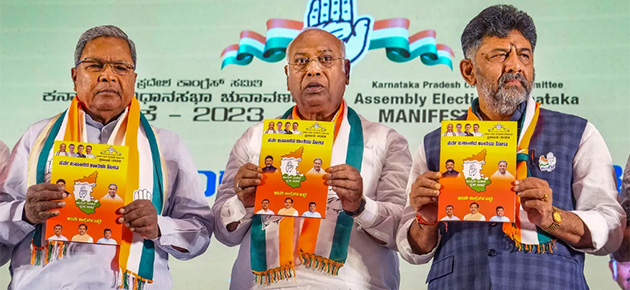
5 'guarantees' of Congress in Karnataka may cost state exchequer Rs 50,000 crore

News Network
May 17, 2023

Congpromieses.jpg

Bengaluru, May 17: The implementation of the five 'guarantees' announced by the Congress may cost the state exchequer an estimated Rs 50,000 crore annually.

Key party leaders who spoke about the cost of the welfare measures insisted that one could not call them "freebies" as they were tools of empowerment.

The 'guarantees' found resonance with voters of the May 10 Assembly elections, particularly with women, and played a key role in the party's resounding victory, political analysts noted.

The Congress bagged 135 seats in the 224-member Assembly, and ousted the BJP from power, with the erstwhile ruling party winning in just 66 constituencies, while the Janata Dal (Secular) managed to get only 19 seats.

Some BJP leaders have alleged that implementation of the 'guarantees' would push the State into financial bankruptcy, and have also claimed that the Congress would not honour its pre-poll promises fully.

During campaigning, Rahul Gandhi and other Congress leaders had repeatedly said that if voted to power, the party's government in its maiden Cabinet meeting on the first day of assuming power would pass orders approving the 'guarantees' to facilitate their swift implementation.

The five schemes that the Congress guaranteed it would implement are 'Gruha Jyothi' -- to provide 200 units electricity free to every household; 'Gruha Lakshmi' -- to grant Rs 2,000 to every woman head of a family; 'Anna Bhagya' -- to distribute 10 kg rice to every member of BPL families every month; 'Yuva Nidhi' -- to sanction Rs 3,000 dole to unemployed graduates and Rs 1,500 to unemployed diploma holders for two years (in the 18-25 age-group); and 'Shakti' -- to enable free travel for women across Karnataka in state buses.

In an interview on Wednesday, vice chairman of the Congress manifesto drafting committee Professor K E Radhakrishna said the implementation of the five guarantee schemes will not cost more than Rs 50,000 crore annually.

"I can authoritatively say that all these guarantee schemes put together will not be more than Rs 50,000 crore," he said.

Radhakrishna, who has the distinction of drafting five manifestos for the Congress, said even some of the Congress leaders have the perception that these schemes cannot be implemented.

"Some of our leaders have that perception but we are very sure because I have worked out the financial implications. It is not more than Rs 50,000 crore. Even Rs 50,000 crore is not a charity. It's empowerment," he said.

Explaining the way these schemes will be implemented, the educationist noted that the total budget of Karnataka government is about Rs three lakh crore. At least 60 per cent of revenue of any good economy is spent on sustained development, Radhakrishna said, adding that it goes to paying salary of government employees and to implement empowerment programmes.

"Revenue moves capital, capital moves revenue. So, Rs 1.50 lakh crore of the Rs three lakh crore budget has to be spent. If that does not happen, then we will not have funds to spend another Rs 1.5 lakh crore. They are related to each other," he explained.

Out of five guarantees, 'Anna Bhagya' is an existing scheme, and the new promise is an extension, he added.

"We were giving seven kg of rice. BJP reduced it to five kg. Now again we want to make it 10 kg. We are giving rice and millets. This will encourage its cultivation and production," the Congress leader pointed out.

Regarding 'Gruha Jyothi', Radhakrishna said Karnataka is a power surplus state and is selling electricity to other states.

According to him, the Congress in its manifesto has promised to set up huge solar parks of 5,000 megawatt capacity. It has also promised to set up a small solar cluster in each village.

"These clusters will generate employment to people in the village and make the villages self-sufficient in terms of electricity. We are going to increase power generation, which will eventually generate employment opportunities," Radhakrishna explained.

The Rs 2,000 guarantee under 'Gruha Lakshmi' is not for all women heads of families, he clarified. "This is only for the Below Poverty Line families. We will not give to rich people. This scheme is only for empowering poor people," the Congress leader said.

Regarding 'Yuva Nidhi', he said world-over unemployment allowance is given in many countries.

"Whether our degree education is relevant for a job is a larger issue, but as of today the graduates are in a helpless condition," Radhakrishna pointed out.

As part of the scheme, the government is planning to set up a large employment exchange, he said.

"We are going to coordinate with 'Bharat Jogo Udyoga Kendra' (Bharat Jodo Employment Centre) where we will take private industries on board," he explained.

The government will also tie up with the Rajiv Gandhi Skill Development Corporation to train and skill the graduates and make them employable by the industries, Radhakrishna said.

Talking about the 'Shakti' scheme of free bus rides for women, he said already students are getting free passes to travel to their college from their house.

"Not every woman travels in the buses. Only those who are not rich travel in buses. It's (the free travel guarantee) will empower garment workers, domestic servants, 'pourakarmikas' and women engaged in menial jobs," he said.

"There will be no conditions. We will be very happy if every woman travels. It will reduce pollution," Radhakrishna quipped.

He said these five schemes are meant only to empower people and they are not freebies.

Recalling the proverb 'If you give a man a fish, you feed him for a day. If you teach a man to fish, you feed him for a lifetime', the educationist pointed out, "But we believe that to catch the fish, that hand that catches the fish should have some minimal strength. That is the empowerment we do."


Comments

Add new comment

  • Coastaldigest.com reserves the right to delete or block any comments.
  • Coastaldigset.com is not responsible for its readers’ comments.
  • Comments that are abusive, incendiary or irrelevant are strictly prohibited.
  • Please use a genuine email ID and provide your name to avoid reject.
coastaldigest.com news network
February 5,2026

protestkerala.jpg

Mangaluru: The KSRTC Mangaluru division has rolled back the fare hike on buses operating on the Mangaluru–Kasaragod route following the suspension of toll collection at the Arikkady toll plaza near Kumbala in Kasaragod district.

The fare revision had been implemented after the National Highways Authority of India (NHAI) began toll collection at the Arikkady plaza on NH-66. As a result, fares for ordinary and Rajahamsa services were increased by ₹7 and ₹10, respectively, raising the bus fare from Mangaluru to Kasaragod from ₹81 to ₹88.

Senior Divisional Controller of KSRTC’s Mangaluru division, Rajesh Shetty, said the fares were reduced after toll collection at the Arikkady plaza was stopped. “The tollgate began operations on January 13, and the toll amount was deducted from the FASTag accounts of KSRTC buses operating on the route. Following an order from the central government to suspend toll collection, KSRTC has also withdrawn the additional fare with immediate effect,” he said.

At present, vehicles travelling on the Mangaluru–Kasaragod route pay toll only at the Talapady toll plaza. The toll for light motor vehicles (LMVs) at Talapady is ₹80 for a same-day return, while heavy vehicles, including buses, are charged ₹250. At Arikkady, the toll rates were ₹130 for LMVs (same-day return) and ₹450 for buses.

Protests against Arikkady toll plaza

The Arikkady toll plaza witnessed widespread protests from January 12, the day toll collection commenced. On the second day, an action committee led by Manjeshwar MLA A K M Ashraf launched an indefinite protest at the site. Except for the BJP, leaders and workers of most major political parties participated in the agitation.

On the night of January 14, a large number of protesters gathered at the plaza and vandalised property, following which authorities temporarily suspended toll operations. The BJP later also expressed opposition to the toll plaza and criticised NHAI’s decision. 

Comments

Add new comment

  • Coastaldigest.com reserves the right to delete or block any comments.
  • Coastaldigset.com is not responsible for its readers’ comments.
  • Comments that are abusive, incendiary or irrelevant are strictly prohibited.
  • Please use a genuine email ID and provide your name to avoid reject.
News Network
January 23,2026

Mangaluru: The Karnataka Government Polytechnic (KPT), Mangaluru, has achieved autonomous status from the All India Council for Technical Education (AICTE), becoming the first government polytechnic in the country to receive such recognition in its 78-year history. The status was granted by AICTE, New Delhi, and subsequently approved by the Karnataka Board of Technical Education in October last year.

Officials said the autonomy was conferred a few months ago. Until recently, AICTE extended autonomous status only to engineering colleges, excluding diploma institutions. However, with a renewed national focus on skill development, several government polytechnics across India have now been granted autonomy.

KPT, the second-largest polytechnic in Karnataka, was established in 1946 with four branches and has since expanded to offer eight diploma programmes, including computer science and polymer technology. The institution is spread across a 19-acre campus.

Ravindra M Keni, the first dean of the institution, told The Times of India that AICTE had proposed autonomous status for polytechnic institutions that are over 25 years old. “Many colleges applied. In the first round, 100 institutions were shortlisted, which was further narrowed down to 15 in the second round. We have already completed one semester after becoming an autonomous institution,” he said. He added that nearly 500 students are admitted annually across eight three-year diploma courses.

Explaining the factors that helped KPT secure autonomy, Keni said the institution has consistently recorded 100 per cent admissions and placements for its graduates. He also noted its strong performance in sports, with the college emerging champions for 12 consecutive years, along with active student participation in NCC and NSS activities.

Autonomous status allows KPT to design industry-oriented curricula, conduct examinations, prepare question papers, and manage academic documentation independently. The institution can also directly collaborate with industries and receive priority funding from AICTE or the Ministry of Education. While academic autonomy has been granted, financial control will continue to rest with the state government.

“There will be separate committees for examinations, question paper setting, boards of studies, and boards of examiners. The institution will now have the freedom to conduct admissions without government notifications and issue its own marks cards,” Keni said, adding that new academic initiatives would be planned after a year of functioning under the autonomous framework.

Comments

Add new comment

  • Coastaldigest.com reserves the right to delete or block any comments.
  • Coastaldigset.com is not responsible for its readers’ comments.
  • Comments that are abusive, incendiary or irrelevant are strictly prohibited.
  • Please use a genuine email ID and provide your name to avoid reject.
News Network
February 3,2026

Bengaluru: Following reports of fresh Nipah virus (NiV) cases in West Bengal and heightened vigilance across parts of Southeast Asia, the Karnataka Health Department has placed the state on high alert and activated emergency preparedness protocols.

Health officials said enhanced surveillance measures have been initiated after two healthcare workers in Barasat, West Bengal, tested positive for the virus earlier this month. While no cases have been reported in Karnataka so far, authorities said the state’s past exposure to Nipah outbreaks and high inter-state mobility warranted preventive action.

Officials have directed district health teams to intensify monitoring, particularly at hospitals and points of entry, and to ensure early detection and isolation of suspected cases.

High Mortality Virus with Multiple Transmission Routes

Nipah virus is a zoonotic disease that can spread from animals to humans and has a reported fatality rate ranging between 60 and 75 per cent. Fruit bats, also known as flying foxes, are the natural reservoirs of the virus and can transmit it by contaminating food sources with saliva or urine.

Known modes of transmission include:

•    Contaminated food: Consumption of fruits partially eaten by bats or raw date-palm sap
•    Animal contact: Exposure to infected pigs or other animals
•    Human-to-human transmission: Close contact with body fluids of infected persons, particularly in healthcare settings

Symptoms and Disease Progression

The incubation period typically ranges from 4 to 14 days, though delayed onset has also been reported. Early symptoms often resemble common viral infections, making prompt clinical suspicion critical.

•    Initial symptoms: Fever, headache, body aches, fatigue, sore throat
•    Progressive symptoms: Drowsiness, disorientation, altered mental state
•    Severe stage: Seizures, neck stiffness and acute encephalitis, which can rapidly progress to coma

Public Health Advisory

The Health Department has issued precautionary guidelines urging the public to adopt risk-avoidance practices to prevent any local spillover.

Do’s
•    Wash fruits thoroughly before consumption
•    Drink boiled and cooled water
•    Use protective equipment while handling livestock
•    Maintain strict hand hygiene

Don’ts
•    Avoid fruits found on the ground or showing bite marks
•    Do not consume beverages made from raw tree sap, including toddy
•    Avoid areas with dense bat populations
•    Do not handle sick or dead animals

Preparedness Measures

Officials confirmed that isolation wards are being readied in major government hospitals and that medical staff are being sensitised to identify early warning signs.

“There is no cause for panic, but there is a need for heightened vigilance,” a senior health official said, adding that there is currently no approved vaccine or specific antiviral treatment for Nipah, and care remains largely supportive.

Comments

Add new comment

  • Coastaldigest.com reserves the right to delete or block any comments.
  • Coastaldigset.com is not responsible for its readers’ comments.
  • Comments that are abusive, incendiary or irrelevant are strictly prohibited.
  • Please use a genuine email ID and provide your name to avoid reject.