



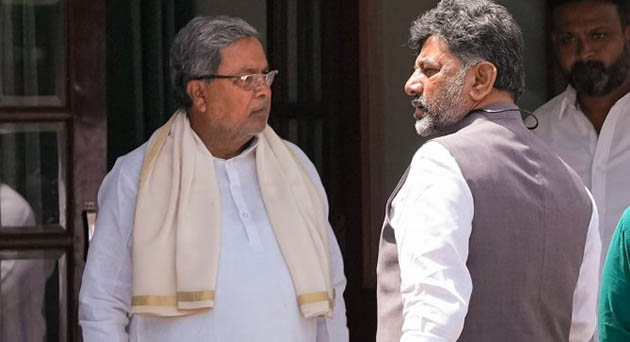
Complaint by 30 MLAs? Karnataka CM, DyCM rule out disgruntlement

News Network
July 25, 2023

CMDCM.jpg

Bengaluru, July 25: Karnataka Chief Minister Siddaramaiah and his Deputy D K Shivakumar on Tuesday ruled out any disgruntlement within the ruling Congress, amid reports that as many 30 legislators have expressed concern over non-implementation of development works in their constituencies, and said there are no such complaints.

Both of them said, the legislature party meeting has been called, most probably on Thursday, as part of a routine exercise to discuss various programmes and policies of the government, and to ensure coordination between government and party MLAs. 

"Who told you?" Siddaramaiah retorted, in response to a question that about 30 MLAs had written to him complaining about the functioning of Ministers and developmental work not taking place. Noting that he had called the legislature party meeting last week, but as Congress leader Rahul Gandhi was about to chair a meeting it was postponed, the CM said he has called it again on Thursday.

"We will discuss it there. It has been just two months since the formation of the government. The Legislature party meeting had to be called, so I called. There are no complaints (against Ministers). They (MLAs) had asked for a legislature party meeting to be called, so have called," he added. The Chief Minister, however, did not want to comment about Shivakumar's claims that a plot was being hatched in Singapore to topple the Congress government in Karnataka. "About Singapore, you ask him. I don't know about it, ask D K Shivakumar." The Deputy Chief Minister's claims on Monday had created a flutter in political circles.

According to reports, Congress MLAs are said to have complained to the Chief Minister and party leadership that they had not been able to get their work done in their constituencies, and also transfers as requested, and have expressed unhappiness regarding Ministers, alleging non-cooperation. The recent statement by senior party leader and MLC B K Hariprasad, that he knows “how to make and bring down a chief minister”, has added fuel to the speculation and is indicative that all is not well within the ruling party. On his part, Shivakumar, who is also the state Congress President termed reports that 30-odd MLAs have written a letter complaining about the functioning of the Ministers as "false" and mere speculations. "It is all false, no one has written such a letter.

The Chief Minister and I have requested all Ministers to work taking into confidence all the legislators and lost candidates of all constituencies. All are doing their job. These are nothing but mere speculations," he told reporters here.

The Deputy CM said, "there are certain programmes, which had to be discussed, there was an Assembly session. Our five guarantee schemes, whether they are reaching people or not, are there any corruption, regarding all this we had to discuss, give guidance and information to our legislators." He said, during the Assembly session, which concluded last Friday, there was no time to call a legislature party meeting and discuss all this.

Observing that there are certain financial constraints as the government has to implement five guarantee schemes, Shivakumar said, "all the legislators have a lot of desire regarding implementing various promises they had given to people, but we are asking the MLAs to keep them on hold for some time now. In my own department legislators are seeking for implementation of works to the tune of Rs 10 crore, 100 crore, 200 crore or 300 crore." As the government, due to financial constraints is not in the position to spend such huge amount, the MLAs are being requested to keep things on hold and have some patience, he said. "MLAs, especially freshers, have been asked to go to the constituencies, remain with the people as there is rain and flooding in some regions; where there is drought like situation in other places. We have to make legislators understand this."

Responding to a question, the Deputy CM said, all Ministers are touring various districts and are doing their job. "What work has not been done to legislators, who have their own rights and responsibilities? Regarding transfers within the time limitations, Ministers have done, rest is left to the Chief Minister," he said. "There is no disgruntlement, it is only media creation".

Comments

Add new comment

  • Coastaldigest.com reserves the right to delete or block any comments.
  • Coastaldigset.com is not responsible for its readers’ comments.
  • Comments that are abusive, incendiary or irrelevant are strictly prohibited.
  • Please use a genuine email ID and provide your name to avoid reject.
News Network
February 3,2026

Bengaluru: Following reports of fresh Nipah virus (NiV) cases in West Bengal and heightened vigilance across parts of Southeast Asia, the Karnataka Health Department has placed the state on high alert and activated emergency preparedness protocols.

Health officials said enhanced surveillance measures have been initiated after two healthcare workers in Barasat, West Bengal, tested positive for the virus earlier this month. While no cases have been reported in Karnataka so far, authorities said the state’s past exposure to Nipah outbreaks and high inter-state mobility warranted preventive action.

Officials have directed district health teams to intensify monitoring, particularly at hospitals and points of entry, and to ensure early detection and isolation of suspected cases.

High Mortality Virus with Multiple Transmission Routes

Nipah virus is a zoonotic disease that can spread from animals to humans and has a reported fatality rate ranging between 60 and 75 per cent. Fruit bats, also known as flying foxes, are the natural reservoirs of the virus and can transmit it by contaminating food sources with saliva or urine.

Known modes of transmission include:

•    Contaminated food: Consumption of fruits partially eaten by bats or raw date-palm sap
•    Animal contact: Exposure to infected pigs or other animals
•    Human-to-human transmission: Close contact with body fluids of infected persons, particularly in healthcare settings

Symptoms and Disease Progression

The incubation period typically ranges from 4 to 14 days, though delayed onset has also been reported. Early symptoms often resemble common viral infections, making prompt clinical suspicion critical.

•    Initial symptoms: Fever, headache, body aches, fatigue, sore throat
•    Progressive symptoms: Drowsiness, disorientation, altered mental state
•    Severe stage: Seizures, neck stiffness and acute encephalitis, which can rapidly progress to coma

Public Health Advisory

The Health Department has issued precautionary guidelines urging the public to adopt risk-avoidance practices to prevent any local spillover.

Do’s
•    Wash fruits thoroughly before consumption
•    Drink boiled and cooled water
•    Use protective equipment while handling livestock
•    Maintain strict hand hygiene

Don’ts
•    Avoid fruits found on the ground or showing bite marks
•    Do not consume beverages made from raw tree sap, including toddy
•    Avoid areas with dense bat populations
•    Do not handle sick or dead animals

Preparedness Measures

Officials confirmed that isolation wards are being readied in major government hospitals and that medical staff are being sensitised to identify early warning signs.

“There is no cause for panic, but there is a need for heightened vigilance,” a senior health official said, adding that there is currently no approved vaccine or specific antiviral treatment for Nipah, and care remains largely supportive.

Comments

Add new comment

  • Coastaldigest.com reserves the right to delete or block any comments.
  • Coastaldigset.com is not responsible for its readers’ comments.
  • Comments that are abusive, incendiary or irrelevant are strictly prohibited.
  • Please use a genuine email ID and provide your name to avoid reject.
News Network
February 5,2026

In an era where digital distractions are the primary rival to academic excellence, the Karnataka Education Department is taking the fight directly to the living room. As the SSLC (Class 10) annual examinations loom, officials have launched a localized "digital strike" to ensure students aren't losing their competitive edge to scrolling or soap operas.

The 7-to-9 Lockdown

The department has issued a formal directive urging—and in some cases, enforcing via home visits—a total blackout of mobile phones and television sets between 7:00 PM and 9:00 PM. This two-hour window is being designated as "sacred study time" across the state until the examinations conclude on April 2.

Key Pillars of the Initiative:

•    Doorstep Advocacy: Teachers are transitioning from classrooms to living rooms, meeting parents to explain the psychological benefits of a distraction-free environment.

•    Parental Accountability: The campaign shifts the burden of discipline from the student to the household, asking parents to lead by example and switch off their own devices.

•    The Timeline: The focus remains sharp on the upcoming exam block, scheduled from March 18 to April 2.

"The objective is simple: uninterrupted focus. We are reclaiming the evening hours for the students, ensuring their environment is as prepared as their minds," stated a senior department official.

Student vs. Reality

While the student community has largely welcomed the "forced focus"—with many admitting they lack the willpower to ignore notifications—the move has sparked a debate on enforceability. Without a "TV Police," the success of this initiative rests entirely on the shoulders of parents and the persuasive power of visiting educators.

Comments

Add new comment

  • Coastaldigest.com reserves the right to delete or block any comments.
  • Coastaldigset.com is not responsible for its readers’ comments.
  • Comments that are abusive, incendiary or irrelevant are strictly prohibited.
  • Please use a genuine email ID and provide your name to avoid reject.
News Network
January 23,2026

Karnataka Governor Thaawarchand Gehlot read only three lines from the 122-paragraph address prepared by the Congress-led state government while addressing the joint session of the Legislature on Thursday, effectively bypassing large sections critical of the BJP-led Union government.

The omitted portions of the customary Governor’s address outlined what the state government described as a “suppressive situation in economic and policy matters” under India’s federal framework. The speech also sharply criticised the Centre’s move to replace the Mahatma Gandhi National Rural Employment Guarantee Act (MGNREGA) with the Viksit Bharat–Guarantee for Rozgar and Ajeevika Mission (Gramin) Act, commonly referred to as the VB-GRAM (G) Act.

Governor Gehlot had earlier conveyed his objection to several paragraphs that were explicitly critical of the Union government. On Thursday, he confined himself to the opening lines — “I extend a warm welcome to all of you to the joint session of the State legislature. I am extremely pleased to address this august House” — before jumping directly to the concluding sentence of the final paragraph.

He ended the address by reading the last line of paragraph 122: “Overall, my government is firmly committed to doubling the pace of the State’s economic, social and physical development. Jai Hind — Jai Karnataka.”

According to the prepared speech, the Karnataka government demanded the scrapping of the VB-GRAM (G) Act, describing it as “contractor-centric” and detrimental to rural livelihoods, and called for the full restoration of MGNREGA. The state government argued that the new law undermines decentralisation, weakens labour protections, and centralises decision-making in violation of constitutional norms.

Key points from the unread sections of the speech:

•    Karnataka facing a “suppressive” economic and policy environment within the federal system

•    Repeal of MGNREGA described as a blow to rural livelihoods

•    VB-GRAM (G) Act accused of protecting corporate and contractor interests

•    New law alleged to weaken decentralised governance

•    Decision-making said to be imposed by the Centre without consulting states

•    Rights of Adivasis, women, backward classes and agrarian communities curtailed

•    Labourers allegedly placed under contractor control

•    States facing mounting fiscal stress due to central policies

•    VB-GRAM (G) Act accused of enabling large-scale corruption

Comments

Add new comment

  • Coastaldigest.com reserves the right to delete or block any comments.
  • Coastaldigset.com is not responsible for its readers’ comments.
  • Comments that are abusive, incendiary or irrelevant are strictly prohibited.
  • Please use a genuine email ID and provide your name to avoid reject.