India generated over 18K tonnes covid waste since June; Karnataka 1,380 tonnes

News Network
October 12, 2020

Bengaluru, Oct 12: India generated 18,006 tonnes of Covid-19 biomedical waste in the last four months, with Maharashtra contributing the maximum (3,587 tonnes) to it, according to a Central Pollution Control Board (CPCB) data.

Around 5,500 tonnes of Covid-19 waste was generated across the country in September - the maximum for a month so far.

According to the data received from state pollution control boards, since June, all states and Union Territories have generated 18,006 tonnes of Covid-19-related biomedical waste which is being collected, treated and disposed of by 198 common biomedical waste treatment facilities (CBWTFs).

Covid-19 biomedical waste could include PPE kits, masks, shoe covers, gloves, human tissues, items contaminated with blood, body fluids like dressings, plaster casts, cotton swabs, beddings contaminated with blood or body fluid, blood bags, needles, syringes etc.

According to the data, Maharashtra generated 3,587 tonnes of Covid-19 waste in four months since June, followed by Tamil Nadu (1,737 tonnes), Gujarat (1,638 tonnes), Kerala (1,516 tonnes), Uttar Pradesh (1,432 tonnes), Delhi (1,400 tonnes), Karnataka (1,380 tonnes) and West Bengal (1,000 tonnes).

Around 5,490 tonnes of such waste was generated in September, with Gujarat contributing the maximum 622 tonnes, followed by Tamil Nadu (543 tonnes), Maharashtra (524 tonnes), Uttar Pradesh (507 tonnes) and Kerala (494 tonnes).

Delhi generated 382 tonnes of Covid-19 bio-medical waste in September, according to the CPCB data.

Around 5,240 tonnes of Covid-19 waste was generated in August, of which 1,359 tonnes was in Maharashtra, and 588 tonnes each in Kerala and Karnataka.

In July, the country generated 4,253 tonnes of Covid-19 waste, with Maharashtra (1,180), Karnataka (540) and Tamil Nadu (401) being the top three contributors.

India generated 3,025 tonnes of Covid-19 waste in June, with Maharashtra alone accounting for 524 tonnes, followed by Gujarat (350 tonnes), Delhi (333 tonnes) and Tamil Nadu (312 tonnes)

The CPCB had in March issued specific guidelines for handling, treatment and disposal of such waste at healthcare facilities, quarantine centres, homes, sample collection centers, laboratories, pollution control boards, urban local bodies and common biomedical waste treatment facilities (CBMWTFs).

The apex pollution body had in May developed the “COVID19BWM” mobile application to monitor coronavirus-related biomedical waste and to compile the data through an electronic manifest system.

This application tracks Covid-19 waste at the time of generation, collection and disposal.

The Supreme Court has made it mandatory for all urban local bodies and state pollution control boards to use the mobile application for tracking biomedical waste daily in a bid to ensure that the waste is collected, transported and sent to the registered CBMWTFs.

The directions came on July 30 on recommendations made in a report by the Environment Pollution (Prevention and Control) Authority.

As on Monday, India's Covid-19 caseload stands at 71.2 lakhs while the death toll is 1.09 lakh.

Comments

Add new comment

  • Coastaldigest.com reserves the right to delete or block any comments.
  • Coastaldigset.com is not responsible for its readers’ comments.
  • Comments that are abusive, incendiary or irrelevant are strictly prohibited.
  • Please use a genuine email ID and provide your name to avoid reject.
News Network
January 23,2026

modIKERALA.jpg

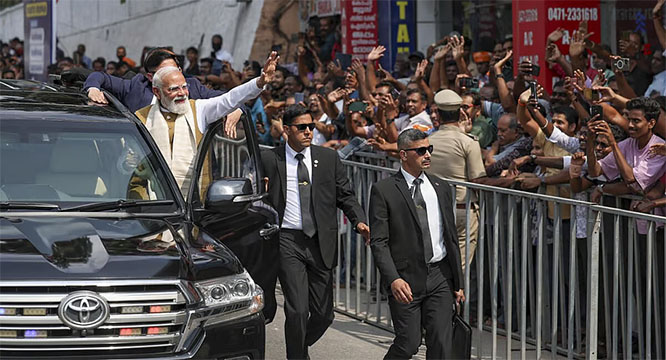
Prime Minister Narendra Modi, during his visit to Thiruvananthapuram on Friday, January 23, indicated that the Bharatiya Janata Party (BJP) is aiming to expand its political footprint in Kerala ahead of the Assembly elections scheduled in the coming months.

Speaking at a BJP-organised public meeting, Modi drew parallels between the party’s early electoral gains in Gujarat and its recent victory in the Thiruvananthapuram Municipal Corporation. The civic body win, which ended decades of Left control, was cited by the Prime Minister as a possible starting point for the party’s broader ambitions in the state.

Recalling BJP’s political trajectory in Gujarat, Modi said the party was largely insignificant before 1987 and received little media attention. He pointed out that the BJP’s first major breakthrough came with its victory in the Ahmedabad Municipal Corporation that year.

“Just as our journey in Gujarat began with one city, Kerala’s journey has also started with a single city,” Modi said, suggesting that the party’s municipal-level success could translate into wider electoral acceptance.

The Prime Minister alleged that successive governments led by the Left Democratic Front (LDF) and the United Democratic Front (UDF) had failed to adequately develop Thiruvananthapuram. He accused both fronts of corruption and neglect, claiming that basic infrastructure and facilities were denied to the capital city for decades.

According to Modi, the BJP’s control of the civic body represents a shift driven by public dissatisfaction with the existing political alternatives. He asserted that the BJP administration in Thiruvananthapuram had begun working towards development, though no specific details or timelines were outlined.

Addressing the gathering at Putharikandam Maidan, Modi said the BJP intended to project Thiruvananthapuram as a “model city,” reiterating his party’s commitment to governance-led change.

The Prime Minister’s visit to Kerala also included the inauguration of several development projects and the flagging off of new train services, as the BJP intensifies its political outreach in the poll-bound state.

Comments

Add new comment

  • Coastaldigest.com reserves the right to delete or block any comments.
  • Coastaldigset.com is not responsible for its readers’ comments.
  • Comments that are abusive, incendiary or irrelevant are strictly prohibited.
  • Please use a genuine email ID and provide your name to avoid reject.
News Network
February 4,2026

Mangaluru: Urban local bodies and gram panchayats should make the use of Kannada on signboards mandatory while issuing trade licences to commercial establishments, Dakshina Kannada Deputy Commissioner Darshan HV said. He also called for regular inspections to ensure compliance.

Presiding over the District Kannada Awareness Committee meeting at the deputy commissioner’s office, Darshan said the city corporation would be directed to ensure that shops operating in malls prominently display their names in Kannada. “All commercial establishments, including shops, companies, offices and hotels, must mandatorily display their names in Kannada on signboards,” he said.

The deputy commissioner added that the National Highways Authority of India (NHAI) would be instructed to include Kannada on signboards along national highways. Banks, he said, would be directed through committee meetings to provide application forms in Kannada.

“Even if English-medium schools and colleges impart education in English, their signboards must display the institution’s name in Kannada. Steps will also be taken to ensure that private buses display place names in Kannada,” Darshan said.

During the meeting, committee members raised concerns over the closure of Kannada-medium schools in rural areas due to a shortage of teachers and stressed the need for immediate corrective measures. They also pointed out that several industries employ workers from other states while overlooking local candidates.

Members further demanded that nationalised banks provide deposit and withdrawal slips in Kannada. It was brought to the deputy commissioner’s notice that the presence of staff without knowledge of Kannada in rural branches of nationalised banks is causing hardship to local customers.

Meanwhile, MP Srinath, president of the District Kannada Sahitya Parishat, urged the district administration to allot land for the construction of a district Kannada Bhavana in Mangaluru.

Comments

Add new comment

  • Coastaldigest.com reserves the right to delete or block any comments.
  • Coastaldigset.com is not responsible for its readers’ comments.
  • Comments that are abusive, incendiary or irrelevant are strictly prohibited.
  • Please use a genuine email ID and provide your name to avoid reject.
News Network
February 1,2026

Bengaluru: Karnataka Deputy Chief Minister D K Shivakumar on Sunday criticised the Union Budget presented by Finance Minister Nirmala Sitharaman, claiming it offered no tangible benefit to the state.

Though he said he was yet to study the budget in detail, Shivakumar asserted that Karnataka had gained little from it. “There is no benefit for our state from the central budget. I was observing it. They have now named a programme after Mahatma Gandhi, after repealing the MGNREGA Act that was named after him,” he said.

Speaking to reporters here, the Deputy Chief Minister demanded the restoration of MGNREGA, and made it clear that the newly enacted rural employment scheme — VB-G RAM G — which proposes a 60:40 fund-sharing formula between the Centre and the states, would not be implemented in Karnataka.

“I don’t see any major share for our state in this budget,” he added.

Shivakumar, who also holds charge of Bengaluru development, said there were high expectations for the city from the Union Budget. “The Prime Minister calls Bengaluru a ‘global city’, but what has the Centre done for it?” he asked.

He also drew attention to the problems faced by sugar factories, particularly those in the cooperative sector, alleging a lack of timely decisions and support from the central government.

Noting that the Centre has the authority to fix the minimum support price (MSP) for agricultural produce, Shivakumar said the Union government must take concrete steps to protect farmers’ interests.

Comments

Add new comment

  • Coastaldigest.com reserves the right to delete or block any comments.
  • Coastaldigset.com is not responsible for its readers’ comments.
  • Comments that are abusive, incendiary or irrelevant are strictly prohibited.
  • Please use a genuine email ID and provide your name to avoid reject.