From MGNREGA to Federalism: Key points of the speech Karnataka Governor refused to read

News Network
January 23, 2026

Karnataka Governor Thaawarchand Gehlot read only three lines from the 122-paragraph address prepared by the Congress-led state government while addressing the joint session of the Legislature on Thursday, effectively bypassing large sections critical of the BJP-led Union government.

The omitted portions of the customary Governor’s address outlined what the state government described as a “suppressive situation in economic and policy matters” under India’s federal framework. The speech also sharply criticised the Centre’s move to replace the Mahatma Gandhi National Rural Employment Guarantee Act (MGNREGA) with the Viksit Bharat–Guarantee for Rozgar and Ajeevika Mission (Gramin) Act, commonly referred to as the VB-GRAM (G) Act.

Governor Gehlot had earlier conveyed his objection to several paragraphs that were explicitly critical of the Union government. On Thursday, he confined himself to the opening lines — “I extend a warm welcome to all of you to the joint session of the State legislature. I am extremely pleased to address this august House” — before jumping directly to the concluding sentence of the final paragraph.

He ended the address by reading the last line of paragraph 122: “Overall, my government is firmly committed to doubling the pace of the State’s economic, social and physical development. Jai Hind — Jai Karnataka.”

According to the prepared speech, the Karnataka government demanded the scrapping of the VB-GRAM (G) Act, describing it as “contractor-centric” and detrimental to rural livelihoods, and called for the full restoration of MGNREGA. The state government argued that the new law undermines decentralisation, weakens labour protections, and centralises decision-making in violation of constitutional norms.

Key points from the unread sections of the speech:

•    Karnataka facing a “suppressive” economic and policy environment within the federal system

•    Repeal of MGNREGA described as a blow to rural livelihoods

•    VB-GRAM (G) Act accused of protecting corporate and contractor interests

•    New law alleged to weaken decentralised governance

•    Decision-making said to be imposed by the Centre without consulting states

•    Rights of Adivasis, women, backward classes and agrarian communities curtailed

•    Labourers allegedly placed under contractor control

•    States facing mounting fiscal stress due to central policies

•    VB-GRAM (G) Act accused of enabling large-scale corruption

Comments

Add new comment

  • Coastaldigest.com reserves the right to delete or block any comments.
  • Coastaldigset.com is not responsible for its readers’ comments.
  • Comments that are abusive, incendiary or irrelevant are strictly prohibited.
  • Please use a genuine email ID and provide your name to avoid reject.
News Network
January 16,2026

gaurimurder.jpg

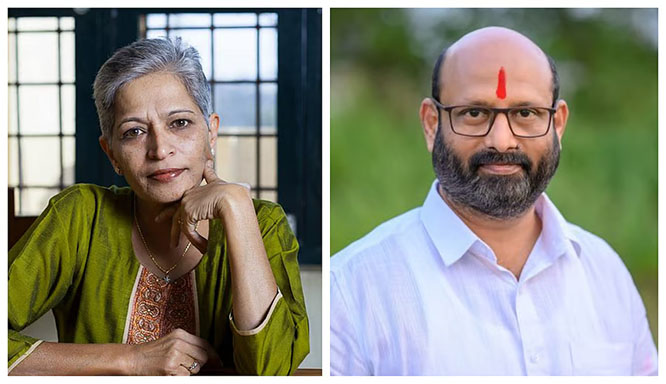
Mumbai: In a shocking development, Shrikant Pangarkar, an accused in the murder of journalist-activist Gauri Lankesh and the Nalasopara arms and ammunition haul case, has won the Jalna Municipal Corporation (JMC) elections as an independent candidate.

Pangarkar emerged victorious from Ward 13 of the JMC, where he was pitted against the BJP. Notably, the Shiv Sena led by Deputy Chief Minister Eknath Shinde, which contested the Jalna civic polls independently, did not field a candidate in the ward.

Gauri Lankesh was shot dead outside her residence in Bengaluru on September 5, 2017. A prominent journalist and activist, she edited Lankesh Patrike, a Kannada weekly founded by her father P Lankesh, and later ran her own publication, Gauri Lankesh Patrike.

Pangarkar was granted bail by the Karnataka High Court on September 4, 2024, in the Lankesh murder case. Ahead of the October 2024 Assembly elections, he was inducted into the Shiv Sena and appointed chief of the party’s Jalna campaign. However, following intense criticism, then Chief Minister Eknath Shinde revoked the appointment.

A former municipal councillor in Jalna between 2001 and 2006 from the undivided Shiv Sena under late Balasaheb Thackeray, Pangarkar later became associated with right-wing organisations.

In August 2018, he was arrested by the Maharashtra Anti-Terrorism Squad (ATS) in connection with the seizure of crude bombs and weapons in Nalasopara and booked under the Explosives Act, Explosive Substances Act, and the Unlawful Activities (Prevention) Act (UAPA). He is currently out on bail in both cases.

Soon after the election results were declared, Pangarkar’s supporters celebrated his victory.

After filing his nomination, Pangarkar had said he was returning to politics after a gap and had received an encouraging response from voters. “I have worked for the people earlier and have returned again,” he said, asserting that the cases against him had no bearing on the elections. “The matter is before the court. I stand before the nyay devta. There may be misunderstandings by agencies, but the court will decide. I am 100 per cent innocent,” he maintained, adding that the Lankesh murder case was unrelated to the civic polls and pertained to Karnataka.

Comments

Add new comment

  • Coastaldigest.com reserves the right to delete or block any comments.
  • Coastaldigset.com is not responsible for its readers’ comments.
  • Comments that are abusive, incendiary or irrelevant are strictly prohibited.
  • Please use a genuine email ID and provide your name to avoid reject.
News Network
January 10,2026

greenland.jpg

US officials have discussed sending lump sum payments to Greenlanders as part of a bid to convince them to secede from Denmark and potentially join the United States, according to four sources familiar with the matter.

While the exact dollar figure and logistics of any payment are unclear, US officials, including White House aides, have discussed figures ranging from $10,000 to $100,000 per person, said two of the sources, who requested anonymity to discuss internal deliberations.

The idea of directly paying residents of Greenland, an overseas territory of Denmark, offers one explanation of how the US might attempt to "buy" the island of 57,000 people, despite authorities' insistence in Copenhagen and Nuuk that Greenland is not for sale.

The tactic ⁠is among various plans being discussed by the White House for acquiring Greenland, including potential use of the U.S. military. But it risks coming off as overly transactional and even degrading to a population that has long debated its own independence and its economic dependence on Denmark. "Enough is enough ... No more fantasies about annexation," Greenland's Prime Minister Jens-Frederik Nielsen wrote in a Facebook post on Sunday after U.S. President Donald Trump again told reporters the U.S. needed to acquire the island.

European leaders say decision for Greenland, Denmark

Leaders in Copenhagen and throughout Europe have reacted to comments by Trump and other White House officials asserting their right to Greenland in recent days with disdain, particularly given that the U.S. and Denmark are NATO allies bound by a mutual defense agreement. On Tuesday, France, Germany, Italy, Poland, Spain, Britain and Denmark issued a joint statement, saying only Greenland and Denmark can decide matters regarding their relations.

Asked for comment about discussions to purchase the island, including the possibility of direct payments to Greenlanders, the White House referred Reuters to remarks by press secretary Karoline Leavitt and Secretary of State Marco Rubio on Wednesday.

During a press briefing, Leavitt acknowledged that Trump and his national security aides were "looking at what a potential purchase would look like." Rubio said he would meet his Danish counterpart next week in Washington to discuss Greenland.

The Danish embassy declined to comment, and Greenland's representative office in Washington did not ⁠respond to a request for comment.

Greenland discussions increasingly serious

Trump has long argued that the US needs to acquire Greenland on several grounds, including that it is rich in minerals needed for advanced military applications. He has also said the Western Hemisphere broadly needs to be under the geopolitical influence of Washington.

While internal deliberations regarding how to seize Greenland have occurred among Trump's aides since before he took office a year ago, there has been renewed urgency ⁠after his government captured Venezuelan leader Nicolas Maduro in a daring snatch-and-grab operation over the weekend, according to sources familiar with internal deliberations.

One source ⁠said White House aides were eager to carry over the momentum from the Maduro operation toward accomplishing Trump's other long-standing geopolitical goals.

"We need Greenland from the standpoint of national security, and Denmark isn't going to be able to do it," Trump told reporters on Air Force One on Sunday. "It's so strategic."

One of the sources familiar with White House deliberations said the internal discussions regarding lump sum payments were not necessarily new. However, that person said, they had gotten more serious in recent days, and aides were entertaining higher values, with a $100,000-per-person payment - which would result in a total payment of almost $6 billion - a real possibility.

Many details of any potential payments were unclear, such as when and how they would be doled out if the Trump administration pursued that route or what exactly would be expected of the Greenlanders in exchange. The White House has said military intervention is possible, though officials have also said the U.S. prefers buying the island or otherwise acquiring it through diplomatic means.

Free association agreement one option

Among the possibilities being floated by Trump's aides, a White House official said on Tuesday, is trying to enter into a type of agreement with the island called a Compact of Free Association.

The precise details of COFA agreements - which have only ever been extended to the small island nations of Micronesia, the Marshall Islands and Palau - vary depending on the signatory. But the US government typically provides many essential services, such as mail delivery and military protection. In exchange, the US military operates freely in COFA countries, and trade with the US is largely duty-free.

COFA agreements have previously been inked with independent countries, and Greenland would likely need to separate from Denmark for such a plan to proceed. In theory, payments could be used to induce Greenlanders to vote for their independence, or to sign onto a COFA after such a vote.

While polls show an overwhelming majority of Greenlanders want independence, concerns about the economic costs of separating from Denmark - among other issues - have kept most Greenlandic legislators from calling for an independence referendum.

Surveys also show most Greenlanders, while open to separating from Denmark, do not want to be part of the US.


Comments

Add new comment

  • Coastaldigest.com reserves the right to delete or block any comments.
  • Coastaldigset.com is not responsible for its readers’ comments.
  • Comments that are abusive, incendiary or irrelevant are strictly prohibited.
  • Please use a genuine email ID and provide your name to avoid reject.
News Network
January 23,2026

Karnataka Governor Thaawarchand Gehlot read only three lines from the 122-paragraph address prepared by the Congress-led state government while addressing the joint session of the Legislature on Thursday, effectively bypassing large sections critical of the BJP-led Union government.

The omitted portions of the customary Governor’s address outlined what the state government described as a “suppressive situation in economic and policy matters” under India’s federal framework. The speech also sharply criticised the Centre’s move to replace the Mahatma Gandhi National Rural Employment Guarantee Act (MGNREGA) with the Viksit Bharat–Guarantee for Rozgar and Ajeevika Mission (Gramin) Act, commonly referred to as the VB-GRAM (G) Act.

Governor Gehlot had earlier conveyed his objection to several paragraphs that were explicitly critical of the Union government. On Thursday, he confined himself to the opening lines — “I extend a warm welcome to all of you to the joint session of the State legislature. I am extremely pleased to address this august House” — before jumping directly to the concluding sentence of the final paragraph.

He ended the address by reading the last line of paragraph 122: “Overall, my government is firmly committed to doubling the pace of the State’s economic, social and physical development. Jai Hind — Jai Karnataka.”

According to the prepared speech, the Karnataka government demanded the scrapping of the VB-GRAM (G) Act, describing it as “contractor-centric” and detrimental to rural livelihoods, and called for the full restoration of MGNREGA. The state government argued that the new law undermines decentralisation, weakens labour protections, and centralises decision-making in violation of constitutional norms.

Key points from the unread sections of the speech:

•    Karnataka facing a “suppressive” economic and policy environment within the federal system

•    Repeal of MGNREGA described as a blow to rural livelihoods

•    VB-GRAM (G) Act accused of protecting corporate and contractor interests

•    New law alleged to weaken decentralised governance

•    Decision-making said to be imposed by the Centre without consulting states

•    Rights of Adivasis, women, backward classes and agrarian communities curtailed

•    Labourers allegedly placed under contractor control

•    States facing mounting fiscal stress due to central policies

•    VB-GRAM (G) Act accused of enabling large-scale corruption

Comments

Add new comment

  • Coastaldigest.com reserves the right to delete or block any comments.
  • Coastaldigset.com is not responsible for its readers’ comments.
  • Comments that are abusive, incendiary or irrelevant are strictly prohibited.
  • Please use a genuine email ID and provide your name to avoid reject.