From MGNREGA to Federalism: Key points of the speech Karnataka Governor refused to read

News Network
January 23, 2026

Karnataka Governor Thaawarchand Gehlot read only three lines from the 122-paragraph address prepared by the Congress-led state government while addressing the joint session of the Legislature on Thursday, effectively bypassing large sections critical of the BJP-led Union government.

The omitted portions of the customary Governor’s address outlined what the state government described as a “suppressive situation in economic and policy matters” under India’s federal framework. The speech also sharply criticised the Centre’s move to replace the Mahatma Gandhi National Rural Employment Guarantee Act (MGNREGA) with the Viksit Bharat–Guarantee for Rozgar and Ajeevika Mission (Gramin) Act, commonly referred to as the VB-GRAM (G) Act.

Governor Gehlot had earlier conveyed his objection to several paragraphs that were explicitly critical of the Union government. On Thursday, he confined himself to the opening lines — “I extend a warm welcome to all of you to the joint session of the State legislature. I am extremely pleased to address this august House” — before jumping directly to the concluding sentence of the final paragraph.

He ended the address by reading the last line of paragraph 122: “Overall, my government is firmly committed to doubling the pace of the State’s economic, social and physical development. Jai Hind — Jai Karnataka.”

According to the prepared speech, the Karnataka government demanded the scrapping of the VB-GRAM (G) Act, describing it as “contractor-centric” and detrimental to rural livelihoods, and called for the full restoration of MGNREGA. The state government argued that the new law undermines decentralisation, weakens labour protections, and centralises decision-making in violation of constitutional norms.

Key points from the unread sections of the speech:

•    Karnataka facing a “suppressive” economic and policy environment within the federal system

•    Repeal of MGNREGA described as a blow to rural livelihoods

•    VB-GRAM (G) Act accused of protecting corporate and contractor interests

•    New law alleged to weaken decentralised governance

•    Decision-making said to be imposed by the Centre without consulting states

•    Rights of Adivasis, women, backward classes and agrarian communities curtailed

•    Labourers allegedly placed under contractor control

•    States facing mounting fiscal stress due to central policies

•    VB-GRAM (G) Act accused of enabling large-scale corruption

Comments

Add new comment

  • Coastaldigest.com reserves the right to delete or block any comments.
  • Coastaldigset.com is not responsible for its readers’ comments.
  • Comments that are abusive, incendiary or irrelevant are strictly prohibited.
  • Please use a genuine email ID and provide your name to avoid reject.
coastaldigest.com news network
January 10,2026

Mangaluru: In a strong pitch for redefining the economic future of coastal Karnataka, Deputy Chief Minister D K Shivakumar on Saturday lamented that the region’s vast natural wealth and tourism potential remain largely underutilised, forcing thousands of coastal youth to migrate outside the state and even abroad in search of opportunities.

Speaking in Mangaluru, Shivakumar said the coastal belt—stretching from Mangaluru to Karwar—continues to be one of Karnataka’s most scenic and resource-rich zones, yet local communities are not benefiting proportionately.

“Our beaches, backwaters, forests and culture are unmatched. But people from Mangaluru and other coastal districts continue to move out because we have not capitalised on what we already have,” he said.

Emphasising the talent of the younger generation, he noted that youth from coastal Karnataka are excelling in countries across the world. “They are brilliant, skilled and globally competitive. Our priority must be to create conditions where they can build their future here, not somewhere else. Our identity should shine on our own soil,” he asserted.

Shivakumar revealed that the state government has finalised a new tourism policy aimed at transforming Karnataka—particularly the coast—into a major tourism hub.

As part of the rollout, meetings will be held with investors, builders, tourism operators, entrepreneurs and local business communities.

“The government will extend full support to tourism development. Before implementing the policy, we will take inputs from stakeholders across Karnataka, especially from the coastal belt. Locals should be the prime beneficiaries of tourism growth,” he said.

He stressed that development must be driven by local capability, local enterprise and local initiative, ensuring that economic gains stay within the region rather than drifting outward.

Shivakumar added that Chief Minister Siddaramaiah is scheduled to visit later in the evening, urging those with concerns or suggestions regarding coastal tourism and youth opportunities to raise them directly during the visit.

Comments

Add new comment

  • Coastaldigest.com reserves the right to delete or block any comments.
  • Coastaldigset.com is not responsible for its readers’ comments.
  • Comments that are abusive, incendiary or irrelevant are strictly prohibited.
  • Please use a genuine email ID and provide your name to avoid reject.
News Network
January 20,2026

iran.jpg

Iranian security and intelligence forces have captured more than 470 individuals in three provinces, identified as key figures behind the recent wave of violent unrest and terrorist activities linked to foreign-backed networks.

The Intelligence Ministry's provincial office in Khorasan Razavi announced on Monday the arrest of 192 armed terrorists, identified as the main agents behind recent riots in the region. 

According to an official statement, the detainees were involved in the killing of several security personnel and civilians, setting fire to mosques, public service facilities, and buses, as well as attacks on military and law enforcement centers.

The seized items from the group include several bulletproof vests, Kalashnikov rifles, hunting weapons, Winchester rifles, and various cold weapons such as daggers, swords, brass knuckles, tactical knives, crossbows, and chains.

Evidence indicates that some of the individuals were tied to hostile movements and terrorist organizations, with links overseas. Others were identified as members of violent criminal gangs, actively taking part in the unrest alongside their associates.

Simultaneously, in the western province of Lorestan, the IRGC announced the arrest of 134 individuals as the main leaders and influential field agents of a US-Israeli terrorist network.

The IRGC statement stated that these individuals formed terrorist cells during the recent unrest, committing "Daesh-like" acts.

They wounded security forces with firearms and cold weapons, and burned and destroyed public and private properties, including mosques, shops, banks, and private and public vehicles.

In the northwestern province of Zanjan, the police reported detaining 150 people identified as principal leaders and agents behind recent riots.

Authorities noted that these individuals were responsible for destroying public and private property and intentionally setting fire to vehicles in the province's squares.

Their crimes include shedding the blood of innocent people, destroying public and private property, attempting to enter military sites, disrupting public order, and spreading terror among citizens.

A variety of cold weapons were reportedly seized from the detainees.

What began late last month as peaceful protests over economic hardship across Iran turned violent after public statements by US and Israeli regime figures encouraged vandalism and disorder.

During the unrest, foreign-backed mercenaries rampaged through cities, killing security forces and civilians and damaging public property.

Comments

Add new comment

  • Coastaldigest.com reserves the right to delete or block any comments.
  • Coastaldigset.com is not responsible for its readers’ comments.
  • Comments that are abusive, incendiary or irrelevant are strictly prohibited.
  • Please use a genuine email ID and provide your name to avoid reject.
News Network
January 14,2026

phone.jpg

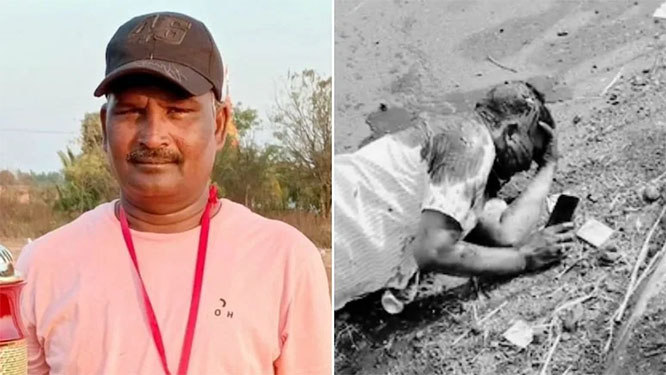
Bidar (Karnataka): A routine ride turned fatal when a nylon kite string slit the throat of a 48-year-old motorcyclist in Karnataka’s Bidar district, claiming his life in a chilling reminder of the deadly threat posed by banned kite-flying materials.

The victim, identified as Sanjukumar Hosamani, was riding near the Talamadagi Bridge when a taut kite string stretched across the road cut deep into his neck, causing profuse bleeding. Critically injured, Hosamani collapsed from his motorcycle but managed to place a final phone call to his daughter.

A disturbing video circulating on social media shows Hosamani drenched in blood, struggling to dial his daughter’s number as life ebbed away.

A passerby attempted to help by pressing a cloth against the wound to stop the bleeding. Locals said an ambulance was called immediately, but it arrived too late. Hosamani succumbed to his injuries before he could be taken to a hospital.

Family members have blamed the delay in emergency response for his death, alleging that timely medical assistance could have saved his life.

Following the incident, Hosamani’s relatives and local residents staged a protest at the accident spot, demanding strict action against the use of nylon kite strings and urgent improvements in emergency medical services.

Police have registered a case at Manna Ekhelli Police Station and said an investigation is underway.

Kite flying during Makar Sankranti is a long-standing tradition across many parts of India. While cotton strings coated with powdered glass were once common, they have increasingly been replaced by cheaper and more durable nylon strings. This durability, however, has proven lethal, as nylon can slice through skin with ease.

Commonly referred to as Chinese manjha, these strings pose a grave danger to two-wheeler riders, who often fail to notice the nearly invisible lines stretched across roads and flyovers.

The Karnataka incident is the latest in a series of such deaths reported across the country. Just this week, a 45-year-old man in Indore died after a kite string slit his throat. Delhi has witnessed multiple fatalities in recent years, including the deaths of a 22-year-old businessman in 2025, a biker in 2022, and a seven-year-old child in 2023.

Despite periodic raids and seizures by authorities, the recurring deaths underline serious gaps in enforcement, raising questions about whether current measures are sufficient to prevent further loss of life.

Comments

Add new comment

  • Coastaldigest.com reserves the right to delete or block any comments.
  • Coastaldigset.com is not responsible for its readers’ comments.
  • Comments that are abusive, incendiary or irrelevant are strictly prohibited.
  • Please use a genuine email ID and provide your name to avoid reject.