States in 'dire straits' due to Centre's failure in managing economy: HD Kumaraswamy

News Network
August 29, 2020
Image
Kumaraswamy

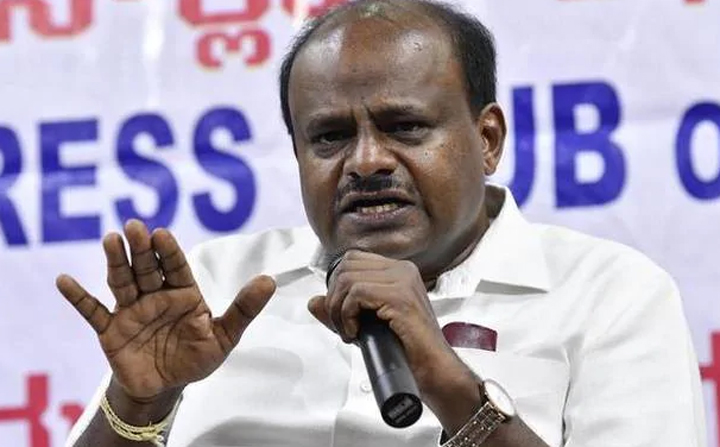
New Delhi, Aug 29: Lashing out at Prime Minister Narendra Modi-led government, former Karnataka Chief Minister HD Kumaraswamy said that states are in "dire straits" due to the failure of the Centre whose "management of the country's economy is flawed and marked by lack of vision".

"The states are in dire straits due to the failure of the Centre whose management of the country's economy is flawed and marked by lack of vision. Instead of asking the states to borrow from the RBI, the Centre itself should borrow from it and compensate the states for the losses," he tweeted.

In a series of tweets, he attacked the Centre over several issues including GST shortfall and also targetted Finance Minister Nirmala Sitharaman over her 'an act of God' remark.

"The irresponsible attitude of the Centre in shirking its commitment towards GST shortfall of the states is condemnable. It has dealt a blow to the federal structure of the country by describing the crisis arising out of COVID-19 pandemic as an unforeseen 'act of God'," Kumaraswamy tweeted.

His response comes a day after Sitharaman referred to COVID-19 pandemic as an "act of God" and said there could be contraction of the economy.

"This year we are facing an extraordinary situation. We are facing an act of God where we may even see a contraction of the economy," she had said.

Alleging that the Centre has literally ruined the economy of states, the Janata Dal (S) leader asked them to resort to borrowings to make up for GST shortfall and also repay them.

"Long ago, architect of the Indian constitution, Dr BR Ambedkar, had expressed concern that the danger of bringing about legislations that establish control over the states' economy through luring cannot be ruled out in the future. Now, the country is staring at such a danger," he said.

He claimed that states that are in a bad economic condition due to COVID-19 and floods are "cursing" the Centre.

"The Centre has placed two options before states. They can opt for borrowing either the GST shortfall amount of Rs 97,000 crores or borrow the entire revenue gap of Rs 2.35 lakh crore that has arisen due to GST shortfall as well as COVID-19 situation," Kumaraswamy said in another tweet.

"Shocked over such a development, the states are bewildered. What can they do if the Centre causes injustice to them citing COVID-19? The states that are in a bad economic condition due to COVID-19 and floods are cursing the Centre," he added.

On Thursday, Finance Miniter Nirmala Sitharaman chaired the 41st Goods and Services Tax (GST) Council meeting.

The Centre has given two options for compensating states on the Goods and Services Tax (GST) to bridge revenue shortfall as the economy faces a prospect of contraction in current fiscal year due to COVID-19 crisis.

The first option provides a special window to states in consultation with the Reserve Bank of India (RBI) to provide Rs 97,000 crore at a reasonable rate of interest. This money can then be repaid after five years from the collection of cess.

The second option is that the entire GST compensation gap of Rs 2.35 lakh of this year can be met by states in consultation with the RBI.


Comments

Add new comment

  • Coastaldigest.com reserves the right to delete or block any comments.
  • Coastaldigset.com is not responsible for its readers’ comments.
  • Comments that are abusive, incendiary or irrelevant are strictly prohibited.
  • Please use a genuine email ID and provide your name to avoid reject.
News Network
December 15,2025

Mangaluru, Dec 15: Air India Express has announced that it will resume direct flight services between Mangaluru and Muscat from March 2026, restoring an important international air link for passengers from the coastal region.

Airport authorities said the service will operate twice a week—on Sundays and Tuesdays—from March 1. The initial flights are scheduled on March 3, 8 and 10, followed by March 15 and 17, with the same operating pattern to continue thereafter. The flight duration is approximately three hours and 25 minutes.

The Mangaluru–Muscat route was earlier operated under the 2025 summer schedule, with services beginning on July 14. At that time, Air India Express had operated four flights a week before suspending the service.

Officials said the summer schedule will come into effect from March 29, after which changes in flight timings and departure schedules from Mangaluru are expected. Passengers have been advised to check the latest schedules while planning their travel.

The resumption of direct flights to Muscat is expected to significantly benefit expatriates, business travellers and others, further strengthening Mangaluru’s air connectivity with the Gulf region.

Comments

Add new comment

  • Coastaldigest.com reserves the right to delete or block any comments.
  • Coastaldigset.com is not responsible for its readers’ comments.
  • Comments that are abusive, incendiary or irrelevant are strictly prohibited.
  • Please use a genuine email ID and provide your name to avoid reject.
News Network
December 4,2025

Mangaluru: Chaos erupted at Mangaluru International Airport (MIA) after IndiGo flight 6E 5150, bound for Mumbai, was repeatedly delayed and ultimately cancelled, leaving around 100 passengers stranded overnight. The incident highlights the ongoing country-wide operational disruptions affecting the airline, largely due to the implementation of new Flight Duty Time Limitations (FDTL) norms for crew.

The flight was initially scheduled for 9:25 PM on Tuesday but was first postponed to 11:40 PM, then midnight, before being cancelled around 3:00 AM. Passengers expressed frustration over last-minute communication and the lack of clarity, with elderly and ailing travellers particularly affected. “Though the airline arranged food, there was no proper communication, leaving us confused,” said one family member.

An IndiGo executive at MIA cited the FDTL rules, designed to prevent pilot fatigue by limiting crew working hours, as the cause of the cancellation. While alternative arrangements, including hotel stays, were offered, about 100 passengers chose to remain at the airport, creating tension. A replacement flight was arranged but also faced delays due to the same constraints, finally departing for Mumbai around 1:45 PM on Wednesday. Passengers either flew, requested refunds, or postponed their travel.

The Mangaluru delay is part of a broader crisis for IndiGo. The airline has been forced to make “calibrated schedule adjustments”—a euphemism for widespread cancellations and delays—after stricter FDTL norms came into effect on November 1.

While an IndiGo spokesperson acknowledged unavoidable flight disruptions due to technology issues, operational requirements, and the updated crew rostering rules, the DGCA has intervened, summoning senior airline officials to explain the chaos and outline corrective measures.

The ripple effect has been felt across the country, with major hubs like Bengaluru and Mumbai reporting numerous cancellations. The Mangaluru incident underscores the systemic operational strain currently confronting India’s largest carrier, leaving passengers nationwide grappling with uncertainty and delays.

Comments

Add new comment

  • Coastaldigest.com reserves the right to delete or block any comments.
  • Coastaldigset.com is not responsible for its readers’ comments.
  • Comments that are abusive, incendiary or irrelevant are strictly prohibited.
  • Please use a genuine email ID and provide your name to avoid reject.
News Network
December 6,2025

pilot.jpg

New Delhi: IndiGo, India’s largest airline, faced major operational turbulence this week after failing to prepare for new pilot-fatigue regulations issued by the Directorate General of Civil Aviation (DGCA). The stricter rules—designed to improve flight safety—took effect in phases through 2024, with the latest implementation on November 1. IndiGo has acknowledged that inadequate roster planning led to widespread cancellations and delays.

Below are the key DGCA rules that affected IndiGo’s operations:

1. Longer Mandatory Weekly Rest

Weekly rest for pilots has been increased from 36 hours to 48 hours.

The government says the extended break is essential to curb cumulative fatigue. This rule remains in force despite the current crisis.

2. Cap on Night Landings

Pilots can now perform only two night landings per week—a steep reduction from the earlier limit of six.

Night hours, defined as midnight to early morning, are considered the least alert period for pilots.

Given the disruptions, this rule has been temporarily relaxed for IndiGo until February 10.

3. Reduced Maximum Night Flight Duty

Flight duty that stretches into the night is now capped at 10 hours.

This measure has also been kept on hold for IndiGo until February 10 to stabilize operations.

4. Weekly Rest Cannot Be Replaced With Personal Leave

Airlines can no longer count a pilot’s personal leave as part of the mandatory 48-hour rest.

Pilots say this closes a loophole that previously reduced actual rest time.

Currently, all airlines are exempt from this rule to normalise travel.

5. Mandatory Fatigue Monitoring

Airlines must submit quarterly fatigue reports along with corrective actions to DGCA.

This system aims to create a transparent fatigue-tracking framework across the industry.

The DGCA has stressed that these rules were crafted to strengthen flight safety and align India with global fatigue-management standards. The temporary relaxations are expected to remain until February 2025, giving IndiGo time to stabilise its schedules and restore normal air travel.

Comments

Add new comment

  • Coastaldigest.com reserves the right to delete or block any comments.
  • Coastaldigset.com is not responsible for its readers’ comments.
  • Comments that are abusive, incendiary or irrelevant are strictly prohibited.
  • Please use a genuine email ID and provide your name to avoid reject.