India becomes stronger only through pluralism, says Moily at Beary Sammelan

December 11, 2011

B3

Mangalore, December 11: Union minister for Corporate Affairs, M. Veerappa Moily on Sunday cautioned against the ploy to divide the society by hoisting 'one nation- one language- one religion' theory and insisted India becomes stronger only if pluralism is allowed to flourish.

Inaugurating the 'Sahithigalondige Mukhamukhi' programme on the second day of the Beary Sammelan here at Townhall, Mr. Moily said India was a land of multiple cultures. Pluralism is the essence of our country and a part of our life. If we go on trying to unite people as a monolithic cultural group, India will lose its pluralistic fabric, he warned.

“India will cease to become India if it loses its multi-ethnic, multi-lingual and multi-religious identity,” he said and added that languages like Beary, Tulu and Konkani have added to the cultural richness of the Dakshina Kannada district. “Diversity has made our coastal districts rich and bountiful,” he added.

Dwelling extensively about how languages grow with closer interaction and co-existence, Mr. Moily claimed that more than 50 per cent of the Beary words have their genesis in Tulu language. But Beary language has a history of over three thousand years. Bearys have not come from any other land. They are the original descendants of the coastal belt, he observed.

Regretting about the increasing chasm between different ethnic groups, he said Tulu and Beary should grow side by side and if there is a gulf between the two languages both the languages will suffer. He also urged the linguists and cultural activists not to discuss and debate the issues related to any particular language in isolation as it will lead to divisive tendencies.

He also urged the Beary academy to ensure that different streams and variety within the language were retained and the identity of the local flavor was not given away in our bid to bring in homogeneity. “It is true of all the languages. We should try to retain the flavor of different cultural groups. We should encourage and promote the Konkani versions spoken by Gowda Saraswat Brahmins and the Catholic Christians. If we try to homogenize these region-specific, religion-specific varities, the beauty of the language and the richness of the language was lost,” he said.

He also urged the writers to contribute new words to the language and this was the only way to grow. “Dynamism leads to progress. We should not become stagnant water. We should take a periodic review of how many new words have been coined in a certain language through such Sammelans,” he said.

Emphasising the need to develop a lexicon for Beary language, Mr. Moily promised to take up the issue with the ministry of culture at the Centre if the Academy came up with a proposal.

He also warned against using language as a tool to further political ambitions by some vested interests. “Language and culture should not become a tool to divide people and reap political gains. If I had continued as Law minister, I would have made violence and atrocities based on language as an offence worthy of being awarded capital punishment,” he said.

Renowned Kannada writer Vaidehi presided over the interactive session. Jayanth Kaikini, noted writer, and P. Sheshadri, award-winning film director spoke on the role of cinema in enriching language. Shamshuddin Madikeri was the moderator. B.A. Moideen, former minister, presented a shawl to Mr. Moily. District in-charge minister J. Krishna Palemar handed over mementoes to the guests. M.B. Abdul Rahman, president of the academy, was present. Former police officer and KPCC joint secretary G.A. Bava was also felicitated on the occasion.

B1

B16

B15

B14

B13

B12

B10_copy

B9

B8

B7

B6

B5

B4

B2

B1

Beary Drama Album

Comments

Add new comment

  • Coastaldigest.com reserves the right to delete or block any comments.
  • Coastaldigset.com is not responsible for its readers’ comments.
  • Comments that are abusive, incendiary or irrelevant are strictly prohibited.
  • Please use a genuine email ID and provide your name to avoid reject.
News Network
January 23,2026

Karnataka Governor Thaawarchand Gehlot read only three lines from the 122-paragraph address prepared by the Congress-led state government while addressing the joint session of the Legislature on Thursday, effectively bypassing large sections critical of the BJP-led Union government.

The omitted portions of the customary Governor’s address outlined what the state government described as a “suppressive situation in economic and policy matters” under India’s federal framework. The speech also sharply criticised the Centre’s move to replace the Mahatma Gandhi National Rural Employment Guarantee Act (MGNREGA) with the Viksit Bharat–Guarantee for Rozgar and Ajeevika Mission (Gramin) Act, commonly referred to as the VB-GRAM (G) Act.

Governor Gehlot had earlier conveyed his objection to several paragraphs that were explicitly critical of the Union government. On Thursday, he confined himself to the opening lines — “I extend a warm welcome to all of you to the joint session of the State legislature. I am extremely pleased to address this august House” — before jumping directly to the concluding sentence of the final paragraph.

He ended the address by reading the last line of paragraph 122: “Overall, my government is firmly committed to doubling the pace of the State’s economic, social and physical development. Jai Hind — Jai Karnataka.”

According to the prepared speech, the Karnataka government demanded the scrapping of the VB-GRAM (G) Act, describing it as “contractor-centric” and detrimental to rural livelihoods, and called for the full restoration of MGNREGA. The state government argued that the new law undermines decentralisation, weakens labour protections, and centralises decision-making in violation of constitutional norms.

Key points from the unread sections of the speech:

•    Karnataka facing a “suppressive” economic and policy environment within the federal system

•    Repeal of MGNREGA described as a blow to rural livelihoods

•    VB-GRAM (G) Act accused of protecting corporate and contractor interests

•    New law alleged to weaken decentralised governance

•    Decision-making said to be imposed by the Centre without consulting states

•    Rights of Adivasis, women, backward classes and agrarian communities curtailed

•    Labourers allegedly placed under contractor control

•    States facing mounting fiscal stress due to central policies

•    VB-GRAM (G) Act accused of enabling large-scale corruption

Comments

Add new comment

  • Coastaldigest.com reserves the right to delete or block any comments.
  • Coastaldigset.com is not responsible for its readers’ comments.
  • Comments that are abusive, incendiary or irrelevant are strictly prohibited.
  • Please use a genuine email ID and provide your name to avoid reject.
News Network
February 5,2026

In an era where digital distractions are the primary rival to academic excellence, the Karnataka Education Department is taking the fight directly to the living room. As the SSLC (Class 10) annual examinations loom, officials have launched a localized "digital strike" to ensure students aren't losing their competitive edge to scrolling or soap operas.

The 7-to-9 Lockdown

The department has issued a formal directive urging—and in some cases, enforcing via home visits—a total blackout of mobile phones and television sets between 7:00 PM and 9:00 PM. This two-hour window is being designated as "sacred study time" across the state until the examinations conclude on April 2.

Key Pillars of the Initiative:

•    Doorstep Advocacy: Teachers are transitioning from classrooms to living rooms, meeting parents to explain the psychological benefits of a distraction-free environment.

•    Parental Accountability: The campaign shifts the burden of discipline from the student to the household, asking parents to lead by example and switch off their own devices.

•    The Timeline: The focus remains sharp on the upcoming exam block, scheduled from March 18 to April 2.

"The objective is simple: uninterrupted focus. We are reclaiming the evening hours for the students, ensuring their environment is as prepared as their minds," stated a senior department official.

Student vs. Reality

While the student community has largely welcomed the "forced focus"—with many admitting they lack the willpower to ignore notifications—the move has sparked a debate on enforceability. Without a "TV Police," the success of this initiative rests entirely on the shoulders of parents and the persuasive power of visiting educators.

Comments

Add new comment

  • Coastaldigest.com reserves the right to delete or block any comments.
  • Coastaldigset.com is not responsible for its readers’ comments.
  • Comments that are abusive, incendiary or irrelevant are strictly prohibited.
  • Please use a genuine email ID and provide your name to avoid reject.
coastaldigest.com news network
February 5,2026

protestkerala.jpg

Mangaluru: The KSRTC Mangaluru division has rolled back the fare hike on buses operating on the Mangaluru–Kasaragod route following the suspension of toll collection at the Arikkady toll plaza near Kumbala in Kasaragod district.

The fare revision had been implemented after the National Highways Authority of India (NHAI) began toll collection at the Arikkady plaza on NH-66. As a result, fares for ordinary and Rajahamsa services were increased by ₹7 and ₹10, respectively, raising the bus fare from Mangaluru to Kasaragod from ₹81 to ₹88.

Senior Divisional Controller of KSRTC’s Mangaluru division, Rajesh Shetty, said the fares were reduced after toll collection at the Arikkady plaza was stopped. “The tollgate began operations on January 13, and the toll amount was deducted from the FASTag accounts of KSRTC buses operating on the route. Following an order from the central government to suspend toll collection, KSRTC has also withdrawn the additional fare with immediate effect,” he said.

At present, vehicles travelling on the Mangaluru–Kasaragod route pay toll only at the Talapady toll plaza. The toll for light motor vehicles (LMVs) at Talapady is ₹80 for a same-day return, while heavy vehicles, including buses, are charged ₹250. At Arikkady, the toll rates were ₹130 for LMVs (same-day return) and ₹450 for buses.

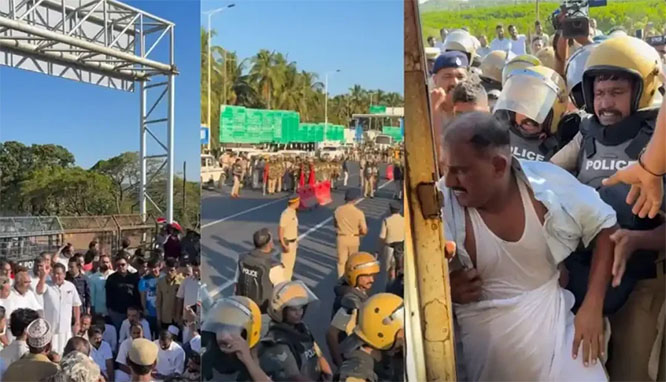
Protests against Arikkady toll plaza

The Arikkady toll plaza witnessed widespread protests from January 12, the day toll collection commenced. On the second day, an action committee led by Manjeshwar MLA A K M Ashraf launched an indefinite protest at the site. Except for the BJP, leaders and workers of most major political parties participated in the agitation.

On the night of January 14, a large number of protesters gathered at the plaza and vandalised property, following which authorities temporarily suspended toll operations. The BJP later also expressed opposition to the toll plaza and criticised NHAI’s decision. 

Comments

Add new comment

  • Coastaldigest.com reserves the right to delete or block any comments.
  • Coastaldigset.com is not responsible for its readers’ comments.
  • Comments that are abusive, incendiary or irrelevant are strictly prohibited.
  • Please use a genuine email ID and provide your name to avoid reject.