



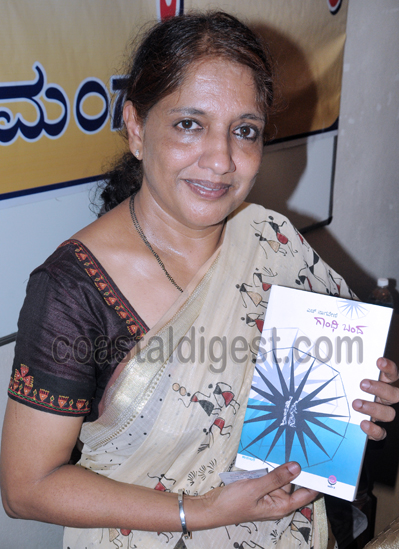
Mangalore, January 7: Popular Kannada writer H Nagaveni has finally revealed that her much discussed novel Gandhi Banda, which has been in the news recently following a demand by a section of a people for its removal from Mangalore University's syllabus, was indeed based on a real story.
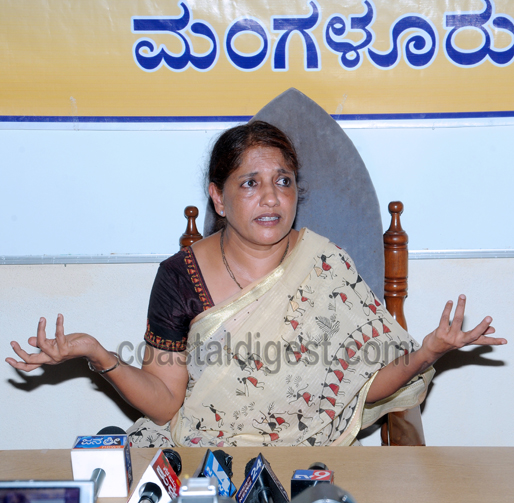
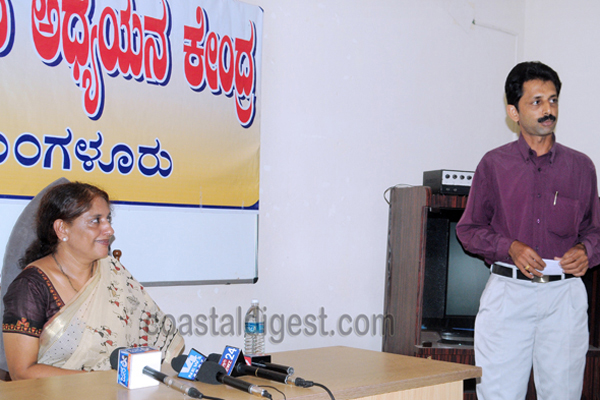
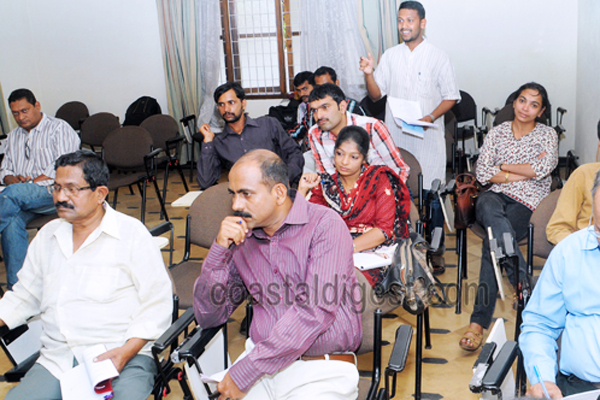
Participating in an interaction programme organized by Journalists Study Centre at Sahodaya Hall here on Saturday, Nagaveni said she had been thinking to write a novel ever since she had met an elderly woman, who finally became the main character of the novel-Draupadi.
In one of the sub plots of the novel, Draupadi, a Brahmin widow, against the will of her fanatic father remarries - that too with a 'patriotic Beary (Muslim) youth', who eventually attains martyrdom. The same Brahmin woman, who had refused to accept widowhood after the death of her Brahmin husband, prefers to follow all the Brahminic restrictions of widowhood after the martyrdom of her Beary husband. “I had met the same Draupadi when I was a class-V student”, she said.
She also advised the media and readers not to stuff the bad concept of 'love-jehad' into the novel.
Brushing aside the allegations of using derogatory words against a particular community in the novel, she questioned how could she be such an ungrateful towards those people, amidst whom she was born and brought up?
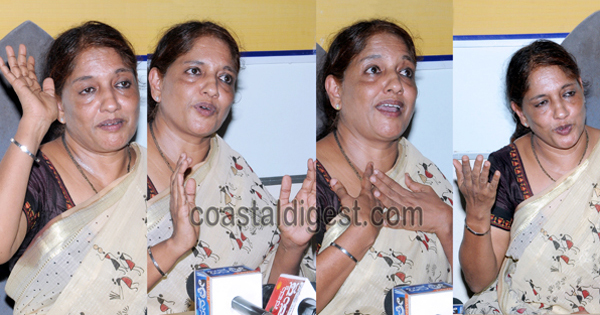
“I never ever used any derogatory words against any community in any of my works. Instead I have employed the spoken language of that period. The strength of my novel indeed lies in its ability to carry a reader beyond these specific experiences towards a larger humanist aspiration,” she said.
“When I wrote the novel over a decade ago, the only thing in my mind was to visualize a topic of national significance within the framework of socio-cultural context of Tulunadu and to douse the flames of communalism in this part of the state”, she said.
She also said that she was stunned when Vishwakarma community, which had been portrayed as a self-reliant working class in the novel, came out with an “immature and hasty reaction” without even reading the novel.
She also said that an innocent working-class community, was being instigated by a powerful upper class, against her and her novel. “It is an unconcealed truth that socially weak Vishwakarma community is being used as dice by communal forces, especially by socially powerful 'supreme caste' people” she lamented.
The novel, which documents the socio-economic metamorphosis in coastal Karnataka region from the year 1920 to 1940, she said, inevitably contains some of the words used by the lower class people at that time. However, those words are nothing compared to the words used in the novels of S L Bhairappa and other male writers.
“Ironically, the people who criticize me for employing the words used by lower class people of Tulunadu in 1920s, do not find any fault in Bhyrappa's novel, where you can find far vulgar words”, she pointed out.
“I respect Bhyrappa and his writings. But, I don't understand why a section of people selectively targeting a woman” said the award winning novelist, adding that these criticism may end her career as a writer.
Asked whether she was ready remove some 'unpleasant' words from novel as instructed by Mangalore University, she said she was not ready to maim her own child.
The writer also expressed her shock over the sudden opposition to the novel, which was whole heartedly welcomed by the people of state a few years ago. “The 'Gandhi Banda' was a textbook for PG students of Mangalore and Kuvempu University students in the past. Now the same novel is being taught in Gulbarga University too. But the opposition aroused all of a sudden in Mangalore University a few months after it was introduced to degree students”, she said, suspecting the conspiracy of a 'power' behind this sudden opposition.

Comments
Add new comment