



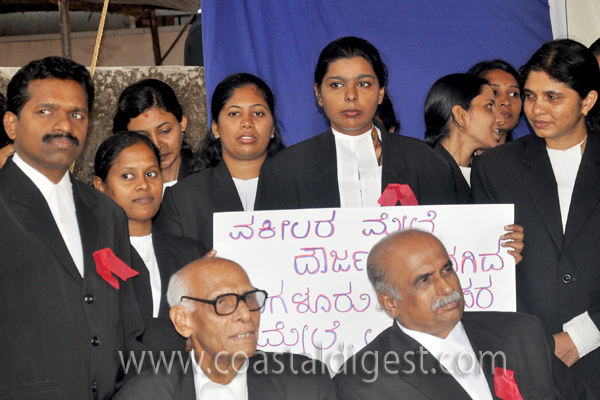
Lawyers protest 'draconian bill', 'police atrocity'

January 20, 2012

law3

Mangalore, January 20: The members of Mangalore Bar Association on Friday staged a protest against the proposed Higher Education Bill, and alleged police atrocities against advocates.

Addressing the protesters on the District Court premises, here, SP Chengappa, president of Mangalore Bar Association (R) said that the Higher Education and Research Bill-2011, introduced in Rajya Sabha by the Central Government, indeed threatens to intrude in the autonomy and independence of legal profession.

The Bill proposes to take away the duties and functions entrusted with the BCI and State Bar Councils and it proposes to vest all these powers with a national commission comprising a few academicians, he said.

He said, Mangalore Bar Association strongly condemns the attempt of the Ministry of Human Resource Development by which it has tried to encroach upon the provision of the Advocates Act 1961 with a view to use the functions and duties of elected bodies compromising of more than 15 lakh advocates of the country.

“The power to take Disciplinary action against lawyers was attempted to be taken away and the proposal was to give this power to some bureaucrats or outsiders so that the government could be at liberty to misuse this power. It is under these backgrounds that the ministry of Human Resource Development has come out with this Bill.” he said.

“We oppose tooth and nail draconian and highly condemnable proposals contained in the Bill which directly affects the vital and basic structures of the Advocates Act 1961”, he added.


law2

law1

Comments

Add new comment

  • Coastaldigest.com reserves the right to delete or block any comments.
  • Coastaldigset.com is not responsible for its readers’ comments.
  • Comments that are abusive, incendiary or irrelevant are strictly prohibited.
  • Please use a genuine email ID and provide your name to avoid reject.
News Network
February 3,2026

Bengaluru: Following reports of fresh Nipah virus (NiV) cases in West Bengal and heightened vigilance across parts of Southeast Asia, the Karnataka Health Department has placed the state on high alert and activated emergency preparedness protocols.

Health officials said enhanced surveillance measures have been initiated after two healthcare workers in Barasat, West Bengal, tested positive for the virus earlier this month. While no cases have been reported in Karnataka so far, authorities said the state’s past exposure to Nipah outbreaks and high inter-state mobility warranted preventive action.

Officials have directed district health teams to intensify monitoring, particularly at hospitals and points of entry, and to ensure early detection and isolation of suspected cases.

High Mortality Virus with Multiple Transmission Routes

Nipah virus is a zoonotic disease that can spread from animals to humans and has a reported fatality rate ranging between 60 and 75 per cent. Fruit bats, also known as flying foxes, are the natural reservoirs of the virus and can transmit it by contaminating food sources with saliva or urine.

Known modes of transmission include:

•    Contaminated food: Consumption of fruits partially eaten by bats or raw date-palm sap
•    Animal contact: Exposure to infected pigs or other animals
•    Human-to-human transmission: Close contact with body fluids of infected persons, particularly in healthcare settings

Symptoms and Disease Progression

The incubation period typically ranges from 4 to 14 days, though delayed onset has also been reported. Early symptoms often resemble common viral infections, making prompt clinical suspicion critical.

•    Initial symptoms: Fever, headache, body aches, fatigue, sore throat
•    Progressive symptoms: Drowsiness, disorientation, altered mental state
•    Severe stage: Seizures, neck stiffness and acute encephalitis, which can rapidly progress to coma

Public Health Advisory

The Health Department has issued precautionary guidelines urging the public to adopt risk-avoidance practices to prevent any local spillover.

Do’s
•    Wash fruits thoroughly before consumption
•    Drink boiled and cooled water
•    Use protective equipment while handling livestock
•    Maintain strict hand hygiene

Don’ts
•    Avoid fruits found on the ground or showing bite marks
•    Do not consume beverages made from raw tree sap, including toddy
•    Avoid areas with dense bat populations
•    Do not handle sick or dead animals

Preparedness Measures

Officials confirmed that isolation wards are being readied in major government hospitals and that medical staff are being sensitised to identify early warning signs.

“There is no cause for panic, but there is a need for heightened vigilance,” a senior health official said, adding that there is currently no approved vaccine or specific antiviral treatment for Nipah, and care remains largely supportive.

Comments

Add new comment

  • Coastaldigest.com reserves the right to delete or block any comments.
  • Coastaldigset.com is not responsible for its readers’ comments.
  • Comments that are abusive, incendiary or irrelevant are strictly prohibited.
  • Please use a genuine email ID and provide your name to avoid reject.
