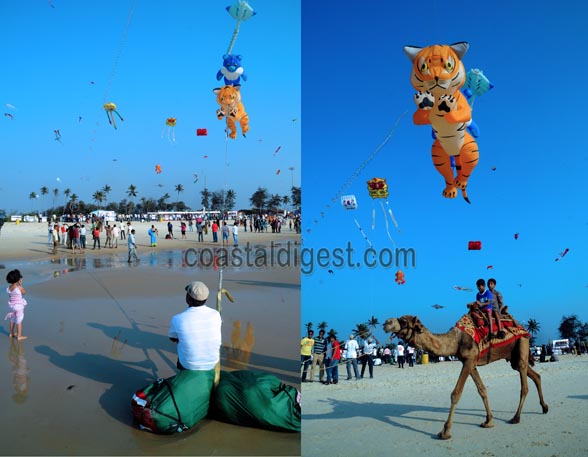
Adorned with kites, skies over Panambur beach flirt with eyes

[email protected] (CD Network, Photos by Ahmed Anwar )
January 21, 2012

kite

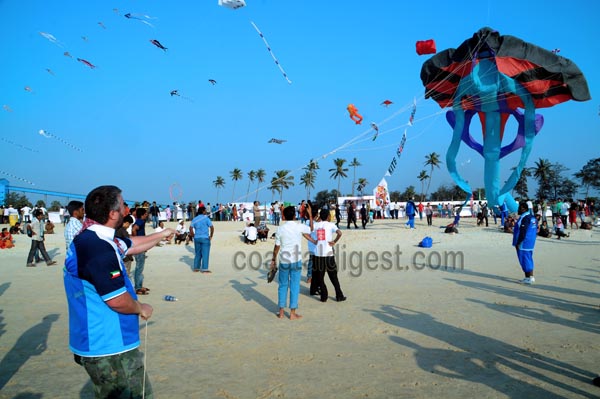
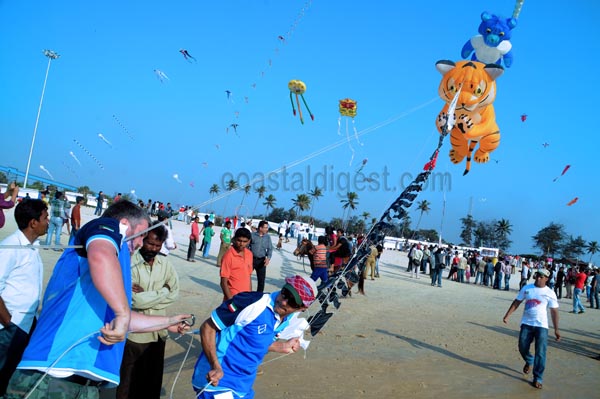
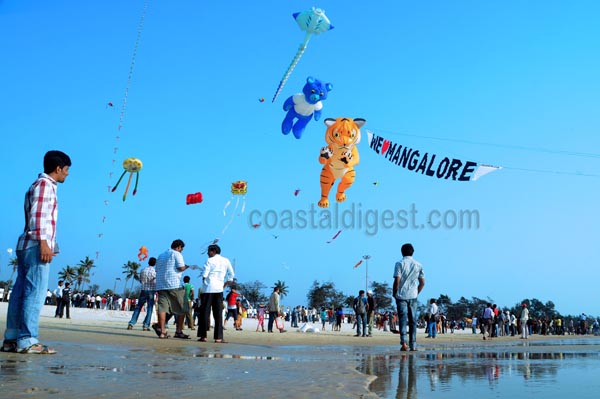
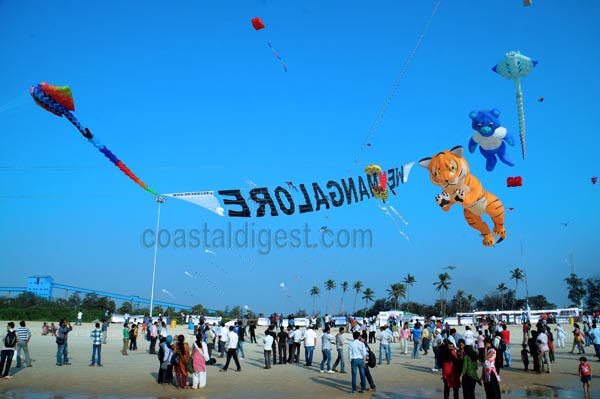
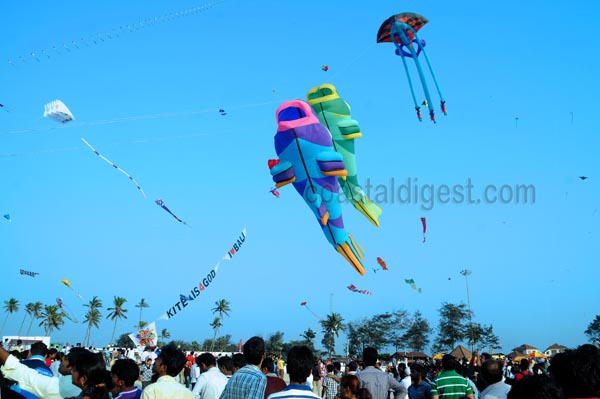
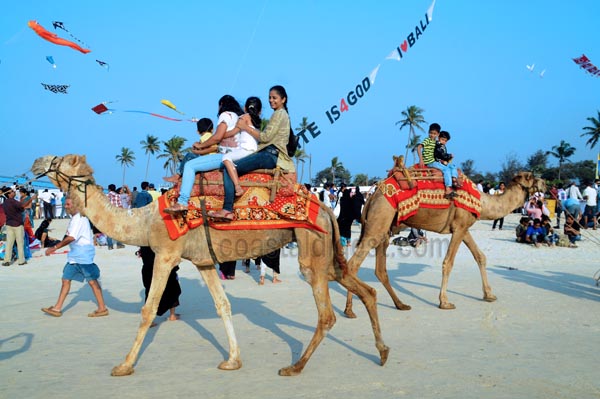
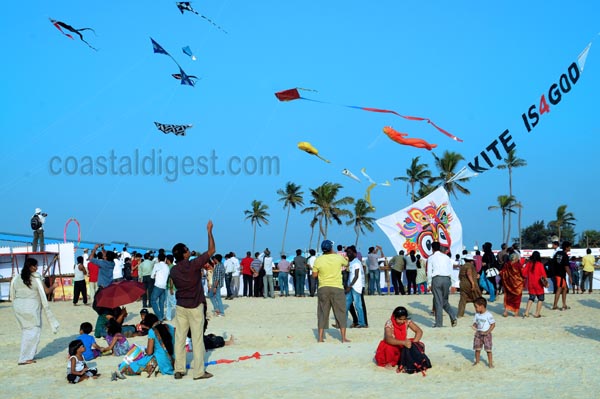
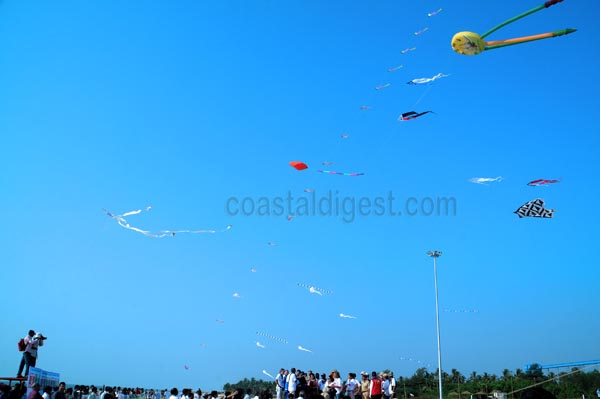
Mangalore, January 21: The skies on Saturday afternoon literally flirted with the eyes of thousands of people who thronged Panambur beach, as the two-day international kite festival got off to a flying start.

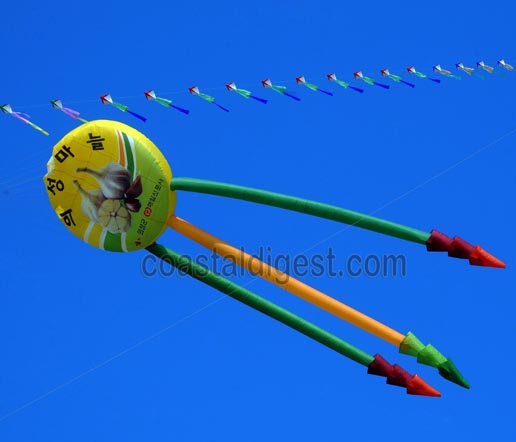
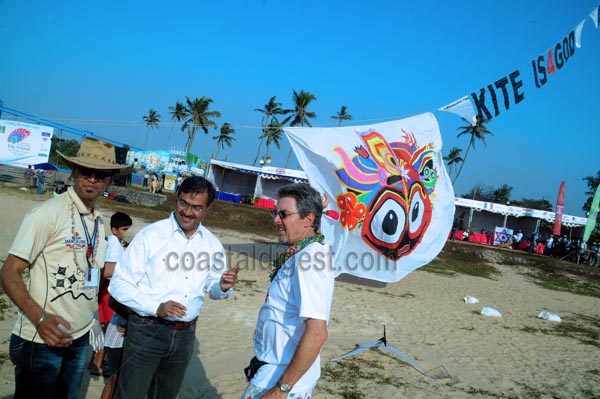
The kite flyers from various parts of the nation and seven foreign nations like United Kingdom, France, Lebanon, Kuwait, Holland, Lebanon and Indonesia, were seen busy flying various types of kites.

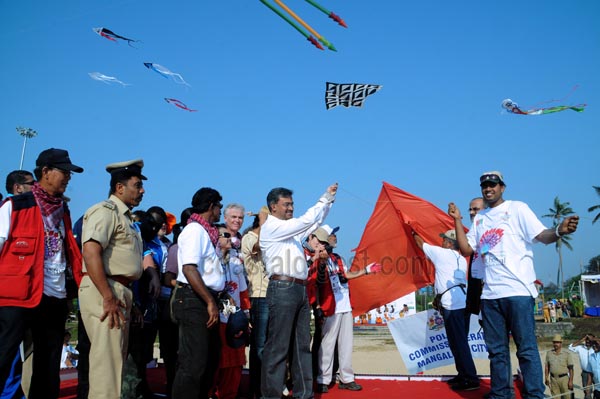
The inaugural function was conducted in a different fashion as all the participating countries came together near the stage. The chief guest of the event was Seemanth Kumar Singh, Commissioner of Police, Mangalore City. After a brief photo session and invocation the Commisioner was guided to a central stage. Along with the organizers led by chief organizer Giridhar Kamath, Seemanth Kumar Singh flew a special kite dedicated to the Police Commissionerate.

Expressing his joy Mr Singh said, “This festival is a symbol of peace and Mangalore City must benefit out of it in terms of tourism. I hope the numbers will increase next year and the foreigners have been kind enough to participate in this unique event. I am grateful to the organizers for having made a kite in the name of our department.” Also present on this occasion was ACP Puttamadhayya. As a symbol of respect a 1 minute silence was observed in memory of the labourers who died at the MRPL blast.

The foreign participants were more than delighted to fly their kites. The French couple of Marco and Saundarine showcased a Revolution kite. Marco said, “We have been to other festivals as well like Ahmedabad and Mumbai, but this one is very well organised. This place is nice for a festival.”

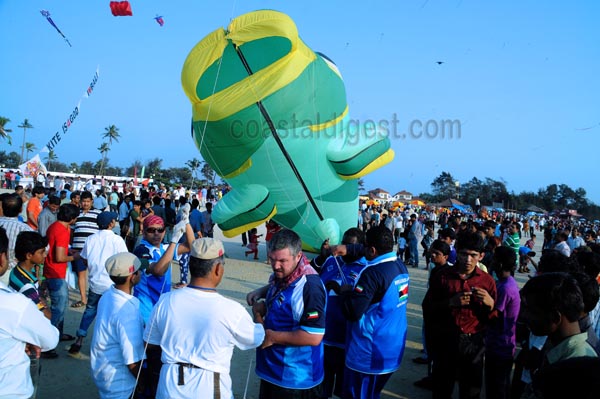
Another participating country Lebanon had two flyers come in. Rami Ilaha said, “We have been to Ahmedabad, Belgaum and the skeleton of our kite is made from carbon graphite and hence it is light in weight. Our kite is in the shape of a duck and it is our favourite hobby.”

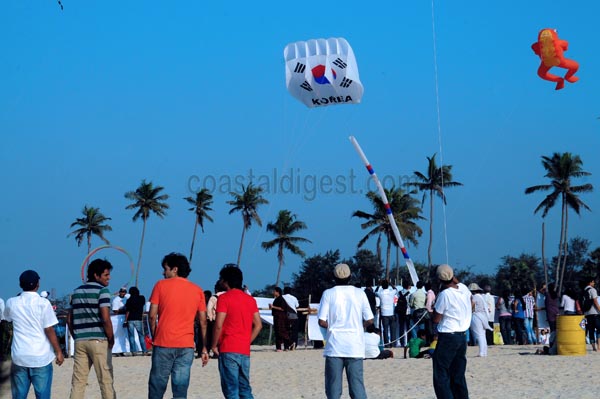
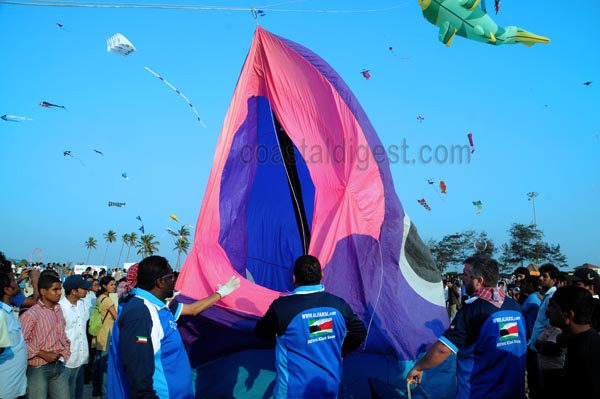
Another interesting team was the one from Kuwait: Tariq and Mohammed Salem. Both had very interesting facts about their kites. They said, “Our kite is already in the Guinness book of world records and our kite is the symbol of our national flag. Its strings weigh around 100 kg and it needs three tractors to fly it. We also have another kite called the Monta-Ray which is bigger than this one, but it is unofficial and still not entered the record books.”

Local hit Team Mangalore also had its kite flying high with pride. This team already has been to eight countries till now.

Mr Giridhar Kamath said that they have sponsored some of the foreign teams and they have enjoyed the hospitality of Team Mangalore.

A major attraction was the techno savvy Prithiviraj, an assistant professor at NITK, Surahtkal who had fixed his indigenously built remote controlled camera attached to a kite which showed the ground below on a screen in his hand.
KT_F21Jan_1

KT_F21Jan_2

KT_F21Jan_3

KT_F21Jan_4

KT_F21Jan_5

KT_F21Jan_6

KT_F21Jan_7

KT_F21Jan_8

KT_F21Jan_9

KT_F21Jan_10

KT_F21Jan_11

KT_F21Jan_12

KT_F21Jan_13

KT_F21Jan_14

KT_F21Jan_15

KT_F21Jan_16

KT_F21Jan_17

KT_F21Jan_18

KT_F21Jan_19

KT_F21Jan_20

ALBUM

Comments

Add new comment

  • Coastaldigest.com reserves the right to delete or block any comments.
  • Coastaldigset.com is not responsible for its readers’ comments.
  • Comments that are abusive, incendiary or irrelevant are strictly prohibited.
  • Please use a genuine email ID and provide your name to avoid reject.
News Network
February 3,2026

wind.jpg

Dakshina Kannada MP Capt Brijesh Chowta has urged the Centre to give high priority to offshore wind energy generation along the Mangaluru coast, citing its strategic importance to India’s green energy and port-led development goals.

Raising the issue in the Lok Sabha under Rule 377, Chowta said studies by the National Institute of Oceanography have identified the Mangaluru coastline as part of India’s promising offshore wind ‘Zone-2’, covering nearly 6,490 sq km. He noted that the region’s relatively low exposure to cyclones and earthquakes makes it suitable for long-term offshore wind projects and called for its development as a dedicated offshore wind energy zone.

Highlighting the role of New Mangalore Port, Chowta said its modern infrastructure, multiple berths and heavy cargo-handling capacity position it well as a logistics hub for transporting and assembling large wind energy equipment.

He also pointed to the presence of major industrial units such as MRPL, OMPL, UPCL and the Mangaluru SEZ, which could serve as direct buyers of green power through power purchase agreements, improving project viability and speeding up execution.

With Karnataka’s peak power demand crossing 18,000 MW in early 2025, Chowta stressed the need to diversify renewable energy sources. He added that offshore wind projects in the Arabian Sea are strategically safer compared to the cyclone-prone Bay of Bengal.

Calling the project vital to India’s target of 500 GW of renewable energy by 2030, Chowta urged the Ministry of New and Renewable Energy to initiate resource assessments, pilot projects and stakeholder consultations at the earliest.

Comments

Add new comment

  • Coastaldigest.com reserves the right to delete or block any comments.
  • Coastaldigset.com is not responsible for its readers’ comments.
  • Comments that are abusive, incendiary or irrelevant are strictly prohibited.
  • Please use a genuine email ID and provide your name to avoid reject.
News Network
January 23,2026

Mangaluru: The Karnataka Government Polytechnic (KPT), Mangaluru, has achieved autonomous status from the All India Council for Technical Education (AICTE), becoming the first government polytechnic in the country to receive such recognition in its 78-year history. The status was granted by AICTE, New Delhi, and subsequently approved by the Karnataka Board of Technical Education in October last year.

Officials said the autonomy was conferred a few months ago. Until recently, AICTE extended autonomous status only to engineering colleges, excluding diploma institutions. However, with a renewed national focus on skill development, several government polytechnics across India have now been granted autonomy.

KPT, the second-largest polytechnic in Karnataka, was established in 1946 with four branches and has since expanded to offer eight diploma programmes, including computer science and polymer technology. The institution is spread across a 19-acre campus.

Ravindra M Keni, the first dean of the institution, told The Times of India that AICTE had proposed autonomous status for polytechnic institutions that are over 25 years old. “Many colleges applied. In the first round, 100 institutions were shortlisted, which was further narrowed down to 15 in the second round. We have already completed one semester after becoming an autonomous institution,” he said. He added that nearly 500 students are admitted annually across eight three-year diploma courses.

Explaining the factors that helped KPT secure autonomy, Keni said the institution has consistently recorded 100 per cent admissions and placements for its graduates. He also noted its strong performance in sports, with the college emerging champions for 12 consecutive years, along with active student participation in NCC and NSS activities.

Autonomous status allows KPT to design industry-oriented curricula, conduct examinations, prepare question papers, and manage academic documentation independently. The institution can also directly collaborate with industries and receive priority funding from AICTE or the Ministry of Education. While academic autonomy has been granted, financial control will continue to rest with the state government.

“There will be separate committees for examinations, question paper setting, boards of studies, and boards of examiners. The institution will now have the freedom to conduct admissions without government notifications and issue its own marks cards,” Keni said, adding that new academic initiatives would be planned after a year of functioning under the autonomous framework.

Comments

Add new comment

  • Coastaldigest.com reserves the right to delete or block any comments.
  • Coastaldigset.com is not responsible for its readers’ comments.
  • Comments that are abusive, incendiary or irrelevant are strictly prohibited.
  • Please use a genuine email ID and provide your name to avoid reject.
News Network
February 1,2026

Bengaluru: The Karnataka High Court has refused to quash an investigation against a WhatsApp group administrator accused of allowing the circulation of obscene and offensive images depicting Hindutva politicians and idols in 2021.

Justice M Nagaprasanna observed that, prima facie, the ingredients of the offence under Section 295A of the Indian Penal Code were made out. “The offence under Section 295A of the IPC is met to every word of its ingredient, albeit prima facie,” the judge said.

The petitioner, Sirajuddin, a resident of Belthangady taluk in Dakshina Kannada district, had challenged the FIR registered against him at the CEN (Cyber, Economics and Narcotics) police station, Mangaluru, for offences under Section 295A of the IPC and Section 67 of the Information Technology Act. Section 295A relates to punishment for deliberate and malicious acts intended to outrage the religious feelings of any class of citizens.

According to the complaint filed by K Jayaraj Salian, also a resident of Belthangady taluk, he received a WhatsApp group link from an unknown source and was added to the group after accessing it. The group reportedly had six administrators and around 250 participants, where obscene and offensive images depicting Hindu deities and certain political figures were allegedly circulated repeatedly.

Sirajuddin was arrested in connection with the case and later released on bail on February 16, 2021. He argued before the court that he was being selectively targeted, while other administrators—including the creator of the group—were neither arrested nor investigated. He also contended that the Magistrate could not have taken cognisance of the offence under Section 295A without prior sanction under Section 196(1) of the CrPC.

Rejecting the argument, Justice Nagaprasanna held that prior sanction is required only at the stage of taking cognisance, and not at the stage of registration of the crime or during investigation.

The judge noted that the State had produced the entire investigation material before the court. “A perusal of the material reveals depictions of Hindu deities in an extraordinarily obscene, demeaning and profane manner. The content is such that its reproduction in a judicial order would itself be inappropriate,” the court said, adding that the material, on its face, had the tendency to outrage religious feelings and disturb communal harmony.

Observing that the case was still at the investigation stage, the court said it could not interdict the probe at this juncture. However, it expressed concern that the investigating officer appeared to have not proceeded uniformly against all administrators. The court clarified that if the investigation revealed the active involvement of any member in permitting the circulation of such content, they must also be proceeded against.

“At this investigative stage, any further observation by this Court would be unnecessary,” the order concluded.

Comments

Add new comment

  • Coastaldigest.com reserves the right to delete or block any comments.
  • Coastaldigset.com is not responsible for its readers’ comments.
  • Comments that are abusive, incendiary or irrelevant are strictly prohibited.
  • Please use a genuine email ID and provide your name to avoid reject.