International kite festival concludes

January 23, 2012

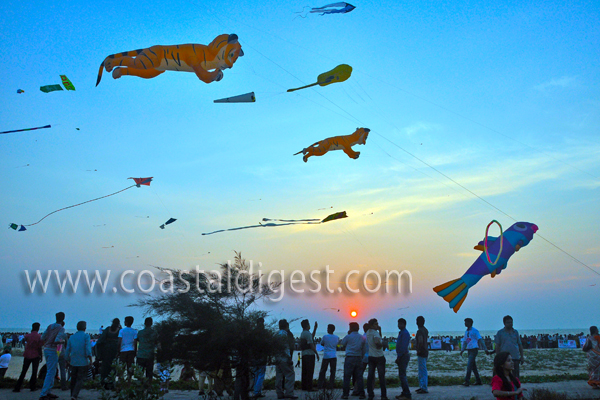
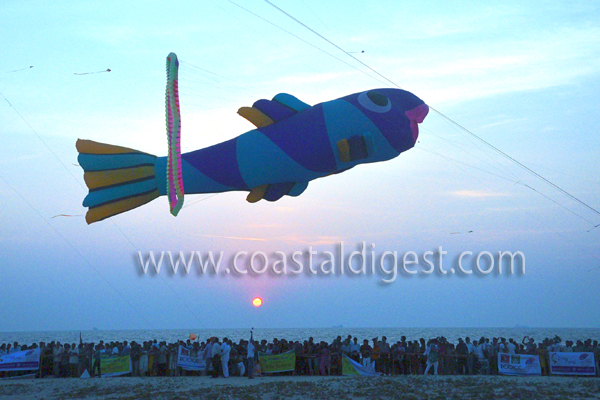
Mangalore, January 23: On Sunday, it was not sea and the shore at Panambur, instead it was sea and oceanic crowd on the shore along with hundreds of kites flying high adding to the happiness of the crowd who had gathered to have a glimpse of them.

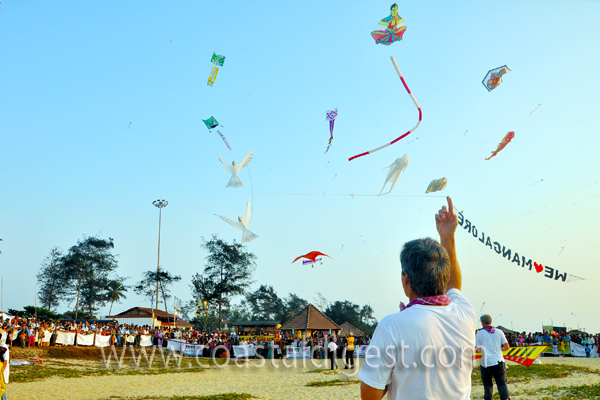
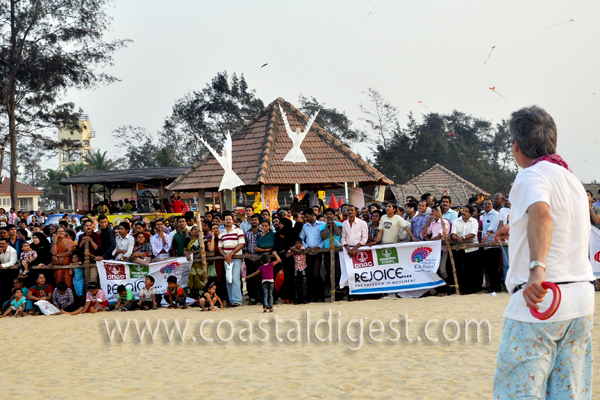
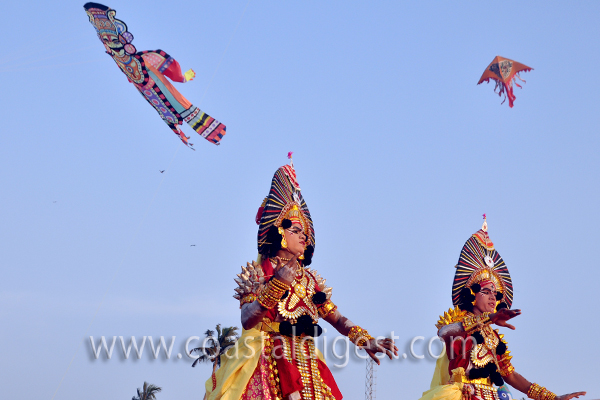
Sunday being a holiday, people came as families bringing along elders to kids to enjoy the rare lavish spectacle that happens at Panambur beach-the International Kite Festival. While the kites of different shapes and sizes flew high resembling the aspirations of the hands flying them, Panambur beach took a look of a gala fair.

To cater to the flowing crowd, several shops had come up. While some plush make-shift restaurants flaunted cozy couches served hot, creamy coffee, sandwiches and burgers, there were couple of ice cream stalls helping the crowd to beat the heat. Rest of the smaller shacks sold sugar cane juice, Manchurians, Kebabs, biryanis and even masala powders. Churmuri and groundnut vendors were busy calling on their potential customers, making brisk business during the festival.

In a beauty lounge, couples of artists were busy drawing portraits of their subjects while some drew beautiful mehndi designs on their customers.

Kids were busy checking the market available for them. A stall selling kites saw highest buyers. From elderly to youth to kids everyone thronged at this stall to pick kites for themselves. While designer kites flew high, tiny kites of plastic made appearances all over. While children jumped on the sand to make their kite fly, elders returned to relive moments of childhood by attempting to try their hands on kite flying.

“Kite flying is not very popular in this region, but as a child, I got an opportunity to live in old Delhi for three to four years. It was there that I learnt the art of making and flying kite. I was a mediocre in the art, but I seemed excellent here in Mangalore because not many of my counterparts knew kite flying,” says Sanjeeva Nayak, a businessman in his late 60s.

As many as seven nations- Netherlands, Indonesia, South Korea, UK, France, Kuwait and Lebanon took part in the fest.

Otto Vassen, the participant from the Netherlands was seen interacting with the crowd by handing over the thread of his kite to the individuals in the crowd asking them to fly it. Lot of people enjoyed this nature of Vassen because everyone, deep down their hearts wanted to fly the big, beautiful kites in the arena.

Bob from UK said that the wind at Panambur beach on Sunday evening was favourable for kite flying because it was simply subtle enough to keep the kite safe intact in the air.

“One fascinating thing about flying kite in India is that the space around the arena is never empty. There is cheering crowd all around the arena, which adds to any kite flier's passion. It is an adrenaline for any flier,” says Bob, who feels that Team Mangalore's kites are the best because it always showcases Mangalore's culture.

The paper kites made by special kids from Chetana, Mangala Jyoti, Saanidhya and Abhaya Ashraya Mangalore were displayed at the venue. The paintings on the kite spoke eloquently on the feelings of the special children, their wish for peace, tranquility and greenery on earth. The section really upheld the theme of the festival-“One sky, one earth, one family.'

For the first time in India, night kite flying was held using high power beams. Colourful kites embellished black background of sky, adding to the glory of the event.

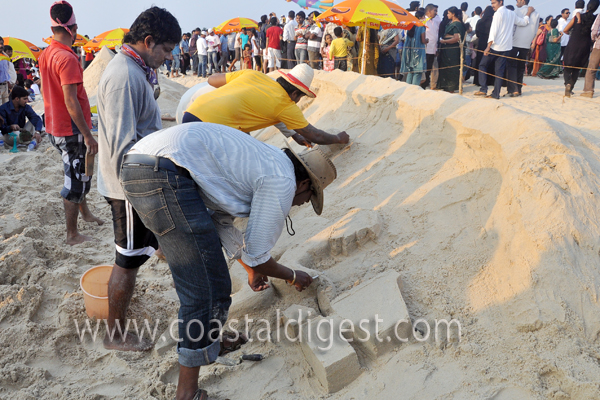
Some groups were even seen making sand art at the venue, which too bagged good response.

All in all, the kite show ended on Sunday but the memory of the paper falcons' ballet in the sky will live for long, only to be replaced by the fresh kites of next year.

kite1_copy

kite2_copy

kite3

kite4

kite5

kite6

kite7

kite8

kite9

kite10

kite11

Comments

Add new comment

  • Coastaldigest.com reserves the right to delete or block any comments.
  • Coastaldigset.com is not responsible for its readers’ comments.
  • Comments that are abusive, incendiary or irrelevant are strictly prohibited.
  • Please use a genuine email ID and provide your name to avoid reject.
News Network
January 23,2026

Karnataka Governor Thaawarchand Gehlot read only three lines from the 122-paragraph address prepared by the Congress-led state government while addressing the joint session of the Legislature on Thursday, effectively bypassing large sections critical of the BJP-led Union government.

The omitted portions of the customary Governor’s address outlined what the state government described as a “suppressive situation in economic and policy matters” under India’s federal framework. The speech also sharply criticised the Centre’s move to replace the Mahatma Gandhi National Rural Employment Guarantee Act (MGNREGA) with the Viksit Bharat–Guarantee for Rozgar and Ajeevika Mission (Gramin) Act, commonly referred to as the VB-GRAM (G) Act.

Governor Gehlot had earlier conveyed his objection to several paragraphs that were explicitly critical of the Union government. On Thursday, he confined himself to the opening lines — “I extend a warm welcome to all of you to the joint session of the State legislature. I am extremely pleased to address this august House” — before jumping directly to the concluding sentence of the final paragraph.

He ended the address by reading the last line of paragraph 122: “Overall, my government is firmly committed to doubling the pace of the State’s economic, social and physical development. Jai Hind — Jai Karnataka.”

According to the prepared speech, the Karnataka government demanded the scrapping of the VB-GRAM (G) Act, describing it as “contractor-centric” and detrimental to rural livelihoods, and called for the full restoration of MGNREGA. The state government argued that the new law undermines decentralisation, weakens labour protections, and centralises decision-making in violation of constitutional norms.

Key points from the unread sections of the speech:

•    Karnataka facing a “suppressive” economic and policy environment within the federal system

•    Repeal of MGNREGA described as a blow to rural livelihoods

•    VB-GRAM (G) Act accused of protecting corporate and contractor interests

•    New law alleged to weaken decentralised governance

•    Decision-making said to be imposed by the Centre without consulting states

•    Rights of Adivasis, women, backward classes and agrarian communities curtailed

•    Labourers allegedly placed under contractor control

•    States facing mounting fiscal stress due to central policies

•    VB-GRAM (G) Act accused of enabling large-scale corruption

Comments

Add new comment

  • Coastaldigest.com reserves the right to delete or block any comments.
  • Coastaldigset.com is not responsible for its readers’ comments.
  • Comments that are abusive, incendiary or irrelevant are strictly prohibited.
  • Please use a genuine email ID and provide your name to avoid reject.
News Network
January 23,2026

Mangaluru: The Karnataka Government Polytechnic (KPT), Mangaluru, has achieved autonomous status from the All India Council for Technical Education (AICTE), becoming the first government polytechnic in the country to receive such recognition in its 78-year history. The status was granted by AICTE, New Delhi, and subsequently approved by the Karnataka Board of Technical Education in October last year.

Officials said the autonomy was conferred a few months ago. Until recently, AICTE extended autonomous status only to engineering colleges, excluding diploma institutions. However, with a renewed national focus on skill development, several government polytechnics across India have now been granted autonomy.

KPT, the second-largest polytechnic in Karnataka, was established in 1946 with four branches and has since expanded to offer eight diploma programmes, including computer science and polymer technology. The institution is spread across a 19-acre campus.

Ravindra M Keni, the first dean of the institution, told The Times of India that AICTE had proposed autonomous status for polytechnic institutions that are over 25 years old. “Many colleges applied. In the first round, 100 institutions were shortlisted, which was further narrowed down to 15 in the second round. We have already completed one semester after becoming an autonomous institution,” he said. He added that nearly 500 students are admitted annually across eight three-year diploma courses.

Explaining the factors that helped KPT secure autonomy, Keni said the institution has consistently recorded 100 per cent admissions and placements for its graduates. He also noted its strong performance in sports, with the college emerging champions for 12 consecutive years, along with active student participation in NCC and NSS activities.

Autonomous status allows KPT to design industry-oriented curricula, conduct examinations, prepare question papers, and manage academic documentation independently. The institution can also directly collaborate with industries and receive priority funding from AICTE or the Ministry of Education. While academic autonomy has been granted, financial control will continue to rest with the state government.

“There will be separate committees for examinations, question paper setting, boards of studies, and boards of examiners. The institution will now have the freedom to conduct admissions without government notifications and issue its own marks cards,” Keni said, adding that new academic initiatives would be planned after a year of functioning under the autonomous framework.

Comments

Add new comment

  • Coastaldigest.com reserves the right to delete or block any comments.
  • Coastaldigset.com is not responsible for its readers’ comments.
  • Comments that are abusive, incendiary or irrelevant are strictly prohibited.
  • Please use a genuine email ID and provide your name to avoid reject.
News Network
February 3,2026

Bengaluru: Following reports of fresh Nipah virus (NiV) cases in West Bengal and heightened vigilance across parts of Southeast Asia, the Karnataka Health Department has placed the state on high alert and activated emergency preparedness protocols.

Health officials said enhanced surveillance measures have been initiated after two healthcare workers in Barasat, West Bengal, tested positive for the virus earlier this month. While no cases have been reported in Karnataka so far, authorities said the state’s past exposure to Nipah outbreaks and high inter-state mobility warranted preventive action.

Officials have directed district health teams to intensify monitoring, particularly at hospitals and points of entry, and to ensure early detection and isolation of suspected cases.

High Mortality Virus with Multiple Transmission Routes

Nipah virus is a zoonotic disease that can spread from animals to humans and has a reported fatality rate ranging between 60 and 75 per cent. Fruit bats, also known as flying foxes, are the natural reservoirs of the virus and can transmit it by contaminating food sources with saliva or urine.

Known modes of transmission include:

•    Contaminated food: Consumption of fruits partially eaten by bats or raw date-palm sap
•    Animal contact: Exposure to infected pigs or other animals
•    Human-to-human transmission: Close contact with body fluids of infected persons, particularly in healthcare settings

Symptoms and Disease Progression

The incubation period typically ranges from 4 to 14 days, though delayed onset has also been reported. Early symptoms often resemble common viral infections, making prompt clinical suspicion critical.

•    Initial symptoms: Fever, headache, body aches, fatigue, sore throat
•    Progressive symptoms: Drowsiness, disorientation, altered mental state
•    Severe stage: Seizures, neck stiffness and acute encephalitis, which can rapidly progress to coma

Public Health Advisory

The Health Department has issued precautionary guidelines urging the public to adopt risk-avoidance practices to prevent any local spillover.

Do’s
•    Wash fruits thoroughly before consumption
•    Drink boiled and cooled water
•    Use protective equipment while handling livestock
•    Maintain strict hand hygiene

Don’ts
•    Avoid fruits found on the ground or showing bite marks
•    Do not consume beverages made from raw tree sap, including toddy
•    Avoid areas with dense bat populations
•    Do not handle sick or dead animals

Preparedness Measures

Officials confirmed that isolation wards are being readied in major government hospitals and that medical staff are being sensitised to identify early warning signs.

“There is no cause for panic, but there is a need for heightened vigilance,” a senior health official said, adding that there is currently no approved vaccine or specific antiviral treatment for Nipah, and care remains largely supportive.

Comments

Add new comment

  • Coastaldigest.com reserves the right to delete or block any comments.
  • Coastaldigset.com is not responsible for its readers’ comments.
  • Comments that are abusive, incendiary or irrelevant are strictly prohibited.
  • Please use a genuine email ID and provide your name to avoid reject.