Venur: Century's second anointing of Bahubali begins

[email protected] (CD Network, Photos by Ahmed Anwar )
January 28, 2012
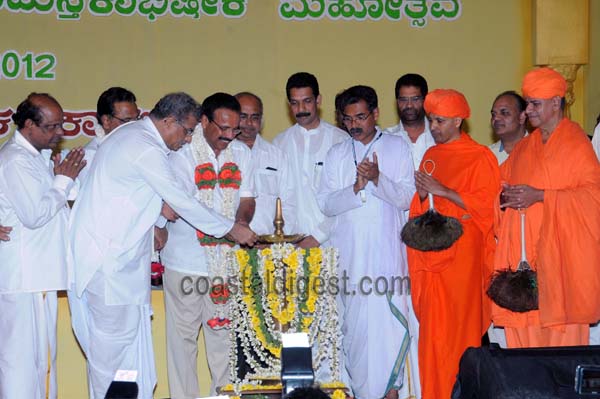
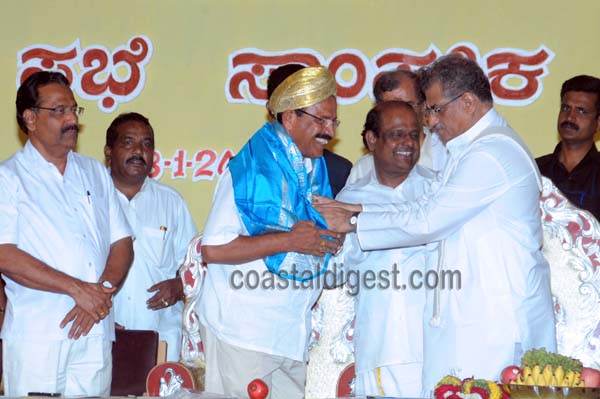
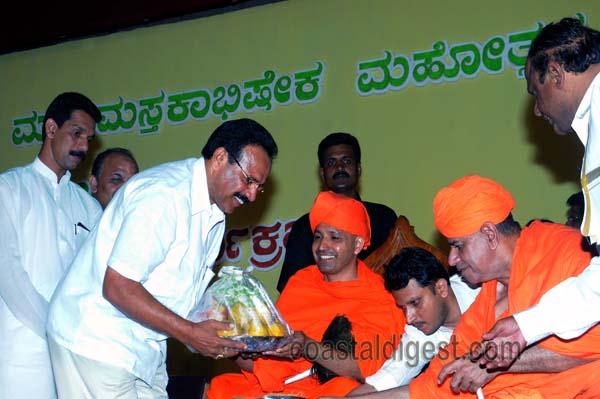
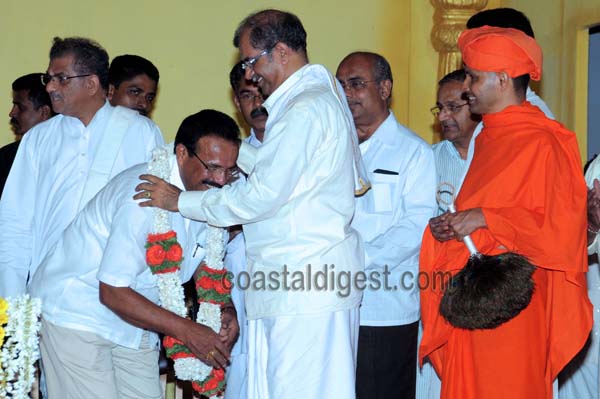
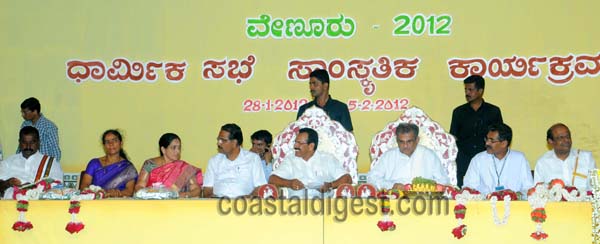
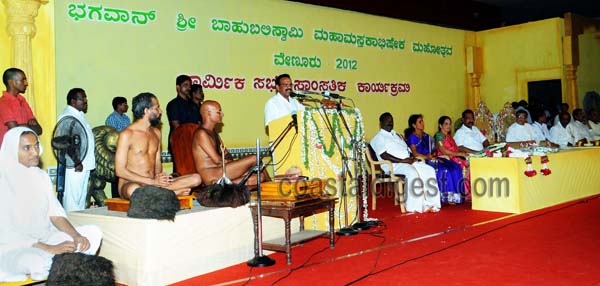
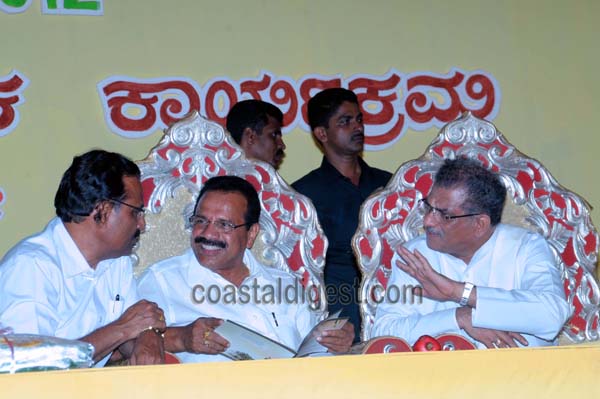
Mangalore, January 28: The second Mahamastakabhisheka (anointing) of the 21st century on Saturday got off to a colourful start with Chief Minister D V Sadananda Gowda stressing the need for values of Jainism like non-violence, sacrifice and spreading happiness in the tension-striken world.

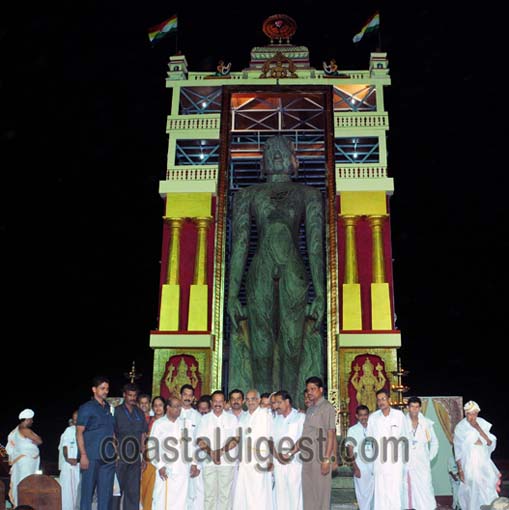
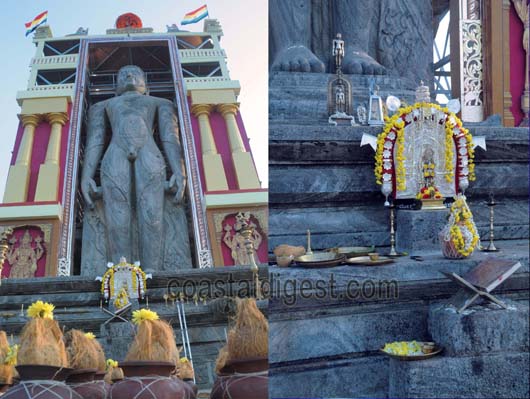
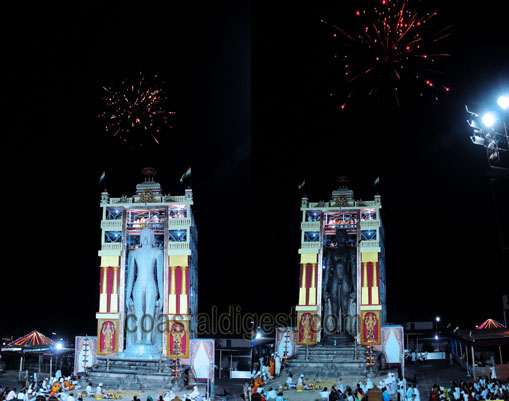
Inaugurating the nine day-long forth Mahamastakabhisheka at historical Venur town in Belthangady taluk, CM said the the massive monolith statue of Bahubali symbolised self-control and subjugation of ego.

“The one important thing that we all must learn from the Jainism is 'sacrifice'. If one learns to self-control and subjugate his ego and abstain from evil traits, he will surely progress in society”, he said.

He opined that the principles of Jainism are relevant for today's society which was full of problems and imbalances.

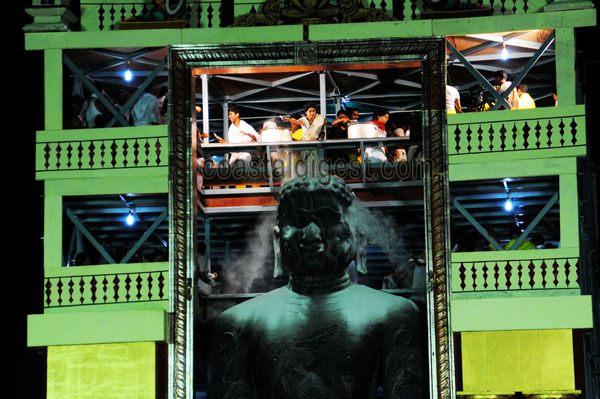
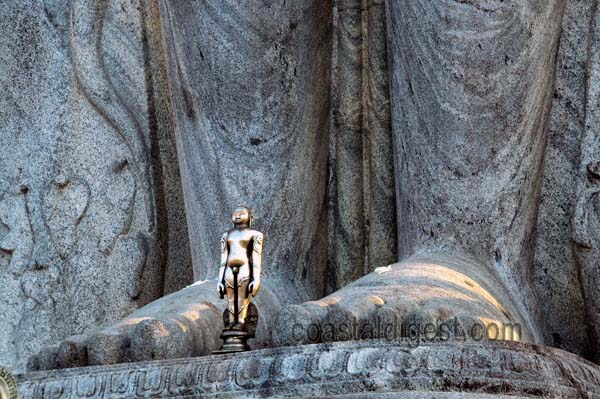
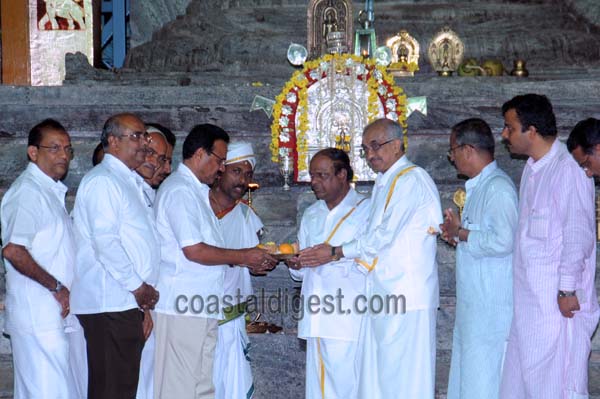
After inaugurating the event, the CM offered his prayers to the 35-foot tall idol.

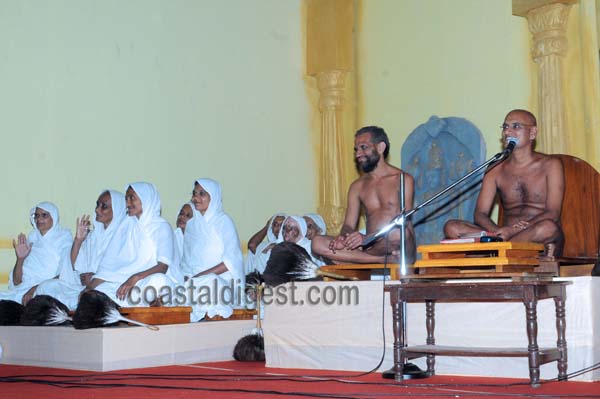
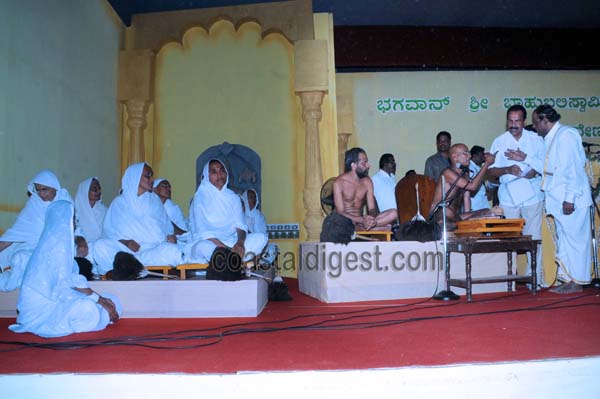
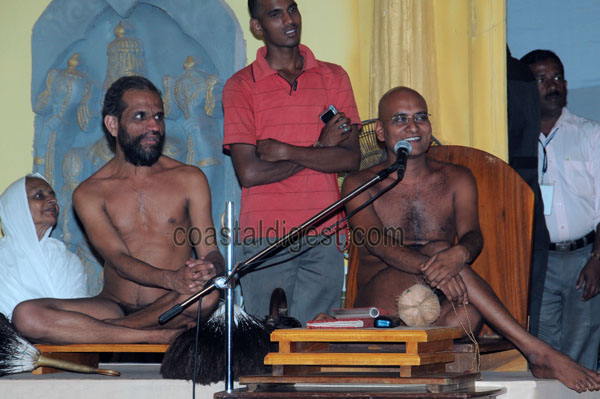
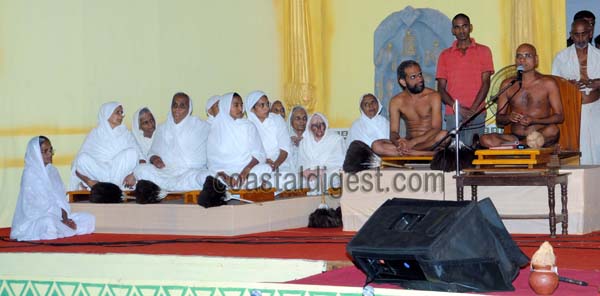
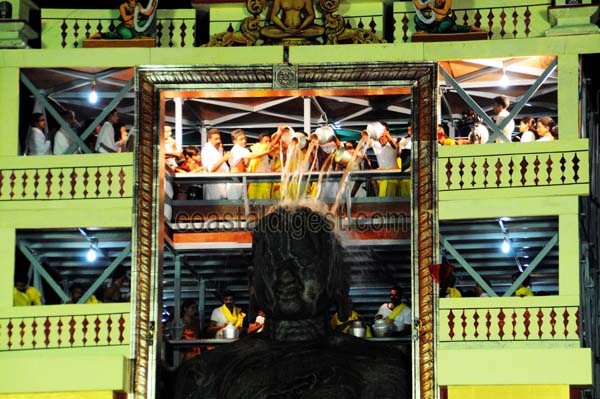
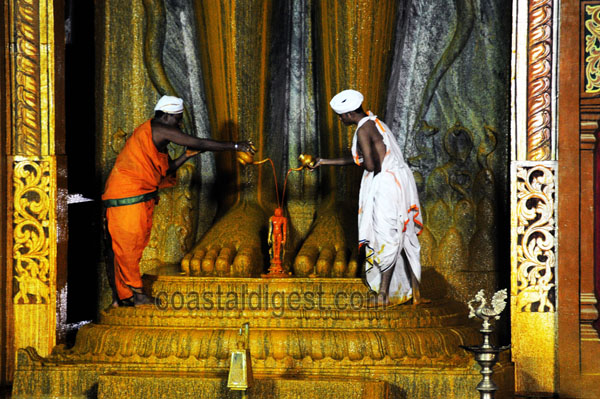
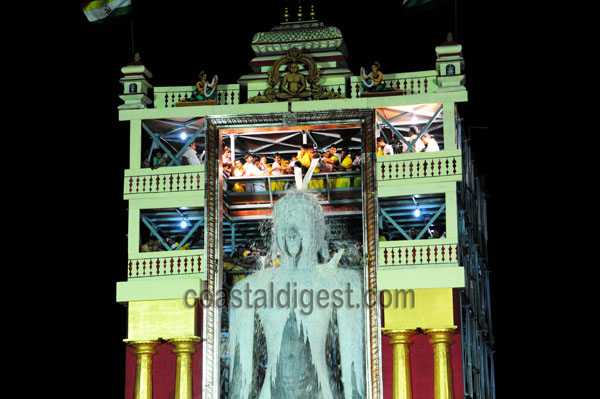
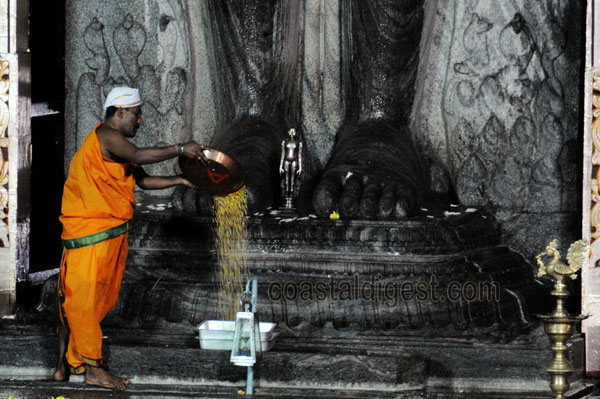
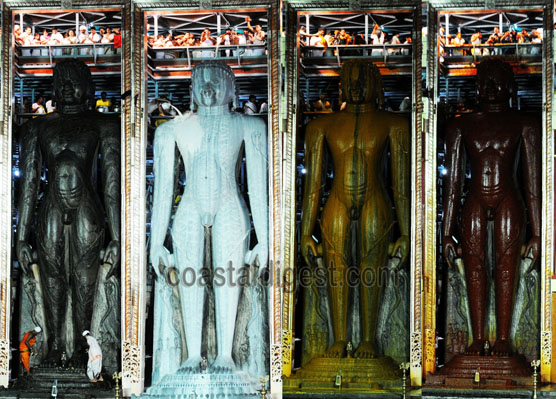
The rituals were carried out strictly following the principles of Jainism. After an attractive procession there was a water abhishekha. Then one after the other, holy things were poured from the statue's curly head to toe.

Tender coconut, sugarcane, milk, sandal, turmeric, red-turmeric, flowers, coins, gold, floral garlands were seen flowing on the giant sculpture. Later, a huge arathi made its presence.

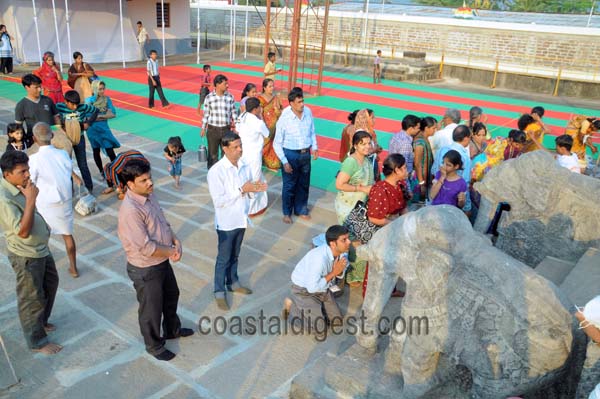
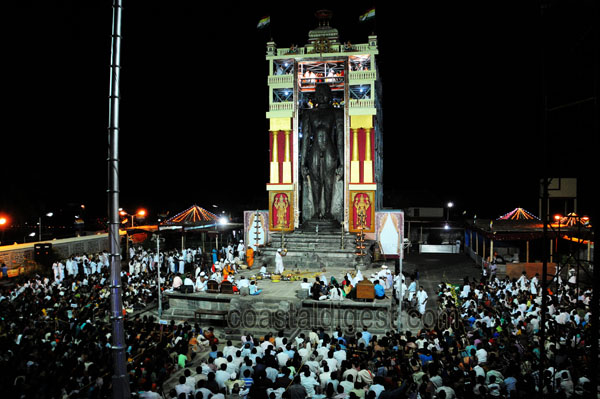
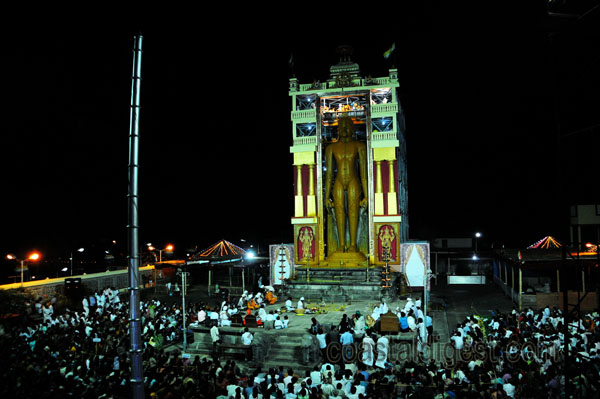
Thousands of devotees from across the country were seen eagerly waiting to get a glimpse of the celebrations.

The Mahamastakabhisheka organisers have set up stairs for devotees to reach the top of the idol and perform the rituals. On the first five days, the abhisheka would be performed using milk, sandalwood paste, and other material stocked in 108 kalashas. Around 450 litres of milk and 5 kg of sandalwood paste would be used in the first five days. This quantity would increase as more kalashas would be used for the abhisheka as the event progresses.

The abhisheka would be performed by families, including Ajila Princely family and Heggade from Dharmastala, on the first eight days of the event. Each family would bear the expenses of the ceremonies performed on the day. People could perform abhisheka on the last day of the event when material stored in 1,008 kalashas would be used.

The State Government had sanctioned Rs. 2 crore for the event. Some portion of this amount had been used for development activities, including asphalting of road and repair of compound wall. To commemorate this historic event, organisers had prepared a plan to provide drinking water for 12 villages surrounding Venur at an estimated cost of Rs. 25 crore. The water for these villages could be pumped from the Phalguni river, according to the organisers.

Going by the history, Thimmannajila Arasa installed the Bahubali statue in Venoor on the banks of Phalguni river in 1604 AD. The first Masthakabhisheka was held in 1928 followed by the second ceremony in 1956 and the third one in 2000.
VNM_29Jan_1

VNM_29Jan_2

VNM_29Jan_3

VNM_29Jan_4

VNM_29Jan_5

VNM_29Jan_6

VNM_29Jan_7

VNM_29Jan_8

VNM_29Jan_9

VNM_29Jan_10

VNM_29Jan_11

VNM_29Jan_12

VNM_29Jan_13

VNM_29Jan_14

VNM_29Jan_15

VNM_29Jan_16

VNM_29Jan_17

VNM_29Jan_18

VNM_29Jan_19

VNM_29Jan_20

VNM_29Jan_21

VNM_29Jan_22

VNM_29Jan_23

VNM_29Jan_24

VNM_29Jan_25

ALBUM

Comments

Add new comment

  • Coastaldigest.com reserves the right to delete or block any comments.
  • Coastaldigset.com is not responsible for its readers’ comments.
  • Comments that are abusive, incendiary or irrelevant are strictly prohibited.
  • Please use a genuine email ID and provide your name to avoid reject.
News Network
February 5,2026

In an era where digital distractions are the primary rival to academic excellence, the Karnataka Education Department is taking the fight directly to the living room. As the SSLC (Class 10) annual examinations loom, officials have launched a localized "digital strike" to ensure students aren't losing their competitive edge to scrolling or soap operas.

The 7-to-9 Lockdown

The department has issued a formal directive urging—and in some cases, enforcing via home visits—a total blackout of mobile phones and television sets between 7:00 PM and 9:00 PM. This two-hour window is being designated as "sacred study time" across the state until the examinations conclude on April 2.

Key Pillars of the Initiative:

•    Doorstep Advocacy: Teachers are transitioning from classrooms to living rooms, meeting parents to explain the psychological benefits of a distraction-free environment.

•    Parental Accountability: The campaign shifts the burden of discipline from the student to the household, asking parents to lead by example and switch off their own devices.

•    The Timeline: The focus remains sharp on the upcoming exam block, scheduled from March 18 to April 2.

"The objective is simple: uninterrupted focus. We are reclaiming the evening hours for the students, ensuring their environment is as prepared as their minds," stated a senior department official.

Student vs. Reality

While the student community has largely welcomed the "forced focus"—with many admitting they lack the willpower to ignore notifications—the move has sparked a debate on enforceability. Without a "TV Police," the success of this initiative rests entirely on the shoulders of parents and the persuasive power of visiting educators.

Comments

Add new comment

  • Coastaldigest.com reserves the right to delete or block any comments.
  • Coastaldigset.com is not responsible for its readers’ comments.
  • Comments that are abusive, incendiary or irrelevant are strictly prohibited.
  • Please use a genuine email ID and provide your name to avoid reject.
News Network
February 4,2026

shettigar.jpg

An Indian resident who won the Dh20 million (approximately Rs 50 crore) jackpot in Abu Dhabi's Big Ticket draw has told of his joy at sharing his life-changing fortune with a friend.

Shanthanu Shettigar, a shop manager in Muscat, regularly buys tickets for the monthly grand prize draw with one of his closest friends – and the pair won on February 3.

Mr Shettigar, 33, who is from Udyavar in Udupi district of the southern state of Karnataka and has lived in the Omani capital for eight years, said he was left speechless after learning of his success.

“When I first moved to Muscat, many of my colleagues were purchasing Big Ticket, which encouraged me to give it a try,” he said.

“I started buying tickets on my own, and later began sharing tickets with a close friend. The ticket that brought me this win was one we purchased together.”

“Like most people, I receive a lot of spam calls, and I was fully absorbed in my work as well. I knew the live draw was taking place tonight, but I never imagined my name would be announced,” he said.

“When I realised it was real and that I had won, I was honestly speechless. It still hasn’t fully sunk in, but I’m extremely happy.”

Mr Shettigar is not sure how he will spend his share of the money, but encouraged others to take part.

“This win was completely unexpected, so I want to take some time to think things through before deciding what to do next,” he said.

“I would definitely encourage others to participate with Big Ticket, whether with family or friends – you never know when your moment might come.”

The Big Ticket was established in 1992 with an initial first prize of Dh1 million. It is one of the most popular monthly raffles in the UAE.

It has transformed the lives of many people across the Emirates and beyond.

Entry to the Big Ticket Millionaire is Dh500. Tickets can be bought online or at counters at Zayed International Airport and Al Ain Airport.

Comments

Add new comment

  • Coastaldigest.com reserves the right to delete or block any comments.
  • Coastaldigset.com is not responsible for its readers’ comments.
  • Comments that are abusive, incendiary or irrelevant are strictly prohibited.
  • Please use a genuine email ID and provide your name to avoid reject.
News Network
February 1,2026

Bengaluru: The Karnataka High Court has refused to quash an investigation against a WhatsApp group administrator accused of allowing the circulation of obscene and offensive images depicting Hindutva politicians and idols in 2021.

Justice M Nagaprasanna observed that, prima facie, the ingredients of the offence under Section 295A of the Indian Penal Code were made out. “The offence under Section 295A of the IPC is met to every word of its ingredient, albeit prima facie,” the judge said.

The petitioner, Sirajuddin, a resident of Belthangady taluk in Dakshina Kannada district, had challenged the FIR registered against him at the CEN (Cyber, Economics and Narcotics) police station, Mangaluru, for offences under Section 295A of the IPC and Section 67 of the Information Technology Act. Section 295A relates to punishment for deliberate and malicious acts intended to outrage the religious feelings of any class of citizens.

According to the complaint filed by K Jayaraj Salian, also a resident of Belthangady taluk, he received a WhatsApp group link from an unknown source and was added to the group after accessing it. The group reportedly had six administrators and around 250 participants, where obscene and offensive images depicting Hindu deities and certain political figures were allegedly circulated repeatedly.

Sirajuddin was arrested in connection with the case and later released on bail on February 16, 2021. He argued before the court that he was being selectively targeted, while other administrators—including the creator of the group—were neither arrested nor investigated. He also contended that the Magistrate could not have taken cognisance of the offence under Section 295A without prior sanction under Section 196(1) of the CrPC.

Rejecting the argument, Justice Nagaprasanna held that prior sanction is required only at the stage of taking cognisance, and not at the stage of registration of the crime or during investigation.

The judge noted that the State had produced the entire investigation material before the court. “A perusal of the material reveals depictions of Hindu deities in an extraordinarily obscene, demeaning and profane manner. The content is such that its reproduction in a judicial order would itself be inappropriate,” the court said, adding that the material, on its face, had the tendency to outrage religious feelings and disturb communal harmony.

Observing that the case was still at the investigation stage, the court said it could not interdict the probe at this juncture. However, it expressed concern that the investigating officer appeared to have not proceeded uniformly against all administrators. The court clarified that if the investigation revealed the active involvement of any member in permitting the circulation of such content, they must also be proceeded against.

“At this investigative stage, any further observation by this Court would be unnecessary,” the order concluded.

Comments

Add new comment

  • Coastaldigest.com reserves the right to delete or block any comments.
  • Coastaldigset.com is not responsible for its readers’ comments.
  • Comments that are abusive, incendiary or irrelevant are strictly prohibited.
  • Please use a genuine email ID and provide your name to avoid reject.