Congress and JD(S) hit out at 'immoral and obscene' St Mary's Island festival

February 6, 2012

KS_JY_Feb6
Udupi/ Padubidri, February 6: Opposition Congress and Janata Dal (Secular) have come down heavily on the ruling BJP for allowing vulgarism and obscenities at the St. Mary's island in the name of promoting tourism during the “Spring Zouk” festival.

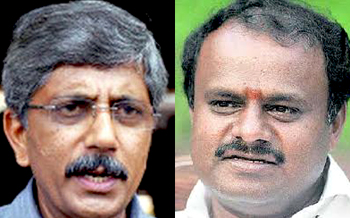
Senior Congress leader and former Minister Jayaprakash Hegde and former chief minister H.D. Kumaraswamy, speaking in Udupi and Padubidri respectively, hit out at the BJP for throwing the Indan culture and values to the winds while allowing the festival on the island.

“Where are the moral police of the BJP and Sangh Parivar, when vulgarism and obscenities are taking place in the name of promoting tourism?” Mr. Hegde asked.

Speaking at a public meeting organized by the Udupi unit of Youth Congress to protest against the use of drugs, free flow of alcohol and other obscenities at the festival at the St. Mary's Island from February 3 to 5, at Malpe here.

Mr. Hegde said that when college going students ate ice-cream together in an ice cream parlour they were beaten up by the moral police. When some students were drinking beer at a pub in Mangalore, they were attacked by the moral police a couple of years ago ”All kinds of immoral things are happening at St. Mary's Island, where are the moral police now? It is most likely they are dancing at the St. Mary's Island” , he ridiculed.

Mr. Hegde said that MLA Raghupati Bhat, who waxes eloquent on Indian culture, had stated that he did not know what was happening on the St. Mary's Island. If it was not known on the first day of the festival, it could have been stopped on the second day. But Mr. Bhat had inaugurated the festival propagating foreign culture.

“The talk of Bharatiya Janata Party (BJP) and Sangh Parivar on patriotism and culture is only limited to words and not deeds. This is just the beginning in the St. Mary's Island and not the end. This obscene culture will spread its tentacles everywhere. One should be cautious about it,” he said.

“The district administration is saying that it would generate Rs. 5 lakh from the festival, it should tell us, where the rest of the money from this mega jamboree is going “, Mr. Hegde said.

Congress leaders Shyamala Bhandary, M.A. Gafoor, Yatish Karkera, Veronica Carnelio, Janardhan Bhandarkar, Amrit Shenoy, Prakyat Shetty and others were present.

'Hindutva exposed'

Meanwhile, speaking in Padubidri former Chief Minister Kumaraswamy said the unsavoury events during the Island Festival had exposed the true face of those who spoke of Hindutva at every given opportunity.

Replying to the queries of presspersons on media reports of use of drugs, free flow of alcohol and other obscenities at the festival on the St. Mary's Island, about six kilometers from Udupi, Mr. Kumaraswamy said that on one side BJP wanted to save the culture of the country. But on the other side, it was permitting rave parties and flow of drugs in the name of promoting tourism in the Coastal districts. “This is extremely shameful,” , he said.

He expressed surprise over Chief Minister D.V. Sadananda Gowda's support to the event in the name of promoting tourism. “If such obscenities and indecent tendencies crossed limits, it would create disharmony in the society,” he said.

In reply to a query, Mr. Kumaraswamy said that the Janata Dal (Secular) would field a candidate for the expected by-poll for the Udupi-Chikmagalur parliamentary constituency.

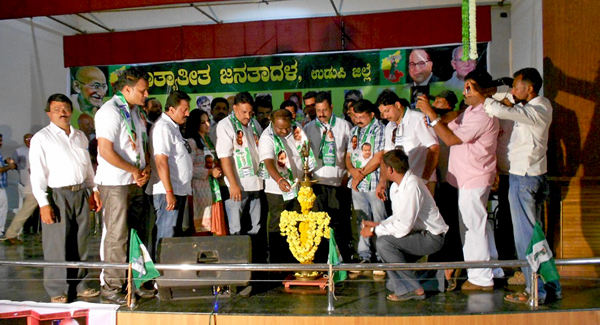
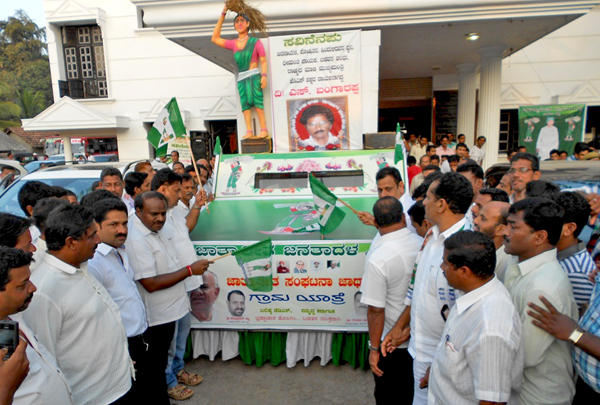
Later Mr. Kumaraswamy inaugurated the Janata Dal (S) party workers meeting here. JD(S) leaders Deviprasad Shetty, Mahendra Kumar, Ghulam Mohammed, Shalini Shetty Kenchanur, Louis Lobo, were present at the meeting, which was also addressed by film star turned politician Pooja Gandhi.

Cong_PD_FEB6_1

Cong_PD_FEB6_2

Cong_PD_FEB6_3

Comments

Add new comment

  • Coastaldigest.com reserves the right to delete or block any comments.
  • Coastaldigset.com is not responsible for its readers’ comments.
  • Comments that are abusive, incendiary or irrelevant are strictly prohibited.
  • Please use a genuine email ID and provide your name to avoid reject.
News Network
January 31,2026

Roy.jpg

Bengaluru: The shooting incident involving CJ Roy, founder of the Confident Group, has once again put the spotlight on a businessman whose life has swung between flamboyant global success and persistent controversy at home.

Though Roy’s business interests extended across continents, his roots lay firmly in Karnataka. An alumnus of Christ School in Bengaluru, he later moved to Tumakuru to pursue an engineering degree. Those familiar with his early years describe him as intensely ambitious, beginning his career as a salesman at a small electronics firm dealing in computers.

Roy’s entry into large-scale real estate came through the Crystal Group, where he worked closely with Latha Namboothiri and rose from manager to director. However, the launch of the Confident Group in 2005 was clouded by industry speculation. Insiders speak of a fallout involving alleged “benami” properties and claims of deception that ultimately led to his independent venture—an episode Roy spent years trying to distance himself from, according to associates.

A tale of two cities

Roy’s professional trajectory diverged sharply across geographies.

In Dubai, he built a reputation as a bold and efficient developer, completing massive luxury residential projects in record time—some reportedly within 11 months. His rapid project delivery and lavish lifestyle in the Emirates earned him admiration and visibility in the real estate sector.

In Bengaluru, however, his image remained far more fractured. Sources say Roy stayed away from the city for several years amid disputes over unpaid dues to vendors and suppliers. Several projects were allegedly stalled, with accusations of unfulfilled commitments to cement and steel suppliers continuing to follow him.

Roy’s return to Bengaluru’s business and social circles began around 2018, marked by a conscious attempt at rebranding. His appointment as Honorary Consul of the Slovak Republic added diplomatic legitimacy, which he complemented with visible CSR initiatives, including ambulance donations and high-profile charity events.

Heavy police presence in Langford Town

Following the incident, police personnel from the Central division were deployed outside the Confident Group building in Langford Town, which also houses the Slovak Honorary Consulate in Bengaluru.

The otherwise busy premises near Hosur Road wore a deserted look on Friday, reflecting the shock and uncertainty that followed the tragedy.

Comments

Add new comment

  • Coastaldigest.com reserves the right to delete or block any comments.
  • Coastaldigset.com is not responsible for its readers’ comments.
  • Comments that are abusive, incendiary or irrelevant are strictly prohibited.
  • Please use a genuine email ID and provide your name to avoid reject.
News Network
February 3,2026

Bengaluru: Following reports of fresh Nipah virus (NiV) cases in West Bengal and heightened vigilance across parts of Southeast Asia, the Karnataka Health Department has placed the state on high alert and activated emergency preparedness protocols.

Health officials said enhanced surveillance measures have been initiated after two healthcare workers in Barasat, West Bengal, tested positive for the virus earlier this month. While no cases have been reported in Karnataka so far, authorities said the state’s past exposure to Nipah outbreaks and high inter-state mobility warranted preventive action.

Officials have directed district health teams to intensify monitoring, particularly at hospitals and points of entry, and to ensure early detection and isolation of suspected cases.

High Mortality Virus with Multiple Transmission Routes

Nipah virus is a zoonotic disease that can spread from animals to humans and has a reported fatality rate ranging between 60 and 75 per cent. Fruit bats, also known as flying foxes, are the natural reservoirs of the virus and can transmit it by contaminating food sources with saliva or urine.

Known modes of transmission include:

•    Contaminated food: Consumption of fruits partially eaten by bats or raw date-palm sap
•    Animal contact: Exposure to infected pigs or other animals
•    Human-to-human transmission: Close contact with body fluids of infected persons, particularly in healthcare settings

Symptoms and Disease Progression

The incubation period typically ranges from 4 to 14 days, though delayed onset has also been reported. Early symptoms often resemble common viral infections, making prompt clinical suspicion critical.

•    Initial symptoms: Fever, headache, body aches, fatigue, sore throat
•    Progressive symptoms: Drowsiness, disorientation, altered mental state
•    Severe stage: Seizures, neck stiffness and acute encephalitis, which can rapidly progress to coma

Public Health Advisory

The Health Department has issued precautionary guidelines urging the public to adopt risk-avoidance practices to prevent any local spillover.

Do’s
•    Wash fruits thoroughly before consumption
•    Drink boiled and cooled water
•    Use protective equipment while handling livestock
•    Maintain strict hand hygiene

Don’ts
•    Avoid fruits found on the ground or showing bite marks
•    Do not consume beverages made from raw tree sap, including toddy
•    Avoid areas with dense bat populations
•    Do not handle sick or dead animals

Preparedness Measures

Officials confirmed that isolation wards are being readied in major government hospitals and that medical staff are being sensitised to identify early warning signs.

“There is no cause for panic, but there is a need for heightened vigilance,” a senior health official said, adding that there is currently no approved vaccine or specific antiviral treatment for Nipah, and care remains largely supportive.

Comments

Add new comment

  • Coastaldigest.com reserves the right to delete or block any comments.
  • Coastaldigset.com is not responsible for its readers’ comments.
  • Comments that are abusive, incendiary or irrelevant are strictly prohibited.
  • Please use a genuine email ID and provide your name to avoid reject.
News Network
January 23,2026

Karnataka Governor Thaawarchand Gehlot read only three lines from the 122-paragraph address prepared by the Congress-led state government while addressing the joint session of the Legislature on Thursday, effectively bypassing large sections critical of the BJP-led Union government.

The omitted portions of the customary Governor’s address outlined what the state government described as a “suppressive situation in economic and policy matters” under India’s federal framework. The speech also sharply criticised the Centre’s move to replace the Mahatma Gandhi National Rural Employment Guarantee Act (MGNREGA) with the Viksit Bharat–Guarantee for Rozgar and Ajeevika Mission (Gramin) Act, commonly referred to as the VB-GRAM (G) Act.

Governor Gehlot had earlier conveyed his objection to several paragraphs that were explicitly critical of the Union government. On Thursday, he confined himself to the opening lines — “I extend a warm welcome to all of you to the joint session of the State legislature. I am extremely pleased to address this august House” — before jumping directly to the concluding sentence of the final paragraph.

He ended the address by reading the last line of paragraph 122: “Overall, my government is firmly committed to doubling the pace of the State’s economic, social and physical development. Jai Hind — Jai Karnataka.”

According to the prepared speech, the Karnataka government demanded the scrapping of the VB-GRAM (G) Act, describing it as “contractor-centric” and detrimental to rural livelihoods, and called for the full restoration of MGNREGA. The state government argued that the new law undermines decentralisation, weakens labour protections, and centralises decision-making in violation of constitutional norms.

Key points from the unread sections of the speech:

•    Karnataka facing a “suppressive” economic and policy environment within the federal system

•    Repeal of MGNREGA described as a blow to rural livelihoods

•    VB-GRAM (G) Act accused of protecting corporate and contractor interests

•    New law alleged to weaken decentralised governance

•    Decision-making said to be imposed by the Centre without consulting states

•    Rights of Adivasis, women, backward classes and agrarian communities curtailed

•    Labourers allegedly placed under contractor control

•    States facing mounting fiscal stress due to central policies

•    VB-GRAM (G) Act accused of enabling large-scale corruption

Comments

Add new comment

  • Coastaldigest.com reserves the right to delete or block any comments.
  • Coastaldigset.com is not responsible for its readers’ comments.
  • Comments that are abusive, incendiary or irrelevant are strictly prohibited.
  • Please use a genuine email ID and provide your name to avoid reject.